


Israel is a country that defies easy interpretation. It is a technological superpower operating under permanent security pressure; a democracy shaped by historical trauma; and a state whose global influence far exceeds its geographic size. To understand Israel is to confront a series of contradictions: a nation that has transformed deserts into productive agricultural landscapes while remaining surrounded by unresolved conflicts; a country celebrated for innovation while defined internationally by its security dilemmas; and a society whose humanitarian achievements exist alongside one of the world’s most enduring geopolitical disputes.
It was against this complex backdrop that a delegation of senior editors from Ghana, Liberia and Sierra Leone, including Dr. Richmond Acheampong, founder and chief executive officer, editor-in-chief and managing editor of The International Lens, undertook a high-level study tour of Israel to gain direct insight into the political, security, technological, agricultural and humanitarian forces shaping the country’s domestic and international outlook.
The visit, organized by the Israeli Embassy to Ghana, Liberia and Sierra Leone, provided the editors with access to key Israeli institutions, policy thinkers, journalists, researchers and humanitarian organizations. More significantly, it offered a rare opportunity to examine Israel not through the simplified narratives that often dominate global discourse, but through direct engagement with the institutions responsible for managing its opportunities and challenges.
For a country of roughly 10 million people, Israel occupies an extraordinary position in international affairs. Its military capabilities, technological ecosystem, diplomatic partnerships and intelligence networks have made it a consequential actor in global politics. Yet its strategic environment remains among the most challenging in the world, shaped by regional rivalries, asymmetric warfare and unresolved questions surrounding peace and security in the Middle East.
History as Strategy
The delegation’s visit began at Yad Vashem, Israel’s World Holocaust Remembrance Centre, a place that represents far more than historical remembrance. It reflects a central pillar of Israel’s national identity and strategic worldview.
The Holocaust, during which Nazi Germany and its collaborators murdered approximately six million Jews during World War II, remains a defining trauma for the Jewish people and a foundational experience influencing the creation of the State of Israel in 1948.
For Israeli policymakers and citizens, the Holocaust is not viewed solely as a historical tragedy but also as a warning about the consequences of vulnerability and the dangers of relying entirely on external guarantees for national survival. This historical memory has profoundly shaped Israel’s defence doctrine, foreign policy priorities and commitment to maintaining military capabilities capable of responding to existential threats.
The delegation’s tour of Jerusalem’s Old City further illustrated how history, religion and geopolitics intersect in Israel. Jerusalem remains one of the most politically sensitive cities in the world, carrying profound significance for Judaism, Christianity and Islam. Its sacred sites and diverse communities reflect both centuries of religious heritage and the unresolved political questions that continue to influence Middle Eastern diplomacy.
The Security State
Israel’s security environment remains one of the defining characteristics of its national strategy.
At the Alma Research and Education Centre, the delegation received briefings on regional security developments and the evolving threats facing Israel, particularly along its northern borders. The discussions highlighted the broader geopolitical competition involving Israel, Iran and Iran-aligned groups across the region.
The Middle East’s security architecture has changed significantly in recent decades. Traditional interstate conflicts have increasingly been replaced by hybrid warfare involving non-state actors, cyber operations, missile technology and information campaigns.
The October 7, 2023, Hamas attack represented a profound strategic shock for Israel. Israeli authorities have said the assault resulted in approximately 1,200 deaths and the capture of more than 200 hostages. The attack triggered a major Israeli military response in Gaza and reshaped regional diplomacy, security calculations and international debate.
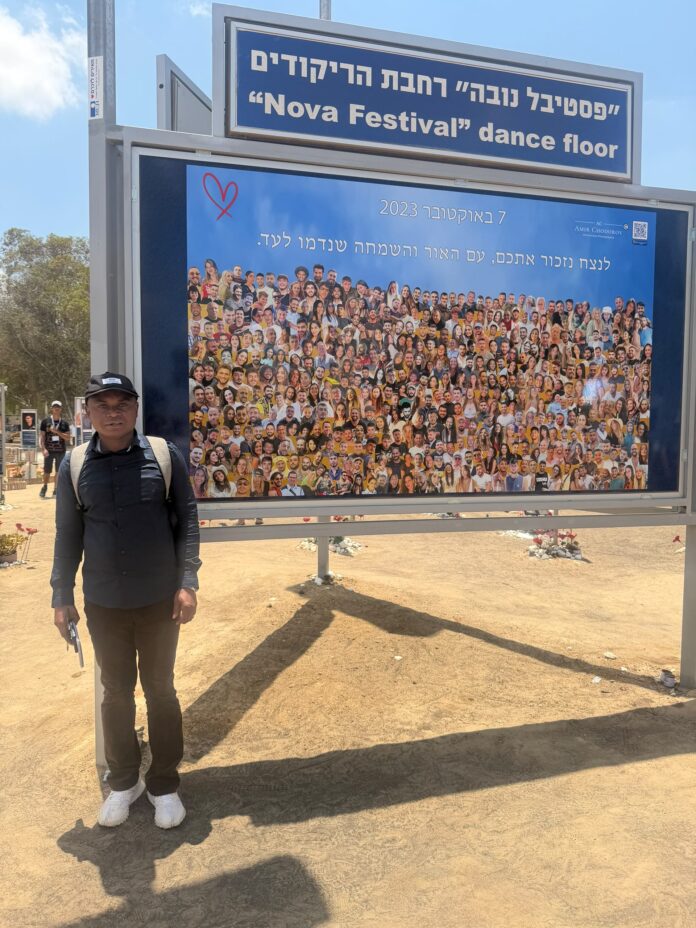
The delegation’s visit to the Nova Music Festival memorial site brought a human dimension to a conflict often discussed through statistics and strategic analysis. Meeting survivor Mazal Tazazo demonstrated the personal consequences of geopolitical instability and reinforced the reality that behind every security crisis are individuals, families and communities affected by violence.
However, any serious analysis of the region must recognize that the Israeli-Palestinian conflict involves profound humanitarian concerns and competing national narratives. The future stability of the Middle East remains closely linked to addressing both Israel’s security concerns and Palestinian aspirations for political rights and self-determination.
Journalism in Wartime
The delegation’s engagement with Kan 11, Israel’s public broadcaster, highlighted another increasingly important dimension of modern conflict: the struggle over information.
In contemporary warfare, credibility has become a strategic resource. Governments, armed groups and societies compete not only for territorial control but also for control of narratives. For journalists, this creates difficult ethical and operational challenges.
The experience of Israeli media organizations operating during conflict demonstrates the pressures faced by public broadcasters during national emergencies: maintaining accuracy while responding quickly, protecting public confidence while avoiding unnecessary escalation and reporting under conditions of uncertainty.
For West African media leaders, the discussions carried broader relevance. Many African countries have experienced political crises, security challenges and democratic transitions where the media has played a critical role in shaping public understanding and accountability.
Innovation as National Power
One of Israel’s most significant strategic assets is its innovation economy. The visit to the Ramat Negev Desert Agro Research and Innovation Centre demonstrated how Israel has converted environmental limitations into technological advantages. In a country where large portions of the territory are arid, agricultural success has depended on scientific research, water management and technological adaptation.
Israel’s agricultural transformation is closely linked to its broader innovation philosophy: using research and technology to overcome structural constraints.
The country is recognized globally for advanced irrigation systems, water recycling and agricultural technologies. Approximately 90% of wastewater is treated and reused, largely for agricultural purposes, making Israel a global leader in water efficiency.
For Africa, where climate change, food insecurity and water scarcity pose growing challenges, Israel’s agricultural model offers important lessons. The continent possesses enormous agricultural potential, yet productivity remains constrained by limited infrastructure, technology gaps and insufficient investment.
The Israeli experience suggests that addressing food security requires more than land availability; it requires innovation, scientific capacity and effective resource management.
Humanitarian Diplomacy
Beyond security and technology, the delegation also encountered Israel’s humanitarian diplomacy through a visit to Save a Child’s Heart.
Since its establishment in 1995, the organization has provided life-saving cardiac treatment to more than 8,000 children from countries lacking adequate pediatric heart care. Its beneficiaries include children from African nations, Palestinian territories and other regions around the world.
This humanitarian work represents a different dimension of international influence. While states often build relationships through political alliances and economic partnerships, medical cooperation creates connections at the human level.
For African countries seeking to expand healthcare capacity, partnerships of this nature demonstrate the potential of international collaboration in addressing specialized medical challenges.
Innovation, Diplomacy and the Limits of Technology
The delegation’s visit to the Peres Centre for Peace and Innovation highlighted Israel’s effort to use technology and entrepreneurship as instruments for economic growth and social cooperation.
Israel’s reputation as a global innovation hub is supported by substantial investment in research and development, with R&D expenditure exceeding 5% of GDP, among the highest levels worldwide. The country has become a leader in cybersecurity, artificial intelligence, medical technology and advanced agriculture.
However, innovation cannot substitute for diplomacy. Technology can improve societies, but it cannot by itself resolve political disputes rooted in history, identity and competing national aspirations.
The enduring challenge for Israel and the wider Middle East remains finding a sustainable framework that combines security, political legitimacy and peaceful coexistence.
A Strategic Lesson for Africa and the World
The West African editors’ mission to Israel provided a broader understanding of a country frequently viewed through narrow geopolitical lenses.
Israel’s experience offers several lessons for African policymakers and societies: the importance of investing in innovation, the strategic value of technological independence, the necessity of resilient institutions and the role of journalism in navigating complex national conversations.
But it also offers a reminder that national power is built not only through economic success or military capability. It is shaped by history, diplomacy, social cohesion and the ability to manage contradictions.
Israel’s story is ultimately one of complexity. It is a nation defined by remarkable achievements and profound challenges; by technological ambition and security anxiety; by humanitarian engagement and geopolitical controversy.
Understanding such a country requires moving beyond headlines and examining the forces, historical, strategic and human, that continue to shape its place in the international system.