

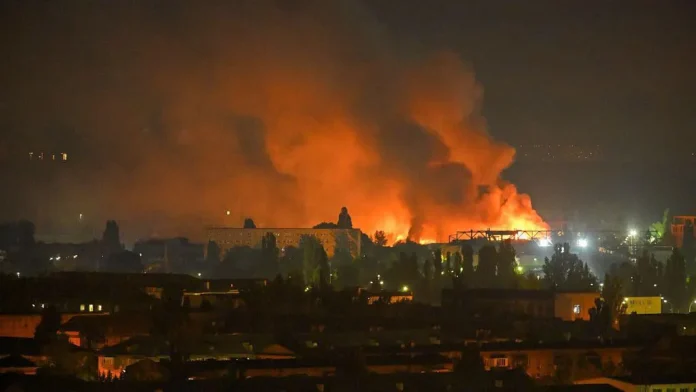

A Russian barrage of ballistic missiles and drones killed at least 21 people across Ukraine, Ukrainian officials said Wednesday, as President Volodymyr Zelensky criticized delays in receiving Western air defense systems, saying more interceptors could have prevented the deaths.
The overnight assault was the deadliest attack on Kyiv and the surrounding region this year, killing 17 people there, authorities said. Strikes in the northeastern city of Kharkiv and the eastern Donetsk region killed one and three people, respectively.
Ukraine has repeatedly called on allies to provide more US-made Patriot missile interceptors to defend against Russian ballistic missiles. The Ukrainian military did not report intercepting any of the missiles launched during the overnight attack.
Zelensky said delays in delivering anti-ballistic missile systems had led to “horrific casualties and destruction”. He later said supplies of interceptors from international partners had been “significantly reduced” this year.
Russia’s Defense Ministry said its forces targeted logistics hubs and supply centers in Kyiv and the surrounding region, claiming the facilities were used to store and distribute weapons, military equipment and materials for producing drones.
The ministry also said Russian forces struck three cargo ships near the Black Sea port of Odesa, alleging the vessels were carrying weapons and military equipment.
Kyiv Mayor Vitali Klitschko said emergency workers were searching damaged areas after residential buildings, a railway station and warehouses were hit, raising fears that people could remain trapped under debris.
Ukraine’s emergency services said one person was killed and at least 16 injured in Kyiv, while the wider Kyiv region reported 16 deaths and 29 injuries. Fires were still being extinguished at five locations across the region, covering about 230,000 square meters.
Ukraine’s air force said Russia launched 24 ballistic missiles, four anti-ship missiles and 115 drones during the attack. Air defenses intercepted 98 drones, but Ukrainian officials did not announce any missile interceptions.
An analysis of Ukrainian air force data by BBC Verify showed that missile interception rates have fallen compared with the same period last year. Between July 6 and Aug. 5, 2026, Ukraine intercepted 156 of 351 Russian missiles, compared with 128 of 192 during the same period in 2025.
The figures show Ukraine’s missile interception rate dropping from 66.7% last year to 44.4% this year, while the number of Russian missile launches increased by 83%. Drone interception rates declined by a smaller margin, from 88.4% in 2025 to 85.8% in 2026.
In Kharkiv, regional governor Oleh Syniehubov said one person was killed and several others injured, including one person in critical condition, following Russian shelling.
Donetsk regional governor Vadym Filashkin said three people were killed and 27 injured in Russian attacks.
The latest strikes come as Russia has intensified attacks on Kyiv in recent weeks, while Ukraine has increased strikes against Russian infrastructure, including power facilities.
In Russia’s Tula region, Governor Dmitry Milyaev said a Ukrainian drone struck a warehouse operated by e-commerce company Wildberries overnight, causing a fire and injuring one person. The facility was evacuated as a precaution, and firefighting crews were working at the scene, the company said.
Ukraine has previously targeted warehouses linked to Wildberries. Russian officials said five people were killed and 10 wounded in strikes on warehouses in the Moscow region on Tuesday. A day earlier, officials said seven people were killed and 58 injured after a drone struck a crowded beach in the Krasnodar region.
Ukraine meanwhile accused Russia of deliberately targeting civilians after a video emerged showing a man being pursued by a drone in Kherson. Ukrainian officials described the incident as a “hunt” and “safari,” while both sides have denied intentionally attacking civilians.
European Commission President Ursula von der Leyen said Wednesday that the European Union had received €1.4 billion ($1.6 billion) from immobilized Russian assets. The funds, she said, would be used to support Ukraine during the war.