

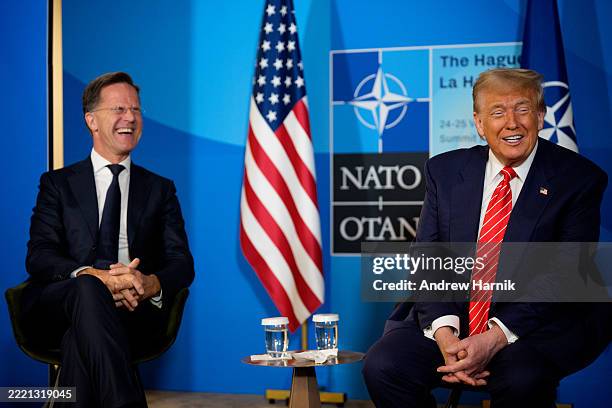

Russia must not be allowed to widen a war it has already failed to bring to a decisive conclusion. That is the central geopolitical message emerging from US President Donald Trump and NATO Secretary-General Mark Rutte’s latest intervention on the conflict in Ukraine. Their warning to Moscow, coupled with renewed calls for a swift diplomatic settlement, signals an important attempt to contain the conflict while preserving Western leverage over the Kremlin.
The two leaders issued their joint position following a meeting at Trump’s Mar-a-Lago residence in Florida on Wednesday, November 25, 2026. According to the White House statement, discussions focused primarily on the Russia-Ukraine war, the conflict involving the United States, Israel and Iran and the need to strengthen defence spending and investment across NATO. Trump and Rutte specifically emphasized that Russia must avoid actions that could intentionally or unintentionally expand the war, insisting that a peaceful resolution should be achieved as rapidly as possible.
The significance of this intervention extends beyond its diplomatic language. It reflects Washington’s determination to prevent the Ukrainian battlefield from becoming the starting point of a wider confrontation involving NATO, while simultaneously testing whether Moscow is genuinely prepared to negotiate. For Rutte, the challenge is equally consequential: maintaining American commitment to European security at a time when Trump’s approach to Russia, NATO burden-sharing and international diplomacy has generated uncertainty among Western allies.
The timing is particularly important. Trump met Russian President Vladimir Putin and Chinese President Xi Jinping during his recent Asian engagements, describing both leaders as friends. Those interactions generated unease among European governments concerned that Washington could pursue an agreement with Moscow without adequately incorporating Ukraine’s interests or Europe’s security calculations. The Florida meeting therefore offered an opportunity to reinforce a common position: diplomatic engagement with Russia must not translate into acceptance of territorial aggression or abandonment of Ukraine.
The Diplomatic Opening and the Risk of a Bad Peace
Trump’s Ukraine policy faces a contradiction: speed is not durability. A settlement negotiated over Kyiv’s head or one that rewards territorial conquest, could freeze the fighting while leaving its causes intact. It would weaken the principle that borders cannot be changed by force and could encourage future aggression.
A diplomatic track nevertheless exists. On November 10, Ukraine, the United States, Britain, France, Germany, Italy, the European Union and NATO met in Abu Dhabi to coordinate ahead of trilateral discussions with Russia. Their statement emphasized sovereignty, territorial integrity and credible security guarantees. Moscow and Kyiv remain far apart, and the extent of Europe’s role in negotiations remains contested.
Rutte presents Trump’s contacts with Putin as a test of Moscow’s seriousness. Dialogue must be backed by military support for Ukraine and consequences for aggression. Any peace deal, or long-term ceasefire if a comprehensive agreement proves impossible, must include security guarantees. Without them, Ukraine could become vulnerable to another offensive.
NATO’s Deterrence and the Global Stakes
Escalation could involve attacks near allied borders, airspace violations, cyber operations, sabotage or pressure on neighbouring states. An incident involving alliance territory could trigger dangerous miscalculation between nuclear powers. NATO’s Article 5 collective-defence commitment makes the risks clear, even though not every incident would automatically prompt a military response.
The alliance is rearming. At the 2025 Hague Summit, members committed to spending 5 per cent of GDP annually on defence and security-related investment by 2035: at least 3.5 per cent on core defence and up to 1.5 per cent on infrastructure, resilience and related priorities. NATO says European allies and Canada increased combined defence expenditure by nearly 20 per cent in real terms in 2025. This reflects a strategic recognition that Russia’s invasion has transformed Europe’s security environment.
The Stockholm International Peace Research Institute (SIPRI) estimates Russia spent $190 billion on its military in 2025 or 7.5 per cent of GDP; Ukraine spent $84.1 billion, equivalent to 40 per cent of GDP. NATO’s 32 members together accounted for $1.581 trillion or 55 per cent of global military expenditure. Ukraine’s resistance continues to depend on reliable external support, ammunition, air defence and financing.
The human toll makes delay indefensible. By October 2026, the UN had verified 75,848 civilian casualties since the full-scale invasion: 17,994 killed and 57,854 injured. It warned the actual toll is likely higher. In October alone, at least 372 civilians were killed and 1,981 injured, 95 per cent more casualties than in October 2025.
Washington’s military attention, diplomatic capacity and defence-industrial resources face competing demands from the simultaneous war involving the United States, Israel and Iran. Moscow could seek to exploit divisions or shifting energy markets. NATO, meanwhile, must deter Russia while navigating instability in the Middle East. The focus on defence production links Ukraine to a wider contest over industrial capacity and alliance cohesion.
Peace Must Be Secured, Not Merely Announced
Washington must consult Kyiv and European capitals, define the concessions it will reject and avoid easing pressure prematurely. European governments must deliver weapons, financing and industrial output. Ukraine must remain a decision-making party to any settlement affecting its territory and sovereignty. There is also a credibility problem for Washington. If Trump signals impatience with Kyiv while offering Moscow diplomatic access, the Kremlin may conclude that time favours Russia. A negotiating position must therefore make clear that continued attacks will carry costs, not rewards.
Moscow must recognize that a durable agreement cannot rest on Ukraine’s permanent vulnerability or NATO’s indifference to threats against its members. Any settlement requires verifiable commitments, monitoring, consequences for violations and guarantees strong enough to deter renewed aggression. Otherwise, a ceasefire could become merely a pause for rearmament.
Trump and Rutte have drawn an important line: Russia must not widen the war and diplomacy must proceed urgently. But urgency must not become a euphemism for capitulation. Ukraine’s future, Europe’s security architecture and the credibility of the transatlantic alliance are at stake. Peace is essential. A settlement that simply postpones the next war is not peace.