

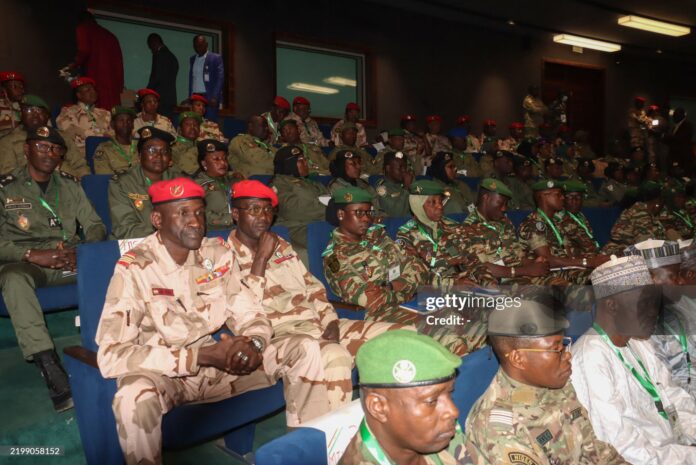

The guns that brought Niger’s military rulers to power may now be turning against them. Heavy gunfire and explosions ripped through Niamey before dawn on Saturday as armed men attacked strategic military and government positions, including Diori Hamani International Airport, the adjoining Base 101 and the security perimeter around the presidential palace.
What began as reports of a terrorist assault quickly evolved into something potentially far more explosive. Multiple security sources said the attackers were mutinous soldiers, raising the spectre of an attempted coup against the junta that has ruled Niger since 2023.
The fighting began shortly after midnight and continued for hours, plunging parts of the capital into fear and uncertainty. Sustained exchanges of gunfire were heard around the airport and Base 101, while fighting was also reported near the presidential palace in the Plateau district.
The apparent coordination of the attacks immediately raised the stakes. This was not simply a strike against a military outpost, but potentially an assault on the machinery of power itself.
From jihadist attack to military revolt
Initially, a security source described those behind the assault as “terrorists” and said they had attempted to breach the presidential palace. That explanation was plausible. Niger has endured a persistent jihadist insurgency, and the airport complex has already been targeted this year.
But the picture changed as the night progressed. Four sources told Reuters that the attackers were mutinous soldiers, while an AFP-cited security source said insurgents from within the armed forces had attempted to enter the presidential palace and were repelled by the presidential guard. Other reports indicated that soldiers had moved into Niamey from locations including Ouallam, Tera and Dosso.
If confirmed, the implications would be profound. General Abdourahamane Tiani came to power through the July 2023 military overthrow of President Mohamed Bazoum. His government has since built its authority around the armed forces, national sovereignty and the promise of defeating the insecurity that had weakened the previous civilian administration.
Now, the greatest threat to that authority may be emerging from inside the barracks.
The battle for the heart of Niamey
Base 101 and the presidential palace are not ordinary targets. Base 101 sits beside Niger’s international airport and is a crucial military facility, while the presidential palace is the symbolic and operational centre of the junta’s political power. Reports that both came under attack suggest an operation with potentially broader ambitions than a conventional jihadist raid.
Security forces said they had retaken Base 101, while loyalist forces were also reported to have secured the presidential palace. Armoured military vehicles were deployed as reinforcements moved through the capital, but the violence did not end immediately. Gunfire resumed around the airport in the early morning, while residents reported sporadic shooting elsewhere in the city. Security forces subsequently launched search operations as attackers were reportedly killed or “neutralized” and others fled.
The uncertainty was compounded by reports that Niger’s state broadcaster was taken off air during the confrontation. In a coup-prone political environment, control of the national broadcaster is never a minor detail: it can determine who controls the narrative, who can declare victory and whether a government can demonstrate that it still commands the state.
A junta confronting its own contradiction
The violence exposes a potentially devastating contradiction at the heart of Niger’s military government. The junta justified its seizure of power partly on the grounds that elected authorities had failed to protect the country. Three years later, it faces the possibility that the institution it relies upon most heavily, the military, may itself be divided.
The government has dramatically reshaped Niger’s foreign and security policy since 2023. French troops were expelled, ties with Western governments deteriorated and relations with Russia deepened. Niger also joined Mali and Burkina Faso in the Alliance of Sahel States after the three countries broke away from ECOWAS.
But the security crisis has persisted. Jihadist groups remain active across large parts of Niger, while attacks have reached the capital. Base 101 and the airport have already been targeted several times in 2026, including a June attack that Niger’s government said killed 11 security personnel and two civilians.
That record has increasingly complicated the junta’s claim that its revolutionary break with the previous order would deliver greater security. But a military mutiny would raise an even more fundamental problem: it would suggest that dissatisfaction is no longer confined to the civilian population or political opposition; it may have reached the security forces themselves.
Not yet a confirmed coup
It is important not to move faster than the evidence. There is, as yet, no definitive public evidence establishing who organized the assault, who commanded the alleged mutineers or whether there was a coherent plan to overthrow Tiani. The junta and officials close to it initially characterized the violence as a terrorist attack, while some reports remain unverified. The competing accounts underscore how little reliable information was available during the night.
But the reported combination of military movements, attacks on Base 101 and the presidential compound, and the alleged involvement of soldiers from outside Niamey is difficult to dismiss. If the attackers were indeed mutinous soldiers, the episode would represent a direct challenge to the junta’s control of the armed forces, and that is a far more dangerous threat than another attack by militants on the capital.
A warning written in gunfire
By Saturday morning, the shooting had diminished and government forces appeared to have regained control of key installations. No definitive casualty toll had been released, but the immediate restoration of order may conceal a deeper crisis. For Tiani, the question is no longer simply whether Niger can defeat armed groups operating beyond the capital. It is whether his government can maintain unity inside the institution that placed him in power.
The irony is stark. Niger’s junta came to power because soldiers turned their guns against the government. Now, three years later, the same logic may be threatening to consume the junta itself.
Saturday’s violence may ultimately prove to have been a failed mutiny, a terrorist assault or something more complicated. The evidence is still developing. But one fact is already impossible to ignore: for several terrifying hours, the battle for Niger’s political future was being fought not on a distant insurgent front, but in the streets surrounding the very seat of military power.