

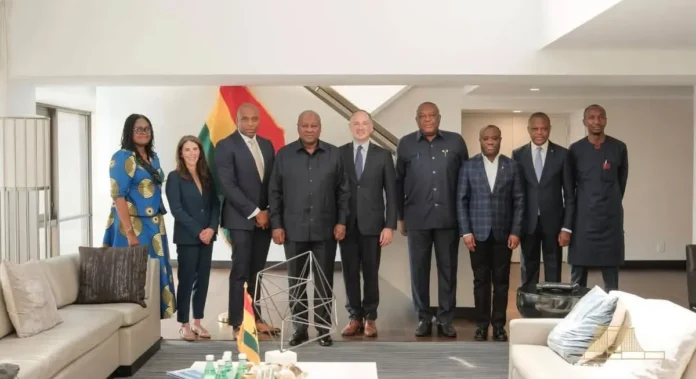

Ghana’s ambition to revive a national airline is entering a potentially significant new phase, with President John Dramani Mahama engaging senior Boeing executives over a broader aviation partnership that could extend well beyond the acquisition of aircraft.
The discussions, held on the margins of the 81st United Nations General Assembly in New York, centred on using Boeing’s expertise to support the restoration of Ghana’s national carrier while building the infrastructure, skills and industrial capacity needed to establish the country as a regional aviation hub.
President Mahama made clear that Ghana’s objective is not simply to buy planes. He said the country is seeking a long-term strategic relationship with Boeing capable of generating skilled employment, facilitating technology transfer, strengthening domestic industry and expanding Ghana’s role in West Africa’s aviation and logistics networks.
The engagement forms part of a broader process initiated by Ghana’s Ambassador to the United States, Victor Emmanuel Smith, and his team. That process has included an earlier Ghanaian delegation visit to Boeing and discussions on developing a wider strategic relationship between the country and the aerospace giant.
Mahama cast the proposed Boeing partnership as more than a deal between Ghana and a global aerospace company. At the New York meeting, he placed it within his government’s wider economic strategy, stressing that international partnerships must translate into tangible gains at home, from fresh investment and skills to industrial growth and a stronger economy.
The talks also examined the development of a regional Maintenance, Repair and Overhaul (MRO) facility in Ghana. If pursued, the hub could provide maintenance and related technical services to airlines operating across West Africa and potentially the wider African market, reducing reliance on overseas facilities while creating a new aviation-services industry in Ghana.
Fleet development and the revival of the national carrier were another major focus. Boeing is expected to provide technical expertise and guidance as Ghana works through the complex requirements involved in restoring a national airline to sustainable operations.
Training and human-capital development also featured prominently in the discussions. The proposed partnership could create pathways for Ghanaian aviation professionals and young people to acquire specialized technical skills, while opening opportunities for technology transfer and higher-value employment.
The emerging framework therefore points to a relationship broader than an aircraft purchase agreement. It could encompass fleet planning, airline development, aircraft maintenance, technical training, technology transfer and industrial development.
For Ghana, the significance of the discussions lies in whether the proposed partnership can translate the ambition of a revived national carrier into a sustainable aviation ecosystem, one capable not only of operating aircraft, but also of creating jobs, developing expertise and supporting Ghana’s position as a regional centre for aviation and logistics.