

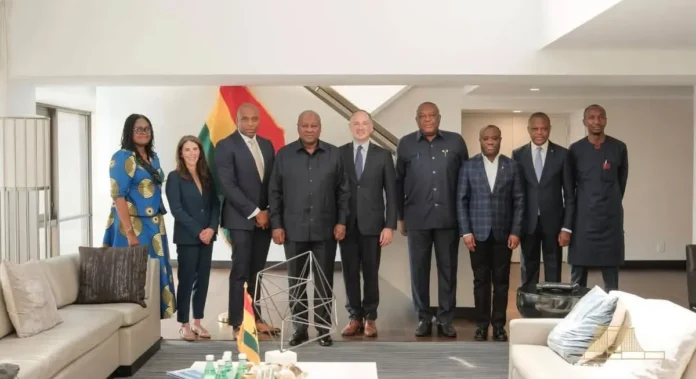

Ghana does not have an airline problem. It has an aviation ambition problem. For years, the national-carrier debate has revolved around the aircraft. That is precisely the wrong place to begin. President John Dramani Mahama’s engagement with Boeing executives in New York matters because it potentially changes the question. The issue is no longer simply whether Ghana can put a national carrier into the sky, but whether Ghana can build an aviation industry around that carrier, one that creates skills, jobs, maintenance capacity, technology and commercial value.
A revived national carrier can connect markets, support tourism and strengthen trade. But none of that happens simply because an aircraft carries the national flag. It happens because the airline is commercially disciplined, reliable and supported by institutions capable of making difficult decisions. A national carrier must therefore be understood not as an isolated airline project, but as part of a broader aviation ecosystem involving training, maintenance, infrastructure, regulation and investment.
Ghana should therefore resist the temptation to treat a national airline as a matter of prestige. National pride may put an aircraft in the air, but it cannot keep one there. The real test is whether Ghana can build an airline that is financially sustainable, professionally managed and capable of generating lasting economic value. The aircraft should be the beginning of the conversation, not the end of it.
The Real Opportunity May Be on the Ground
The most interesting part of the Boeing discussions may be the proposed regional Maintenance, Repair and Overhaul (MRO) facility. This is where the conversation becomes genuinely industrial. If Ghana can develop an MRO hub capable of serving airlines across West Africa and potentially the wider African market, the country would not merely be operating aircraft; it would be selling aviation services. Engineers, technicians, inspectors, logistics specialists and other skilled professionals could build careers here, while companies could develop around maintenance, parts, training and related services. That is a fundamentally different proposition from simply buying planes.
It also exposes the standard by which this partnership should be judged. Ghana should ask: How much technical knowledge will remain in the country? How many skilled jobs will be created? How much maintenance expenditure currently leaving Ghana can be retained? How many Ghanaian firms can enter the supply chain? These questions shift the focus from the size of the aircraft fleet to the depth of the economic value the partnership can create.
Geography alone will not make Ghana a regional aviation hub. A hub requires reliability, competitive costs, strong regulation, technical competence and sustained investment. Location creates possibility; performance creates a hub.
The Hard Work Begins After the Headlines
This is where Ghana must be brutally realistic. Strategic partnerships can produce announcements long before results, and Ghana cannot afford another cycle in which political excitement outruns commercial preparation. The proposed relationship with Boeing must therefore be converted into specific obligations, clear timelines and measurable outcomes. Fleet planning must follow passenger demand, route economics and operational requirements, not political symbolism. Training must produce internationally useful expertise, not certificates that lead nowhere, while technology transfer must mean actual knowledge, capabilities and opportunities for Ghanaian professionals and firms, not merely a phrase in a presentation.
The national carrier will require disciplined governance, protected from political pressures that can distort commercial decisions. Routes cannot become rewards. Aircraft cannot become monuments. And losses cannot forever be explained as the unavoidable price of national pride. The MRO proposal faces the same test. It will need credible demand, financing, technical standards, qualified personnel and a business model strong enough to compete. Boeing can bring expertise, but it cannot manufacture Ghanaian institutional discipline.
A foreign partnership also does not guarantee technology transfer. Knowledge, training, local participation and industrial opportunities must be deliberately negotiated, clearly defined and consistently measured. If the Boeing relationship is to become more than another high-profile announcement, Ghana will have to build the institutions, commercial discipline and local capabilities needed to turn partnership into lasting industrial value.
Build The Industry, Not Just the Brand
The strongest case is not that Ghana might again have a national airline. It is that aviation could become a platform for wider economic transformation. Think beyond the cabin: engineering, logistics, tourism, training, freight, maintenance, technology and professional services. Think about young Ghanaians gaining specialized skills that can travel across an industry rather than depending on one employer, and domestic companies moving into higher-value supply chains. President Mahama has linked the Boeing engagement to an economic agenda in which international partnerships should deliver investment, skills, industrialization and expansion at home. That is the benchmark, not ceremony, not headlines, but results.
Ghana must also understand what failure would look like. It would be easy to announce aircraft, celebrate a national carrier and declare victory. It would be much harder to build an institution that survives political transitions, economic shocks and managerial changes. The objective should not be to put a Ghanaian flag back on an aircraft and call the job done. The objective should be to build an aviation industry capable of standing on its own feet, creating opportunities beyond the airline itself and generating value across the wider economy.
That is the standard Ghana should impose before an aircraft is ordered, a ribbon is cut or a promise is celebrated as progress. Every major commitment should be measured against whether it expands skills, strengthens local businesses, creates sustainable employment, deepens industrial capacity and builds an ecosystem that can endure beyond any single administration. The question is not simply whether Ghana can acquire aircraft, but whether those aircraft can become part of a larger economic architecture.
If Boeing helps Ghana achieve that, the partnership could become an industrial opportunity of real consequence. If it produces only planes, Ghana will have bought the symbol while missing the substance. The test is simple: build the ecosystem or repeat the cycle.