


Ethiopia and Eritrea have severed diplomatic relations after Addis Ababa ordered the closure of its embassy in Asmara and expelled 10 Eritrean diplomats, dramatically escalating tensions as renewed fighting in northern Ethiopia threatens to draw neighbouring states deeper into the conflict.
Ethiopia’s Foreign Ministry said Thursday that it was closing its mission in Eritrea because of what it described as Asmara’s “direct and indirect acts of hostility and belligerence against Ethiopia”. The 10 Eritrean diplomats were given 48 hours to leave the country.
Eritrea responded by declaring that Ethiopia’s expulsion of its diplomatic personnel effectively amounted to the closure of Asmara’s embassy in Addis Ababa. Eritrea’s Foreign Ministry said it had “no option but to reciprocate in kind and sever all diplomatic ties with Ethiopia with all the negative corollaries that this entails”.
The diplomatic rupture came hours after explosions were heard in Addis Ababa, raising fears that fighting that erupted last week in the northern regions of Tigray, Amhara and Afar could be spreading toward the Ethiopian capital.
A source linked to an opposition alliance told Reuters that the alliance had conducted several drone strikes in Addis Ababa, including attacks aimed at military headquarters. If confirmed, the strikes would represent the first known use of drones by anti-government forces against targets in the capital, hundreds of kilometres from the main battlefront.
Three diplomatic sources, speaking anonymously because of the sensitivity of the situation, confirmed that explosions had been heard. Witnesses, however, reported no visible damage around the military base.
There was no immediate response from spokespeople for Prime Minister Abiy Ahmed’s office, the Ethiopian National Defence Force, the federal government or the Tigray People’s Liberation Front, the TPLF.
The Ethiopian government has accused Eritrea, Sudan and Egypt of backing an opposition alliance led by the TPLF, which is fighting federal forces. All three governments have denied the allegations.
The latest fighting represents the most serious escalation in Ethiopia since the 2020-2022 civil war, a conflict that killed hundreds of thousands of people and drew Eritrean forces into combat alongside Ethiopia’s federal military.
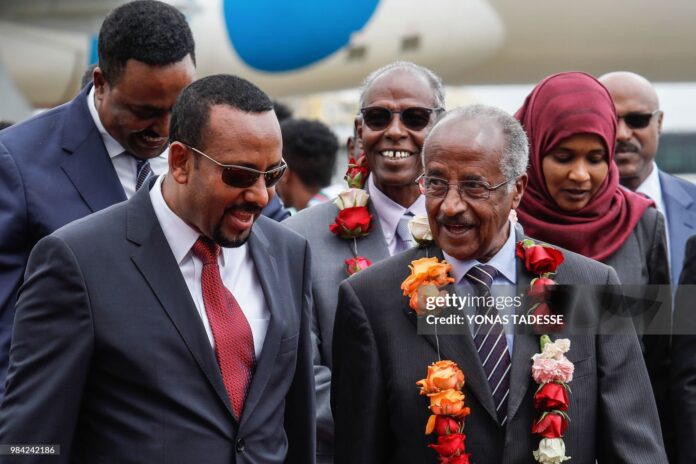
The two countries’ current confrontation marks a dramatic reversal of the rapprochement that followed Abiy’s rise to power. Ethiopia reopened its embassy in Asmara in 2018 after the two countries restored diplomatic relations following years of hostility. The reconciliation earned Abiy the Nobel Peace Prize.
That partnership deteriorated rapidly after the 2022 peace agreement that ended the Tigray war. Eritrea was not a party to the agreement, and relations between Asmara and Addis Ababa subsequently became increasingly strained.
At the centre of the broader dispute is also Ethiopia’s demand for reliable access to the Red Sea. The landlocked country has repeatedly described sea access as a strategic necessity for its economy and national security. Eritrea, meanwhile, has expressed fears that Ethiopia could ultimately seek control of the Assab port by force.
The diplomatic crisis widened further on Thursday when Ethiopia also declared an Egyptian diplomat persona non grata and ordered him to leave within 48 hours, according to the state-run Ethiopian Broadcasting Corporation and two people familiar with the matter. Egypt’s Foreign Ministry did not immediately respond to requests for comment.
The moves came as military developments suggested that neither side was backing away from the renewed confrontation.
Haji Awol Arba, chief administrator of Ethiopia’s Afar region, told Al Jazeera days after the fighting began that Eritrean soldiers had entered Afar to support the opposition offensive. Eritrea’s information minister did not immediately respond to a request for comment.
Meanwhile, federal troops and allied militias have reported advances in both Tigray and Afar, although Reuters has been unable to independently verify those battlefield claims.
In southern Tigray, federal forces have been pushing toward Mekelle, the regional capital. In neighbouring Afar, opposition forces have seized several towns, although pro-government forces have since retaken some positions.
The pro-government Tigray Peace Forces militia said on Thursday that its forces had recaptured Erbeti, a town previously seized by TPLF forces. The militia credited the Ethiopian military with providing “magnificent air support”.
The fighting has already produced a significant humanitarian cost. Tens of thousands of people have fled their homes in Afar, according to Valerie Browning, founder of the Afar Pastoralist Development Association.
The possibility of drone warfare has added a new and potentially consequential dimension to the conflict. Ethiopia’s national intelligence service has imposed a ban on drones over Addis Ababa. Anti-government forces had not previously been known to operate armed drones, although evidence of a developing capability has emerged.
On Tuesday, the Tigray Peace Forces said they had recovered drone frames and batteries from forces linked to the TPLF.
Edward Bach, a senior Africa analyst at risk intelligence firm Verisk Maplecroft, said the opposition’s ability to strike Addis Ababa would fundamentally alter the political and military dynamics of the conflict. Such attacks, he said, could undermine the government’s portrayal of the capital as insulated from the fighting while eroding the federal forces’ important advantage in air power.
The danger now extends beyond Ethiopia’s battlefield. The collapse of diplomatic relations with Eritrea, accusations involving Egypt and Sudan, reported cross-border military involvement and the possibility of attacks reaching Addis Ababa have transformed the latest Tigray conflict into a broader regional security crisis.
What began as renewed fighting in Ethiopia’s north is increasingly testing the fragile relationships that emerged from the end of the country’s previous civil war. With neighbouring governments already being drawn into competing accusations and military calculations, the risk is that Ethiopia’s internal conflict could acquire consequences far beyond its borders.