

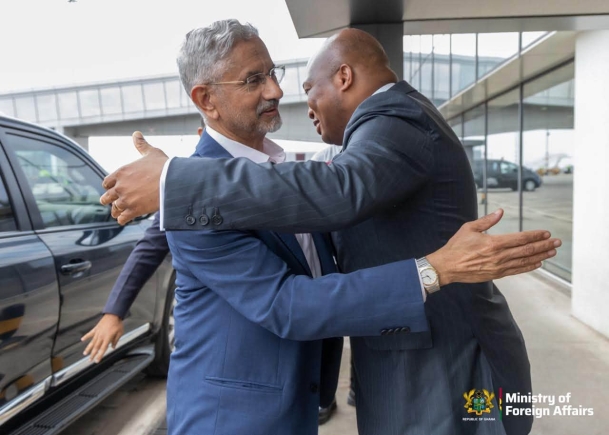

Ghana’s decision to formally apply to join BRICS is not a diplomatic footnote; it is a strategic signal. On October 6, 2026, Foreign Affairs Minister Samuel Okudzeto Ablakwa announced that Cabinet had decided to pursue membership, saying the objective was to diversify partnerships, widen economic opportunities and deepen cooperation with the Global South. India, whose foreign minister was visiting Accra, has already been approached to help Ghana navigate the application. The timing matters. Ghana is emerging from an IMF Extended Credit Facility programme and has shifted to a non-financial Policy Coordination Instrument. The World Bank puts Ghana’s 2025 GDP at $114.2 billion, with 6.0 percent growth, while its population stands at 35.1 million. This is not a great power seeking to rewrite the international system. It is a middle-sized African state seeking more room to manoeuvre inside it.
BRICS is now considerably larger than the original Brazil-Russia-India-China grouping. Its current membership comprises 11 states, representing about 49 percent of the world’s population, 39 percent of global GDP and 23 percent of international trade. Its expanding economic and geopolitical weight gives Accra a potentially valuable platform for trade, investment and diplomatic coalition-building. For Ghana, membership could therefore provide another channel through which to engage major emerging economies while reducing excessive dependence on traditional Western partners and broadening the country’s strategic options. The attraction is not necessarily ideological alignment with every BRICS member; rather, it is the opportunity to operate in a wider diplomatic and economic ecosystem at a time when global power is becoming increasingly dispersed.
But membership is not automatic, and Ghana has announced a bid, not secured a seat. BRICS says accession proceeds from formal interest to potential membership and then full membership, with Sherpas, foreign ministers and ultimately leaders deciding by consensus. That process means Accra must demonstrate that its application can command the political support of existing members, each of which has its own strategic interests and calculations. Ghana’s bid should therefore be understood not as a guaranteed diplomatic victory but as the opening move in a potentially consequential geopolitical negotiation. The real test will be whether Accra can convert its interest in BRICS into concrete economic and strategic gains without compromising its longstanding relationships with the United States, European Union and other Western partners.
The Economic Logic Is Powerful, But Not Magical
The strongest case for Ghana is diversification. Ghana already trades heavily with BRICS economies, particularly China and India. Ghana-China trade reached a record $14.1 billion in 2025, up 19.3 percent. In 2024, China supplied 45.9 percent of Ghana’s imports from Asia, while India supplied 13.7 percent. Ghana’s trade statistics also show China, India and South Africa among important destinations and sources. That concentration creates both opportunity and vulnerability. A formal BRICS relationship could help Ghana move beyond buying manufactured goods and exporting raw commodities. It could support investment in processing, infrastructure, digital technology, energy and transport.
The New Development Bank, associated with BRICS, makes that prospect particularly relevant. The bank has $52.7 billion in paid-in capital and had approved 96 projects worth $32.8 billion. For a country seeking infrastructure and industrial financing, deeper engagement with the BRICS ecosystem could open additional channels of capital and development cooperation. But BRICS cannot substitute for economic reform. Ghana’s debt problems, currency risks, productivity constraints and dependence on commodities will not disappear because Accra sits at a BRICS table. Nor should policymakers confuse diplomatic access with guaranteed investment.
The strategic prize, therefore, is bargaining power. Ghana could use closer ties with China, India, Brazil, the Gulf and other emerging economies to negotiate from a broader base with Western partners. The objective should not be to replace one sphere of dependence with another, but to expand Ghana’s room for manoeuvre. BRICS membership can strengthen that position if Accra approaches it as an instrument of economic diversification and strategic autonomy. That is diversification, not necessarily alignment.
The Security Question Is More Complicated
Here the BRICS calculation becomes harder. BRICS is not a military alliance and carries no Article 5-style collective-defence commitment. It has no constitutive treaty, permanent secretariat or common defence structure. Its significance is political: it gives states a forum for coordinating positions on global governance, sanctions, development and the international order. For Ghana, that creates an important distinction. Joining BRICS would not mean receiving a BRICS security guarantee against jihadist violence spilling south from the Sahel, maritime insecurity in the Gulf of Guinea or cyber threats. Those problems require operational capabilities, intelligence and partnerships, not summit communiqués.
Ghana’s existing Western security relationships remain substantial. In August 2026, Ghana’s Defence Ministry said US cooperation included joint exercises, intelligence sharing, counter-terrorism support, maritime security and plans involving drone-based intelligence, surveillance and reconnaissance. In September, Ghana again reaffirmed its defence and security partnership with Washington, including logistics, institutional development, peacekeeping, cyber defence and maritime security. These relationships remain important because Ghana’s security environment is shaped by threats that demand practical cooperation, intelligence access and operational capacity rather than diplomatic alignment alone.
That makes strategic balance essential. Accra should not allow BRICS membership to undermine interoperability with the United States, European partners or African security institutions. Ghana’s military value lies partly in being a trusted, interoperable partner and a contributor to UN peace operations. The strategic objective, therefore, should be diversification rather than substitution: Ghana should add partnerships, markets and diplomatic options without trading one dependency for another.
The Geopolitical Price of Greater Autonomy
The deeper consequence is diplomatic. Ghana’s BRICS bid would place it more visibly inside the argument over whether the international system should remain predominantly Western-led or become more plural and representative. BRICS itself describes its purpose as strengthening Global South participation and pressing for reforms in global governance. For Ghana, that can be useful. Accra has long benefited from a reputation for democratic stability, multilateral engagement and peacekeeping. A stronger voice within Global South coalitions could reinforce Ghana’s demand for reform of institutions whose voting structures often lag behind today’s economic realities.
But autonomy has a cost. BRICS includes China and Russia, whose relations with the United States and its allies are marked by strategic rivalry and, in Russia’s case, war-related sanctions. Ghana will face pressure to clarify positions on sanctions, global conflicts, technology standards and contested international norms. BRICS criteria themselves emphasize good relations with all members, support for governance reform and, for partners, avoiding unilateral sanctions not authorized by the UN Security Council. That is where Accra must be disciplined. Ghana should join only if it can preserve what has historically made its foreign policy effective: flexibility, credibility and the ability to work across competing blocs. The objective should be strategic autonomy, not bloc politics.
The smartest policy would therefore be conditional engagement. Ghana should seek market access, investment, technology, development finance and diplomatic leverage from BRICS while maintaining its US and European security partnerships, ECOWAS commitments and wider African obligations. The test is simple: does membership expand Ghana’s choices? If yes, the bid is strategically sound. If it merely replaces one external dependence with another, it is not diversification. It is dependency with a different flag.
That distinction matters. For Ghana, the greatest geopolitical asset is not allegiance but room to manoeuvre when rival powers compete for influence over time. Ghana is not choosing between East and West. It is trying to ensure that, in an increasingly fractured world, it has enough partners to choose for itself.