

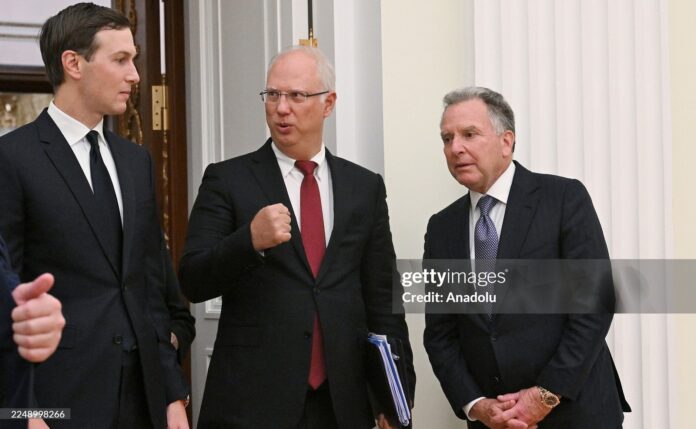

US and Russian officials are discussing a potential deal that could put American investors into the Nord Stream gas pipelines and eventually restore Russian gas sales to Germany, five people familiar with the talks told Reuters.
The discussions involve US special envoy Jared Kushner and Kirill Dmitriev, a close adviser to Russian President Vladimir Putin, as Washington and Moscow explore possible economic arrangements alongside efforts to end the war in Ukraine.
A US investment in Nord Stream would give American companies a financial interest in energy flows between Russia and Europe if the war ends and sanctions are eased. It would also reopen one of the most politically sensitive questions in Europe: whether Russian gas should ever return to the continent.
Kushner and Dmitriev have met in Moscow and New York in recent weeks. Two people familiar with the matter said Nord Stream remains under discussion, though it was unclear how extensively the pipeline project was addressed during those meetings.
A White House official said any potential deal involving Russia would have to be negotiated with the US International Development Finance Corporation and the Treasury Department and would have to benefit American companies and taxpayers. The official said there had been no recent discussions specifically about Nord Stream.
Dmitriev has been pushing for the restoration of Russian gas sales to Germany. Last month, he met US Energy and Treasury Department representatives to discuss possible energy initiatives between Washington and Moscow. His representative declined to comment.
Deal Faces Major Obstacles
Any attempt to revive Nord Stream would face immediate legal and political barriers. The pipelines are under US and European sanctions, making a restart illegal under current rules. President Donald Trump could seek to relax or waive US sanctions, but that could become more difficult if Democrats regain control of Congress in next month’s midterm elections.
A US official said the obstacles were significant enough to make a deal unlikely in the medium term.
Germany is also opposed to reopening the pipelines. A spokeswoman for the German economy and energy ministry said Nord Stream and Russian gas remain sanctioned in Europe and that Germany has secured alternative supplies. Reopening the pipelines would require government approval, she said, adding that Berlin does not want such a move.
Before Russia’s full-scale invasion of Ukraine in February 2022, Germany obtained more than half of its gas from Russia through the two Nord Stream pipelines.
Moscow later cut gas supplies to Europe. The pipelines were mothballed and then badly damaged by underwater explosions in September 2022.
Europe Divided Over Russian Gas
The possibility of restoring Russian energy exports is emerging as relations between Moscow and much of Europe remain deeply hostile. Germany is among Ukraine’s biggest military supporters, while German officials have accused Russia of conducting a systematic campaign of hybrid attacks.
Five European intelligence chiefs told Reuters earlier this year that Russia was not seeking a quick end to the war and was using talks with Washington to pursue business opportunities.
Some German lawmakers say a new energy deal would strengthen Moscow while the war continues. Michael Kellner, a German lawmaker who oversaw energy policy after Russia’s invasion, said such an arrangement could leave Europe paying the price while American and Russian interests benefited financially.
Germany’s governing coalition opposes reopening Nord Stream, but the far-right Alternative for Germany or AfD, supports renewed Russian gas imports. Dmitriev is due to meet AfD leaders early next year to discuss the possible return of Russian gas.
Poland is also watching the discussions but remains opposed to reopening Nord Stream, according to a person familiar with the government’s position. Poland and the Baltic states have consistently rejected renewed energy dependence on Russia.
Gazprom Stake Complicates Potential Deal
Ownership of Nord Stream presents another obstacle. Russia’s state-owned Gazprom holds 51% of the company controlling the pipelines. Two German companies hold another 31%, while French and Dutch firms own the remainder.
The German shareholders want to retain their stakes, according to a person familiar with the matter, allowing Germany to preserve influence if Gazprom sells its share. That could make any US investment more complicated, requiring agreement among Russian, American and European interests.
Lukoil Deal Also on the Table
The Nord Stream discussions are part of wider talks over Russian energy assets. Kushner and Dmitriev have also discussed the possible sale of businesses owned by Russian oil giant Lukoil, including refineries and petrol stations in Europe and elsewhere, two people familiar with the discussions said.
Under the proposal, a consortium involving the US International Development Finance Corporation and investors from Qatar and the United Arab Emirates would acquire the assets. US authorities would then lift sanctions to facilitate the transactions.
A White House official said Kushner and special envoy Steve Witkoff had worked with the Development Finance Corporation on a deal designed to secure a substantial upfront payment for the United States and a share of future profits. Lukoil and Gazprom did not respond to requests for comment.
Energy Becomes Part of Peace Diplomacy
The discussions underscore Kushner’s belief that commercial interests can help drive a political settlement. After meetings in Moscow, Kushner travelled to Kyiv and spoke with European officials about the impact of the war on energy prices. He promoted economic arrangements intended to give governments a financial stake in peace.
A revived Nord Stream would give Russia a route back into Europe’s lucrative gas market while potentially giving US investors a share of the profits. But it would also reopen a fundamental European security debate over whether the continent should again rely on Russian energy.
For now, there is no agreement to revive Nord Stream and Germany remains opposed. Yet the pipeline is once again part of high-level US-Russian discussions, a sign that the economic terms of a possible postwar settlement are already being debated alongside the politics of ending the war.