

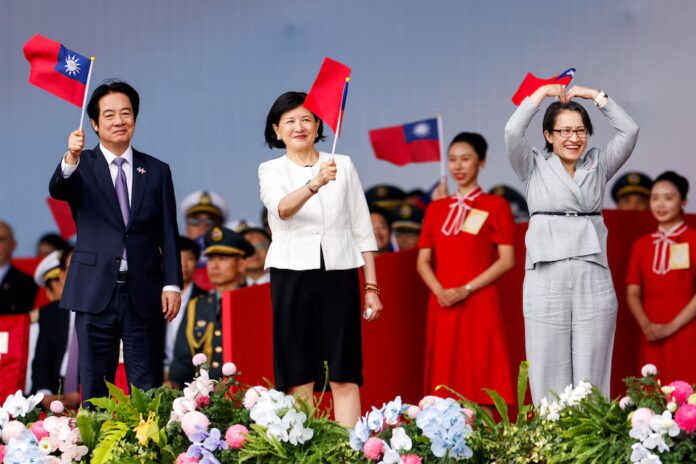

Taiwan will strengthen its military deterrence without abandoning its commitment to peace, President Lai Ching-te declared on Saturday, warning that the island would not surrender its freedom or accept Beijing’s attempts to bring it under Chinese control.
Addressing a National Day gathering outside the Presidential Office, Lai said Taiwan’s right to determine its own future must be respected, insisting that stronger defences were necessary to prevent conflict rather than provoke it.
The speech came amid mounting military and political pressure from China, which claims Taiwan as its territory despite strong objections from the democratically elected government in Taipei.
Lai argued that peace could not be secured through goodwill alone, particularly as China expands its military capabilities with advanced weapons, including stealth fighters, aircraft carriers and an extensive missile arsenal.
He said Taiwan would remain open to engagement with Beijing but would resist any arrangement that compromised its freedom or placed its people under Chinese authority.
The president also framed Taiwan’s struggle as a broader test of international principles, arguing that the outcome would help determine whether powerful countries could use force to deny other people’s their right to choose their political future.
China’s Taiwan Affairs Office had not responded to a request for comment at the time of publication. Beijing has repeatedly denounced Lai as a separatist and rejected his overtures for dialogue, maintaining that Taiwan must eventually come under its control. China has not ruled out the use of force to achieve that objective.
The United States welcomed Lai’s stated commitment to peace and stability across the Taiwan Strait. A senior US administration official cautioned that the president’s National Day address should not be used to justify coercive or aggressive measures against the island.
Washington remains Taiwan’s most important international supporter, although the two sides do not maintain formal diplomatic relations.
Lai’s address included a notable departure from his usual formulation that neither side of the Taiwan Strait is subordinate to the other. Instead, he invoked the biblical image of a city upon a hill, calling for Taiwan to project courage and confidence as it confronts mounting external pressure.
He maintained that increased defence investment was intended to discourage military aggression and create conditions for meaningful negotiations, rather than close the door to dialogue.
According to a Taiwanese official who briefed reporters, Lai also addressed the need to manage tensions between Washington and Beijing, welcoming efforts by the two powers to use dialogue to reduce the danger of confrontation and war. The remarks were described as a direct response to last month’s China-US summit in Washington.
The president nevertheless urged democracies across the Indo-Pacific to work together to preserve regional peace and stability, signalling that Taiwan’s security should be viewed within a wider international effort to maintain the existing regional order.
Taiwan’s defence modernization has gained urgency as it confronts a Chinese military vastly larger than its own. In parallel, Taipei has been increasing military expenditure and upgrading its armed forces to strengthen its capacity to deter an attack.
China conducted military exercises around Taiwan in 2024, shortly after Lai delivered his first National Day address as president, but did not stage similar drills on the occasion last year. Its most recent major exercises near the island took place in late December, following reports of an $11 billion US arms package for Taipei, the largest such deal announced for Taiwan.
US President Donald Trump has yet to approve a proposed second package valued at $14 billion.
Taiwan’s National Day commemorates the anniversary of the 1911 uprising that led to the collapse of China’s last imperial dynasty and the establishment of the Republic of China.
After losing the Chinese civil war to Mao Zedong’s communist forces in 1949, the Republic of China government retreated to Taiwan, where the name remains the island’s formal designation.
Against that historical backdrop, Lai’s message was clear: Taiwan seeks peaceful relations and international cooperation, but its pursuit of peace will not come at the expense of its freedom, security or democratic self-government.