

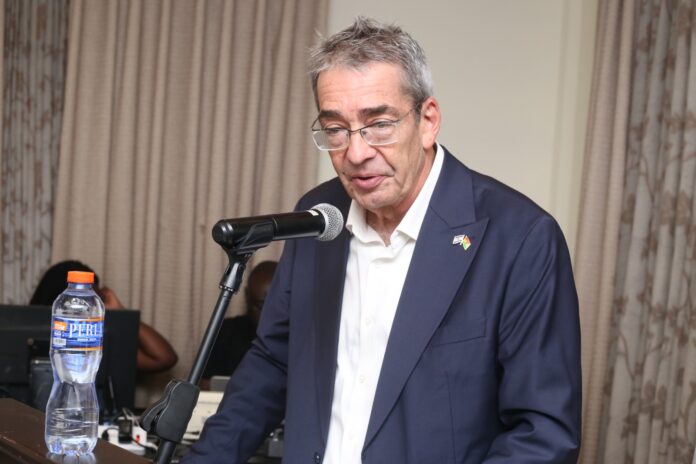

Israeli Ambassador to Ghana, Liberia and Sierra Leone Roey Gilad says the October 7, 2023, Hamas-led attack has left Israel traumatized, more suspicious and less confident, even as the country has emerged stronger and more determined to protect its security.
He said the massacre, which killed about 1,200 Israelis, injured thousands and saw 251 people abducted into Gaza, had fundamentally changed the country and left lasting scars on families across Israel.
“Israel, after the 7 October massacre, is not the same country”, Mr. Gilad said, describing Israelis as “less naive and more suspicious, less peaceful and more nervous, less self-confident and more sceptical”.
The ambassador was speaking at the annual October 7 massacre memorial event organized under the auspices of the Embassy of Israel in Ghana. This year’s event featured a special symposium examining terrorism in the Middle East and Africa.
Three years after the attack, Mr. Gilad said the pain had not diminished and, for many Israelis, had grown more intense.
He described the assault as probably the greatest disaster to have befallen the Jewish people since the Holocaust, saying it had shaken Israel’s fundamental belief that the Jewish state was the ultimate guarantor of Jewish security.
“Every family, every soul in Israel, carries a scar, even if this scar cannot be seen”, he said.
Mr. Gilad compared the enduring national memory of October 7 to that of the September 11, 2001, attacks in the United States, saying Israelis remembered where they were when the assault began at 6:29 a.m.
Despite the trauma, he said Israel had become stronger and more determined to defend its future.
Citing the proverb, “He who wants peace should be ready for war”, the ambassador said Israel continued to seek peace but insisted that any settlement must guarantee the security and freedom of its people.
He said Israel had fought two wars with Iran since October 7 and remained engaged in conflict with Hamas in Gaza, arguing that the war against the Palestinian militant group would continue until it was disarmed and dismantled.
Mr. Gilad also pointed to what he described as positive developments in the region, including a less hostile Syrian leadership and political dialogue between Israel and Lebanon’s government aimed at addressing Hezbollah’s presence along the countries’ shared border.
He expressed appreciation for Ghana’s contribution to regional security through its participation in the United Nations Interim Force in Lebanon (UNIFIL), noting that Ghanaian soldiers serving with the mission were familiar with the Israeli-Lebanese border, known as the Blue Line.
The ambassador acknowledged the heavy human cost of the Gaza war but placed responsibility for the Palestinian suffering on Hamas, arguing that the group’s October 7 attack had triggered a devastating chain of events.
He said the symposium was intended to move beyond commemoration and examine lessons from the massacre that could be relevant to African countries confronting terrorism.
The central message, he said, was that terrorism posed a common challenge regardless of geography.
“Terror is terror. Whether in Lebanon, in Gaza or in the Sahel, it is the same challenge”, Mr. Gilad said.
He warned that the growing threat posed by non-state armed groups to established states was a global security concern requiring wider international attention.