

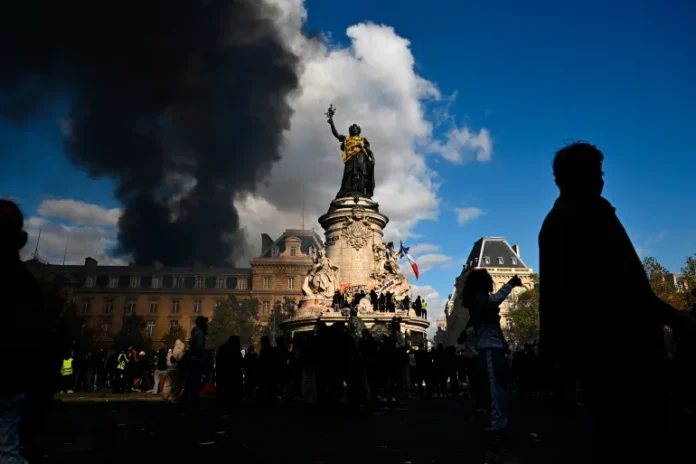

France was rocked by violent clashes between police and protesters on Saturday, with 272 people arrested as tens of thousands took to the streets to protest soaring living costs, deteriorating public services and widening inequality.
The unrest spread across major cities, including Paris, Marseille, Lyon, Toulouse and Angers, in some of the country’s most serious demonstrations in years. Police faced groups of masked protesters as shops were ransacked, public buildings vandalized and vehicles set ablaze.
France’s Interior Ministry reported 272 arrests by mid-afternoon, citing confrontations with security forces, looting attempts and damage to public property. Authorities attributed the violence to far-left groups, while demonstrators maintained that the majority of participants were peaceful and blamed a minority of troublemakers for the destruction.
In Paris, police fired tear gas as they withdrew from groups of predominantly young protesters dressed in black, many wearing masks, hoodies and protective goggles. Clouds of gas spread near a high-end department store close to the city’s opera district, leaving some tourists coughing as nearby businesses hurriedly closed their doors.
Windows were smashed at shops and restaurants across the capital, while burning cars and rubbish bins added to the disorder.
In Lyon, demonstrators set fire to the city’s tourist office. Marseille’s mayor reported vandalism at the town hall and said additional police personnel were being deployed following discussions with the national government.
The demonstrations also drew comparisons with France’s Yellow Vest movement, which began in 2018 over fuel taxes before expanding into a nationwide campaign against the rising cost of living and economic inequality. Protesters wearing high-visibility vests blocked roads on Saturday, reviving a symbol associated with that earlier wave of unrest.
The current protests began last month at high schools in disadvantaged northern suburbs of Paris, where complaints about teacher shortages and deteriorating facilities developed into a broader challenge over public spending, economic hardship and unequal access to essential services.
Lola, a 19-year-old demonstrator in Paris, said the movement was driven by the mounting cost of everyday necessities, expensive fuel and frustration over the treatment of students demanding better education.
She also pointed to injuries sustained by high school protesters during demonstrations and called for more teachers and improved learning conditions.
Authorities had deployed a substantial police presence across central Paris, particularly around prominent landmarks such as the Champs-Elysees and the Arc de Triomphe. Both areas were excluded from the routes of two authorized demonstrations.
The unrest presents another challenge for President Emmanuel Macron as he approaches the final stretch of his presidency amid political fragmentation and mounting economic pressures.
Government efforts to bring down France’s public debt have failed to calm financial markets, with borrowing costs climbing to their highest levels in more than two decades.
Police conduct has also become a major source of controversy. Demonstrators have suffered serious injuries during previous protests, including a teenager who lost a hand after picking up a stun grenade.
Prime Minister Sebastien Lecornu has said more than 900 police officers were injured during earlier demonstrations. France’s police watchdog is investigating at least 24 allegations of police violence.
Though authorities suspended the use of stun grenades during the student protests, Interior Minister Laurent Nunez said the devices could be deployed during Saturday’s demonstrations.
The unrest extended beyond France. In Brussels, several hundred demonstrators, mostly young people, took to the streets, with some clashing with police. Belgian student groups said they opposed rising education costs and proposed reforms they fear could restrict access to higher education.
Albania also witnessed another day of unrest, as police appeared to fire rubber bullets at demonstrators during the fifth consecutive day of mass student protests demanding the resignation of Prime Minister Edi Rama.
In France, the widening demonstrations underscore the political risks facing Macron as public frustration over living standards, public services and inequality intensifies. The renewed use of Yellow Vest imagery further evokes the earlier movement that forced his government to announce billions of euros in tax cuts after nationwide protests.