

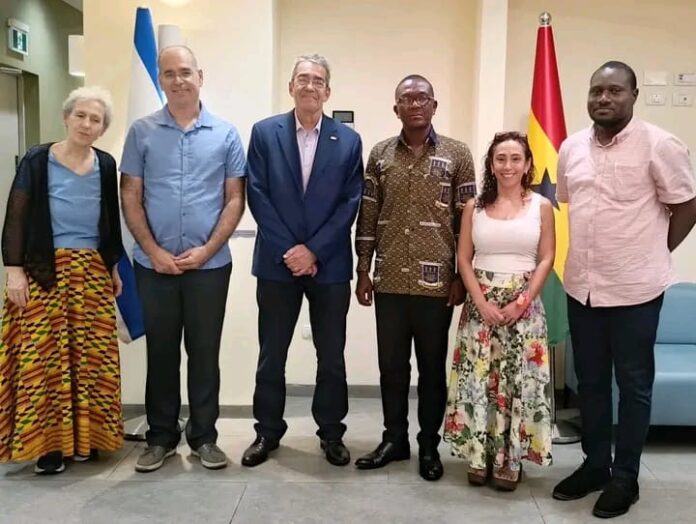

Academic cooperation must be measured by what it produces, not by the photographs taken at diplomatic meetings. The reported meeting between Dr. Akpeko Agbevade of the University of Ghana and Israeli Ambassador Roey Gilad offers an opportunity to strengthen educational relations between Ghana and Israel. But its real significance will depend on whether discussions translate into research, student mobility, institutional investment and lasting intellectual exchange.
Held at the Israeli Embassy on Friday, October 16, 2026, the meeting also involved Professor Yaniv Reingewertz, Head of the Department of Public Administration and Policy at the University of Haifa, and his wife, Dr. Tali Haviv Reingewertz. According to the report, participants explored opportunities for academic cooperation, including joint research, student exchanges and other collaborative initiatives.
These are worthwhile ambitions. Universities increasingly operate in a world where knowledge, expertise and innovation cross national borders. Ghanaian institutions cannot afford intellectual isolation, just as foreign universities seeking meaningful international engagement must look beyond ceremonial partnerships.
Yet diplomatic goodwill is only the starting point. Ghana has seen enough development aspirations framed in impressive language to understand that announcements alone do not guarantee progress. A meeting becomes consequential when it establishes priorities, identifies responsibilities, mobilizes resources and creates measurable outcomes. Without these foundations, academic cooperation risks becoming another attractive declaration whose practical benefits remain difficult to identify.
The central question, therefore, is not whether Ghana and Israel should cooperate academically. It is whether both sides can build a partnership that serves their universities, benefits their students and addresses problems that matter to their societies.
Knowledge Partnerships Must Serve Ghanaian Priorities
The University of Ghana and the University of Haifa bring together institutions with different national contexts and potentially complementary academic strengths. Properly structured cooperation could create opportunities for scholars to exchange methods, test ideas across settings and develop research capable of informing public policy.
The emphasis on public administration and policy is particularly relevant. Governments face difficult questions concerning institutional performance, public accountability, service delivery and the effective use of limited resources. Collaborative research could help scholars examine these challenges comparatively, provided the universities agree on specific questions and establish a clear programme of work.
However, Ghana must approach international academic partnerships with a firm understanding of its own priorities. Cooperation should not be pursued simply because a foreign institution offers access to expertise or international recognition. It should respond to identifiable needs within Ghanaian universities and the wider society.
That means involving Ghanaian researchers in setting research agendas, determining methods and interpreting findings. It also means ensuring that local institutions retain meaningful ownership of the knowledge they help produce. International collaboration becomes unequal when one side supplies the context, participants and data while the other controls funding, publication and intellectual recognition.
Ghanaian universities must therefore negotiate partnerships that encourage mutual learning rather than one-directional knowledge transfer. Foreign expertise can be valuable, but local experience is not a lesser form of knowledge. Researchers who understand Ghana’s institutions, communities and policy challenges must participate as equal partners.
The objective should be intellectual reciprocity: Israeli scholars gaining insight from Ghanaian experience while Ghanaian researchers benefit from additional methods, networks and opportunities. Neither side should be reduced to a provider of resources or a recipient of expertise.
Student Exchanges Must Not Become Privileges for a Few
Student exchanges are among the most visible promises of international academic cooperation. They can expose students to unfamiliar perspectives, different teaching approaches and research environments that broaden their intellectual horizons. But mobility programmes can also reproduce inequality when participation depends primarily on personal wealth, institutional connections or access to scholarships.
For Ghanaian students, an exchange opportunity is meaningful only if it is financially and academically accessible. Travel, accommodation, insurance and living expenses can create substantial barriers. The announcement of a partnership, without clear information about funding and selection, does little for capable students who cannot afford to participate.
Both universities should therefore establish transparent eligibility criteria, scholarship arrangements and academic recognition procedures. Students must know whether credits earned abroad will count towards their degrees and whether participation will delay graduation. Institutions should also consider reciprocal opportunities, enabling students from both countries to experience each other’s academic environments.
Equally important is the question of who benefits after participants return home. Exchange programmes should connect international exposure to research projects, teaching, innovation and professional development within Ghana. Otherwise, universities may celebrate individual journeys without building lasting institutional capacity.
Joint research deserves similar scrutiny. Successful collaboration requires more than agreement in principle. It needs defined research questions, realistic budgets, responsible data management, publication arrangements and clear expectations concerning authorship. Where projects address sensitive social or public-policy questions, ethical oversight and respect for participants must remain central.
These safeguards are not bureaucratic obstacles. They are the conditions that make collaboration credible, fair and sustainable.
Diplomatic Goodwill Must Survive Political and Institutional Tensions
Academic partnerships do not exist outside politics. Relations between countries can be affected by international disputes, public opinion and changing diplomatic circumstances. Cooperation involving Israeli institutions may therefore attract scrutiny beyond the immediate educational objectives of the participants. Such sensitivities should neither automatically determine the outcome nor be dismissed as irrelevant.
Universities must protect academic freedom, encourage honest debate and ensure that scholarly engagement is not confused with unconditional endorsement of government policies. Cooperation should be judged by its educational value, ethical standards and practical contribution, while respecting the rights and responsibilities of participating institutions.
For Ghana, the appropriate response is neither reflexive rejection nor uncritical enthusiasm. It is principled engagement, supported by transparency, clearly defined objectives and institutional accountability. These standards should apply consistently to partnerships with Israel and with every other international partner.
The Israeli Embassy’s stated commitment to supporting educational partnerships between the two countries provides a useful opening. The next step should be to turn that commitment into a practical framework involving university leadership, researchers and students. Publicly identifiable priorities, agreed timelines, funding arrangements and periodic assessments would help distinguish substantive cooperation from diplomatic symbolism.
Ultimately, the meeting’s importance will be determined by what follows. Are joint research projects established? Do students gain accessible exchange opportunities? Are academic outputs shared fairly? Do the participating institutions develop lasting programmes that continue beyond individual relationships?
These are the questions that Ghanaian universities, students and the wider public should ask.
Diplomacy can open doors, but institutions must do the work that makes those openings worthwhile. Ghana-Israel academic cooperation deserves neither exaggerated celebration nor premature dismissal. It deserves serious implementation, fair terms and measurable results. Knowledge partnerships should leave universities stronger, students better equipped and societies better informed. Anything less would make the promise greater than the achievement.