

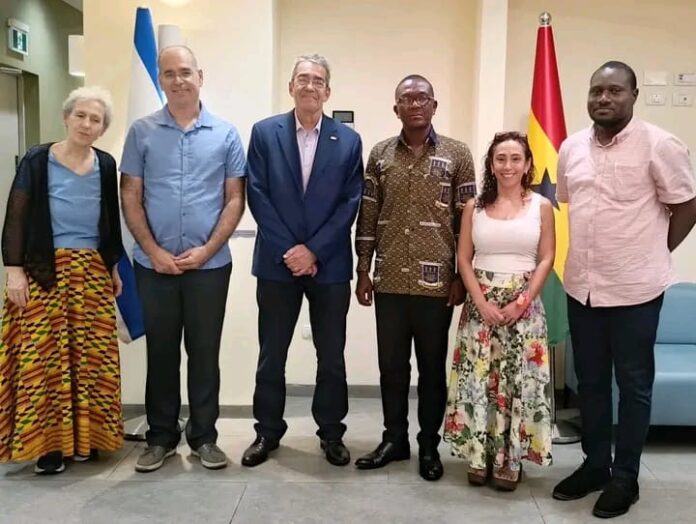

Diplomacy that stops at a handshake is ceremony, not strategy. The Israeli Embassy in Ghana says it remains committed to educational partnerships that promote knowledge sharing, research and academic development. The commitment matters only if it produces funded projects, trained researchers and useful technology. The Embassy’s statement followed a meeting on Friday, 16 October 2026, between Ambassador Roey Gilad and Dr. Akpeko Agbevade of the University of Ghana, accompanied by Professor Yaniv Reingewertz, head of the Department of Public Administration and Policy at the University of Haifa, and his wife, Dr. Tali Haviv Reingewertz. Discussions covered joint research, student exchanges and other forms of collaboration. However, the meeting signals diplomatic interest, not proof of a formal agreement or an approved budget.
That distinction is crucial. Academic diplomacy can build trust across borders without requiring governments to agree on every regional or international dispute. Goodwill becomes strategic when institutions define priorities, responsibilities and measurable results. Without clear commitments, meetings risk producing statements of intent that never translate into tangible benefits for universities, researchers or students.
Ghana and Israel should therefore treat the encounter as the beginning of a durable research relationship, not an achievement in itself. Both sides should identify priority research areas, establish funding arrangements, set timelines for student and staff exchanges, and agree on mechanisms for evaluating progress. The ultimate test of this engagement will not be the warmth of diplomatic relations but whether it delivers practical academic opportunities, advances research and generates knowledge that benefits both countries.
The Research Gap Is the Strategic Case
Ghana needs greater research capacity, while Israel offers experience in turning research into innovation. World Bank data sourced from the UNESCO Institute for Statistics put Israel’s gross domestic expenditure on research and development at 6.35 per cent of GDP in 2023. Ghana’s latest figure in the same series is 0.38 per cent, but it dates to 2010. Although the figures are not contemporaneous and Ghana’s outdated data cannot reflect its current investment, they highlight the need for updated statistics and sustained research funding.
Research requires an ecosystem of funding, universities, businesses, skilled workers, intellectual-property rules and pathways for translating findings into public benefits. A partnership that imports expertise without strengthening Ghanaian capacity would deepen dependence rather than close the gap. Cooperation must therefore prioritize local skills, institutions and the ability to develop homegrown solutions.
The University of Ghana provides a foundation for such collaboration through its research priorities, which include health, food production and processing, climate adaptation, development policy and emerging technologies. Its research policy emphasizes collaboration, quality, integrity and internationally aligned standards. The university’s International Programmes Office, established in 1997, coordinates international agreements, visiting scholars, student mobility and research collaboration, providing existing structures through which a Ghana-Israel research partnership could be developed.
Make Cooperation Deliver for Ghana
The first test should be whether the relationship answers Ghanaian needs. Joint teams from the University of Ghana and the University of Haifa could develop competitive proposals in public administration, digital government, water management, agricultural technology, public health and climate resilience. Professor Reingewertz’s specialism could support evidence-based policymaking, subject to matching expertise.
A practical programme should establish a joint steering committee with named academic leads and a public work plan; launch seed grants for teams including early-career Ghanaian researchers, with transparent selection and independent peer review; create reciprocal student and faculty exchanges, including remote supervision and short research placements; and publish annual reporting on grants awarded, researchers trained, papers produced, patents or prototypes developed, and policies informed by the work.
Money will determine credibility. Research councils, foundations and responsible businesses may contribute, with conditions disclosed and academic independence protected. Travel scholarships, laboratory access, internet, administration and publication costs must also be funded. Without this support, exchange opportunities may be captured by students and academics already best placed to travel.
Equity must be designed, not assumed. Ghanaian researchers should help set the questions, lead work packages and share authorship, data access and intellectual property under clear agreements. Research involving communities must secure ethical approval, informed consent and appropriate local benefit. Agreements should spell out how data are stored, how sensitive information is protected, how disputes are resolved and whether technologies can be maintained affordably in Ghana. Knowledge sharing requires both sides to contribute and learn.
From Diplomatic Promise to Measurable Influence
Security and geopolitics make this agenda consequential. Ghana operates in a region facing pressure from violent extremist groups in the Sahel, climate stress, maritime insecurity and cyber risks. Universities cannot replace security agencies or diplomacy, but can strengthen evidence for prevention, crisis response, digital resilience and accountable governance. Research collaboration should remain civilian-led and transparent, with any sensitive or dual-use work subject to applicable law and rigorous oversight.
The politics demand realism. Israel’s regional conflicts and foreign-policy concerns can shape public perceptions of Israeli partnerships. Ghanaian institutions should neither disregard those concerns nor allow them to overshadow an assessment of the merits of individual projects. Academic cooperation must respect freedom of inquiry, lawful expression, institutional autonomy and equal treatment. Transparent selection, open publication where appropriate and clear ethical safeguards will help protect the relationship from accusations that scholarship is merely public relations.
The Embassy can make its commitment tangible by convening universities, public agencies, businesses and research funders; helping identify Israeli technical partners; and supporting a transparent pipeline of calls for proposals. It should not claim credit for outcomes that universities and researchers produce. The universities should publish an agreed work plan, specify duration and funding and report against a baseline. An annual review would let the public judge performance. Reporting should include deadlines, responsible institutions, annual budgets and independently verifiable outcomes. Public reporting should make accountability visible.
The measure of success is not the number of meetings or photographs released. It is whether Ghanaian researchers gain durable skills, whether joint findings address real public problems, whether students from both countries can participate and whether discoveries become accessible services, policies or enterprises. Israel brings research experience; Ghana brings local knowledge and West African priorities. Neither should treat the other merely as donor, market or symbol.
The Embassy’s statement therefore presents an opportunity and a test. Convert the promise into transparent funding, reciprocal mobility, jointly governed research and measurable public value, and academic diplomacy can become a quiet instrument of long-term trust. Leave it at expressions of commitment, and the meeting will join the crowded archive of diplomatic occasions that sounded more consequential than they proved to be for both countries.