

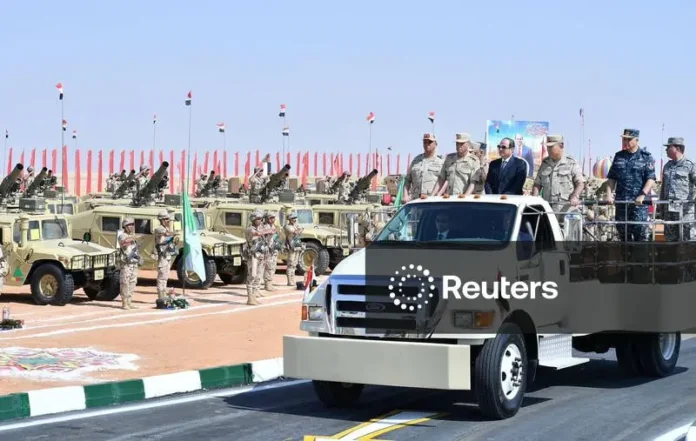

Egyptian President Abdel Fattah al-Sisi has ruled out extending his stay in office beyond 2030 and proposed a 30-month military academy programme to prepare potential leaders for top positions across the state.
Addressing graduates at the Egyptian Military Academy on Saturday, President Abdel Fattah al-Sisi, 71, said his exit from office at the end of his current term was a settled matter, as he outlined plans to transform the institution into a training hub for future national leaders.
The initiative would place the military academy at the heart of efforts to prepare Egyptians for senior public office, reinforcing the armed forces’ expanding influence in civilian governance and the economy under Sisi, a former army general.
Sisi said a committee supervised by the speaker of parliament and comprising intellectuals, politicians, and the ministers of higher education and justice would establish selection criteria for candidates and prepare legislation governing the programme.
He said the training would be open to PhD holders from reputable Egyptian and international universities. Selected candidates would spend 30 months studying the workings of the state, its resources and the principles required to safeguard them.
Graduates could subsequently be considered for leadership positions across government, including the presidency, ministerial portfolios, governorships and parliament.
Sisi said the initiative was intended to ensure that Egyptians had a pool of trained candidates from whom they could choose their future leaders. However, he did not explain how graduates would be nominated for elected office or appointed to government positions.
He also pledged to leave behind a state equipped with capable men and women prepared to take on national responsibilities.
Reaffirming his commitment to the existing constitutional framework, Sisi said Egypt’s constitution would not be amended and that the conclusion of his presidency in 2030 was no longer open to debate.
Sisi is serving a six-year term after winning re-election in December 2023. Constitutional amendments approved in a 2019 referendum extended presidential terms from four to six years and permitted him to seek a third term, enabling him to remain in office until 2030.
His announcement comes against the backdrop of decades of military influence in Egyptian politics. Sisi assumed the presidency in 2014, a year after leading the military’s removal of Mohamed Morsi, the country’s first democratically elected president, following mass protests against his government.
Morsi belonged to the Muslim Brotherhood, the region’s oldest Islamist organization. After taking power, Sisi’s government launched a sweeping crackdown on the group and consolidated its hold on the country.
The proposed leadership programme would further formalize the military academy’s role in preparing individuals for positions extending well beyond defence, although key questions remain about how candidates will be selected and how the initiative will interact with Egypt’s electoral and political institutions.