


An election referee cannot campaign for one of the teams and expect every spectator to trust the whistle. That is the hard question facing Ghana’s Electoral Commission after the Coalition of Domestic Election Observers (CODEO) demanded that Deputy Chairperson Emelia Affi Agbenyo resign over her documented involvement in the National Democratic Congress’s 2024 campaign. This is not a verdict that she would manipulate an election. It is a test of institutional judgment: whether someone who publicly advocated for a party can now convincingly oversee a process in which that party’s future may depend on her institution.
CODEO’s concern rests on specific, dated evidence. It says the NDC announced Agbenyo in August 2024 as a governance-sector spokesperson for its election manifesto, a role she also listed on LinkedIn. The coalition cited a Facebook video posted on September 20 featuring then-candidate John Dramani Mahama and the party’s campaign song, followed by a pro-change message accompanying Mahama’s photograph on October 31. On December 2, she reportedly wrote on X that she would vote against the government and used hashtags explicitly supporting Mahama and the NDC’s campaign. These are not merely allegations of private sympathy; they describe public political advocacy during an election campaign.
The distinction is far from trivial. Citizens cannot reasonably demand that electoral commissioners have no personal views. They can, however, expect officials at the apex of election administration to avoid recent, visible partisan campaigning. A candidate’s supporter may be honest and competent, but the role requires more than personal honesty: it requires conduct that gives rival parties no reasonable grounds to suspect that the referee has chosen a side.
Independence Is Not Enough
Ghana’s Constitution gives the EC independence in performing its functions. Article 46 says it shall not be subject to the direction or control of any person or authority, while Article 45 assigns it responsibilities including compiling the voters’ register, demarcating electoral boundaries and conducting public elections. The seven-member Commission’s authority is not ceremonial; it governs the rules and decisions on which democratic competition rests.
Yet constitutional independence and perceived impartiality are related, not identical. Corporate governance offers a useful parallel: boards do not manage conflicts of interest only by insisting that directors are personally honourable. They disclose interests, establish recusal procedures and protect the institution from reasonable suspicion. The aim is to prevent avoidable doubts before decisions become contentious.
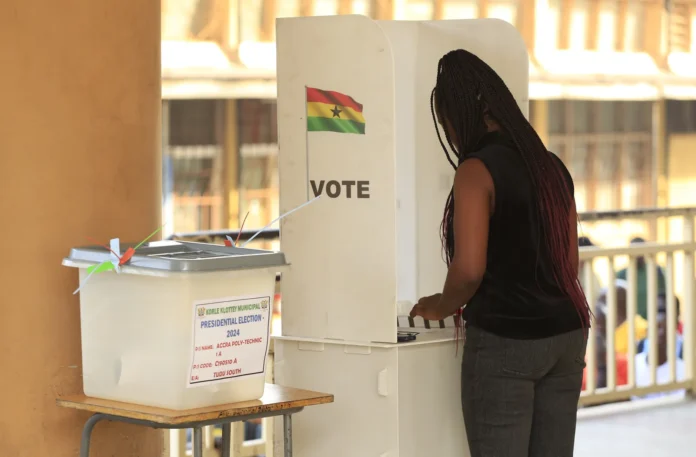
That standard is especially important in Ghana, where electoral disputes can quickly become tests of institutional legitimacy. In the 2024 presidential election, the EC declared Mahama the winner with 56.55 per cent of valid votes in 267 constituencies in its initial December 9 announcement, while Mahamudu Bawumia received 41.61 per cent. The Commission later updated its results. An appearance of partiality can make routine decisions look politically loaded.
A Serious Governance Problem
The 2024 election also illustrates the scale of the public trust at stake. The EC reported 18,774,159 registered voters on its website and 40,976 polling stations. Commonwealth observers’ final report recorded 11,931,420 votes cast in 275 constituencies, including 247,937 rejected ballots, and turnout of 63.97 per cent across those constituencies. These figures do not show that Agbenyo influenced the result. They demonstrate how many citizens depend on credible, transparent and consistent administration.
The governance question is not whether a person who once supported a party is permanently disqualified from public service. Political participation should not become lifelong disqualification. A deputy chairperson is not an ordinary administrator. The office carries a duty to serve all parties and voters equally. Recent campaign spokesperson duties and public messages supporting one side create a conflict of perception that cannot be dismissed as a private political preference.
The appointment process itself deserves scrutiny. Under Article 70(2), the President appoints EC chairpersons, deputy chairpersons and members acting on the advice of the Council of State. The Constitution does not expressly require parliamentary confirmation of these appointments. Legality alone does not settle whether an appointment is wise or defensible. A system that places substantial appointment power in the presidency should be especially careful to demonstrate safeguards against actual or perceived partisan capture.
What Should Happen Now?
CODEO’s call for resignation is severe, but it identifies a real governance risk. A transparent response would also help distinguish evidence from inference, protect Agbenyo’s right to answer, and establish a consistent standard for future commissioners, whatever party nominated or supported them in office. Agbenyo should be given an opportunity to respond to the evidence and explain how she understands the obligations of her new office. Any review must be fair, evidence-based and transparent.
Still, explanations cannot erase the central issue. The public record described by CODEO is not a vague association or an unverified rumour; it includes an announced campaign role and dated public posts. If those records are accurate, the burden is on the institution to show why they do not undermine confidence or to acknowledge that they do. A promise of neutrality may not be sufficient after visible conduct has raised doubts.
President Mahama also faces a consistency test. In 2023, while in opposition, he criticized the appointment of people he described as known party activists to the EC and called for reforms to the appointment process. CODEO now asks him to apply that principle when the appointee served his own party’s campaign. Institutional credibility depends on standards applied regardless of who benefits. A principle that changes with the party in power is not a principle; it is a tactic.
The choice is not between assuming Agbenyo is dishonest and ignoring the problem. It is between treating public confidence as a core asset of electoral governance or as a public-relations inconvenience. The EC’s authority rests not only on constitutional text, but on the willingness of winners and losers to accept its decisions. In a democracy, the referee must be fair and must look fair. Where recent partisan campaigning casts a credible shadow over that role, resignation is a defensible remedy, and meaningful appointment reform is the lasting one.