

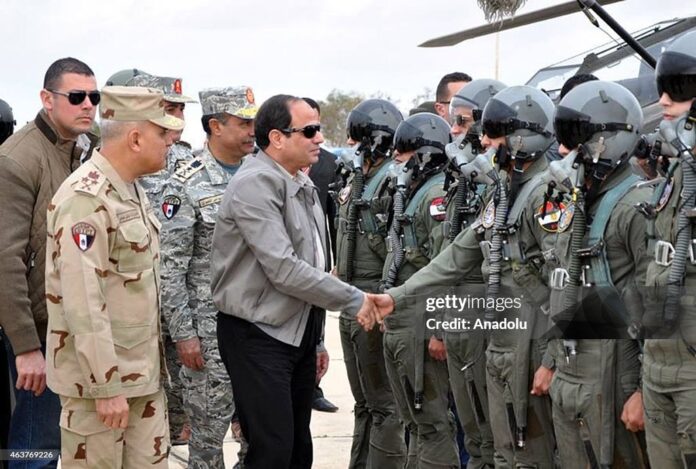

The message from Cairo is blunt: Egypt will help shield Saudi Arabia, but it will not join a war of conquest in Yemen. President Abdel Fattah al-Sisi’s distinction is more than diplomatic phrasing. As Houthi missile and drone attacks intensify, it defines the boundary between Arab solidarity and another open-ended intervention in a shattered country. It also tests the credibility of the Mecca Joint Defence Agreement, signed by Saudi Arabia, Türkiye and Pakistan on 7 August 2026, which treats an armed attack on one signatory as an attack on all. The central question is whether collective defence can deter attacks without turning defence into escalation.
Sisi’s statement on 21 October followed meetings in Riyadh between Saudi Crown Prince Mohammed bin Salman and Egypt’s foreign minister, Badr Abdelatty, alongside intelligence chief Hassan Rashad. Egypt’s parliament postponed a vote on authorizing military support until 26 October. Under Article 152 of Egypt’s constitution, overseas combat deployment requires consultation with the National Defence Council and approval by two-thirds of parliament’s 596 members: at least 398 votes. This is not yet an unconditional deployment order. It is a political signal, bounded by law and by Cairo’s insistence that Egyptian forces defend Saudi territory and borders, not attack Yemen.
The Mecca Pact’s Test
The Mecca pact promises a harder regional deterrent. Yet its public terms remain limited: the full agreement has not been published, and the collective-defence clause does not publicly specify automatic troop deployments, command arrangements or the geography of retaliation. Analysts therefore should not mistake a headline commitment for an operational plan. Saudi Arabia brings money and strategic weight; Türkiye contributes a substantial military and defence industry; Pakistan adds experienced armed forces and nuclear deterrence, though no nuclear-sharing provision has been confirmed. Egypt’s entry would add a large Arab military, control of the Suez Canal approaches and direct proximity to the Red Sea. But Cairo has not joined, and Sisi’s carefully defined offer is not equivalent to accession.
The real test lies in how that commitment translates into action. The pact’s credibility depends not only on whether members promise to respond, but on whether they can agree what response is lawful, proportionate and useful. Houthi attacks on Saudi cities and infrastructure may trigger solidarity, but striking targets inside Yemen is not the only possible answer. Integrated air defence, early-warning intelligence, interception coordination, protection of airports and energy facilities and maritime surveillance could raise the cost of attacks without expanding the battlefield. A defensive coalition that cannot distinguish protection from punishment risks becoming another mechanism for widening war. The Mecca agreement will be judged by whether it prevents attacks, not by how loudly its members threaten retaliation.
Yemen Is Not a Target Set
The Houthis control Sana’a and much of northern Yemen. They are aligned with Iran, which has supplied support and technology, but should not be treated as a force whose decisions are entirely dictated from Tehran. Their missile and drone campaigns exploit Saudi Arabia’s vast geography and the vulnerability of fixed infrastructure. Air defence can intercept many threats, but defending every airport, oil installation and urban centre at once is costly and never guaranteed. The current escalation also unfolds amid a wider regional war involving Iran, the United States and Israel, increasing the danger that a strike intended as deterrence will be interpreted as a new front.
Egypt has direct interests at stake. The Red Sea links the Suez Canal to the Indian Ocean and insecurity threatens shipping, canal receipts and the wider Egyptian economy. Yet Cairo remembers the limits of military solutions. Egypt joined the Saudi-led coalition in 2015 but maintained a comparatively limited combat role. The campaign did not restore a unified Yemeni state; years of fighting instead fragmented authority and deepened civilian suffering. The United Nations estimated 19.5 million Yemenis needed humanitarian assistance and protection in 2025; its 2026 reporting projected more than 21 million would need assistance. Yemen’s economy has contracted by over half since the war began, while millions face hunger and failing services. A new air campaign would risk imposing further costs on civilians without guaranteeing that Houthi launch capabilities would disappear.
Solidarity Without Escalation
Sisi’s position is therefore strategically coherent, not timid. Saudi security is important to Egypt, but an offensive role in Yemen could expose Egyptian troops, strain public finances and place Cairo on a direct collision course with Iran. Reuters reported that a Saudi central-bank deposit of $5.3 billion was due in Egypt this month, underscoring the depth of the economic relationship, and the sensitivity of security choices. Financial ties do not prove that Cairo’s policy is purchased; they do show why Riyadh expects solidarity. Parliament’s debate, including concerns about mission costs and duration, reflects a legitimate question: what precisely would Egyptian forces be asked to do, for how long and under whose command?
The Mecca pact sharpens that dilemma. Its signatories describe it as defensive and open to other states, but a mutual-defence clause cannot erase differences in threat perception or national interest. Egypt must decide whether joining would strengthen deterrence or reduce its freedom to manoeuvre. For now, Sisi is drawing a line: protect Saudi territory, avoid offensive operations in Yemen and keep diplomacy alive. That formula could become a model for the pact, collective protection without automatic escalation, if the members build practical systems for intelligence-sharing, air defence and crisis consultation.
The test is urgent. Riyadh needs credible protection; Cairo needs to avoid a costly quagmire; and Yemen’s civilians need a path out of war. The Mecca agreement should not be measured by the number of flags assembled or the force of its rhetoric. It should be measured by fewer missiles reaching Saudi cities, safer Red Sea shipping, and renewed pressure for a negotiated settlement. A shield can deter. A sword may only deepen the conflict.
Sisi’s red line offers principled solidarity without confusing defence with a mandate for another endless war across Yemen again.