

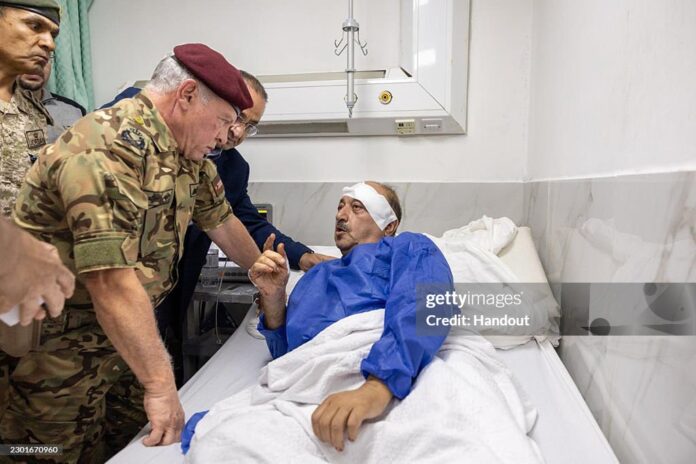

Jordan’s King Abdullah has ordered security forces to pursue those responsible for a deadly attack on a Greek Orthodox church, demanding an uncompromising response as authorities hunt for the gunmen who killed eight people and wounded 40 others during a funeral service in Karak governorate.
The attackers opened fire indiscriminately for several minutes in broad daylight on Friday, targeting mourners gathered at the church in one of the rare attacks against Jordan’s Christian minority. The shooting triggered heightened security measures across the kingdom, with additional deployments around shopping malls, foreign embassies and other sensitive locations.
King Abdullah issued the directive on Saturday while presiding over a meeting of the National Security Council, describing the killings as a grave terrorist crime and insisting that the government would show no tolerance towards those threatening the lives and security of Jordanians.
The Royal Court said the monarch had instructed security agencies to pursue the perpetrators with maximum force, stressing that protecting citizens was an overriding national responsibility.
Despite the scale of the violence, no group had claimed responsibility for the attack by Saturday. Jordanian authorities also cautioned against drawing conclusions about the perpetrators’ affiliations, saying investigations were still at an early stage and that it remained unclear whether the gunmen had connections to established militant organizations operating inside or outside the country.
The attack has nevertheless raised serious concerns about the security of religious minorities in a country widely regarded as one of the Middle East’s more stable states and a key American partner in counterterrorism operations. Jordanian security agencies have previously announced the disruption of several suspected Islamist militant plots.
The human toll was evident at hospitals where survivors were receiving treatment. Tarek Ammarin, whose relative was among those injured, described the incident as an exceptionally brutal act of violence, saying the scale of the bloodshed had shocked the community.
Police maintained a visible presence outside Saint George’s Greek Orthodox Church on Saturday. The church is located approximately 120 kilometres southwest of the capital, Amman.
Prime Minister Jafar Hassan condemned the killings, attributing the violence to extremist ideology and religious fanaticism. He warned that the government would not allow such forces to undermine Jordanian society or threaten its tradition of coexistence.
The US Embassy in Amman also announced that security had been reinforced at several locations across the kingdom following the shooting, reflecting concerns about possible further threats.
The attack has drawn particular attention because Christians, although a longstanding component of Jordanian society, constitute a minority of the country’s population. Jordan also occupies an important position in Christianity’s historical geography, hosting several biblical sites that attract pilgrims from across the world.
In Karak, where the attack occurred, local officials joined the national outcry, condemning the gunmen and expressing solidarity with the victims and their families.
Bahjat al-Rushda, mayor of Shihan village in Karak, denounced the perpetrators as religious extremists and expressed confidence that the violence would not destabilise the country.
His remarks reflected a broader determination among Jordanian officials to prevent the attack from deepening religious divisions or undermining public confidence in national security institutions.
Jordan’s security concerns have also intensified against the backdrop of wider regional instability. The kingdom has been among America’s Middle Eastern allies affected by Iranian attacks this year, following US and Israeli military strikes against Iran in February.
That volatile regional environment has placed additional pressure on Jordan, whose strategic position and close security cooperation with Washington make it an important actor in efforts to contain militant threats and regional escalation.
For the government, however, the immediate priority remains identifying the attackers, establishing their motives and determining whether the killings were part of a wider extremist operation.
The investigation will be closely watched in a country where religious coexistence has long been an important element of national identity. Authorities now face the challenge of delivering justice for the victims while preventing the violence from becoming a catalyst for wider insecurity or sectarian tensions.