

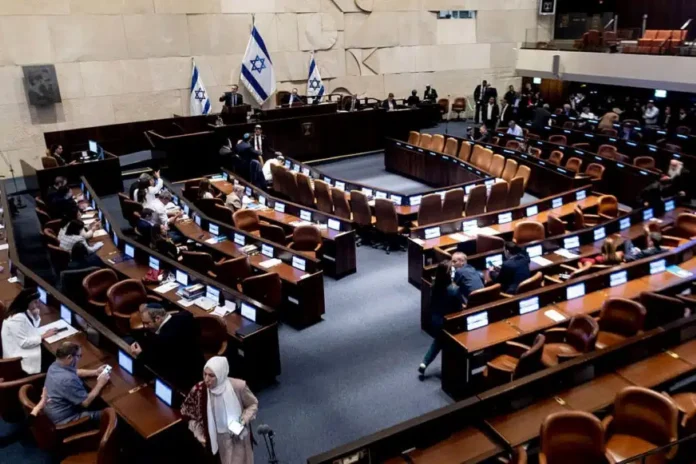

As Israelis prepare to vote on October 27, the battle for power may be determined less by the party that finishes first than by smaller political movements fighting to cross the electoral threshold. In a deeply divided country still grappling with the consequences of October 7, the mathematics of exclusion could prove decisive.
Israel’s October 27 election is about much more than Benjamin Netanyahu’s political survival. It is a defining contest over national leadership, security, political accountability and the direction of a country still confronting the consequences of Hamas’ October 7, 2023, attacks. Yet one of the most consequential numbers on election night may not be the number of seats won by Likud or its principal rivals. It may be 3.25%.
That is Israel’s electoral threshold: the minimum share of valid national votes a party list must secure to qualify for representation in the 120-member Knesset. A party that falls below this threshold receives no seats, regardless of how many thousands of Israelis supported it. A party that crosses it becomes eligible to participate in parliamentary seat allocation, generally securing approximately four seats or more. This is not a technical footnote. It is a potentially decisive mechanism in determining which political forces can influence the formation of Israel’s next government.
Israelis do not directly elect their prime minister. They vote for national party lists, with parliamentary seats distributed proportionally among qualifying lists. A government must command the support of at least 61 of the Knesset’s 120 members to secure a majority. Consequently, the difference between a party receiving 3.2% and one receiving 3.3% can be politically enormous. A relatively small movement in voter support can determine whether an entire political faction enters parliament or disappears from the parliamentary arithmetic.
The Knesset’s official explanation of the Bader-Ofer seat allocation system confirms that only lists crossing the 3.25% threshold participate in the distribution of parliamentary seats. Votes cast for unsuccessful lists are excluded from the calculation, increasing the relative weight of votes cast for qualifying parties. Surplus-vote agreements between eligible lists can further influence the final distribution.
Why the Threshold Could Break the Political Deadlock
The latest available polling makes this electoral mechanism particularly important. The October 23 polling average published by Israelielection.org placed Netanyahu’s bloc at approximately 52.4 seats, compared with 49.6 for the mainstream anti-Netanyahu Zionist opposition. Arab parties accounted for approximately 14 seats, while another four seats were classified as belonging to parties positioned between the two principal blocs. These are polling projections, not election results. Nevertheless, they illustrate the central problem confronting Israel’s political establishment: neither principal camp appears to have established a dependable governing majority. The distribution of support among smaller parties, as well as their willingness to cooperate after election day, could prove decisive.
Gadi Eisenkot’s Yashar party has emerged as a major opposition contender, alongside B’Yachad, the joint electoral list led by former prime ministers Naftali Bennett and Yair Lapid. Avigdor Liberman’s Yisrael Beiteinu and Yair Golan’s Democrats are also competing for influence across the anti-Netanyahu camp. Though these parties share opposition to Netanyahu’s continued leadership, they are not a unified political movement. Their differences over religion and state, judicial reform, military conscription and the Palestinian question could complicate coalition negotiations.
Likud, meanwhile, remains central to Netanyahu’s efforts to retain power, alongside Shas, United Torah Judaism, Religious Zionism and Itamar Ben-Gvir’s Otzma Yehudit. These parties provide the ideological and parliamentary foundations of his political bloc, but their individual electoral fortunes and policy demands will influence the negotiations that follow the vote. The threshold creates an additional danger for smaller movements, particularly those struggling to establish consistent support sufficient for parliamentary representation.
Polling published between October 20 and 23 indicated uncertainty surrounding parties such as Reservists-Economic, Amcha Yisrael and Blue and White. Their prospects varied across individual surveys, with some struggling to establish consistent support sufficient for parliamentary representation. Reservists-Economic reached approximately four seats in some projections, while other surveys placed it below the qualifying line. This uncertainty makes the final days of campaigning particularly consequential for smaller parties whose parliamentary survival may depend on a narrow margin of voter support.
Consider the consequences. If a small opposition-aligned party receives 3.1%, its votes are excluded from parliamentary seat allocation. If it crosses the threshold, it becomes eligible for representation and could strengthen the opposition’s negotiating position. The same principle applies to parties associated with Netanyahu’s camp. The threshold is therefore politically neutral in law, but its electoral consequences can favour one political bloc over another, depending on which parties fall short and how the remaining seats are distributed.
There is, however, an important qualification. Votes excluded below the threshold do not automatically transfer to the largest party or directly to an opposing bloc. Rather, their exclusion changes the pool of votes used to allocate seats among qualifying lists. Surplus-vote agreements between eligible parties can further influence the final distribution under the Bader-Ofer system. Understanding this distinction is essential to avoiding simplistic claims about wasted votes.
October 7, Security and the Crisis of Political Legitimacy
The stakes extend well beyond parliamentary arithmetic. October 7 fundamentally altered Israel’s national security debate and exposed profound weaknesses in intelligence, military preparedness and political leadership. The Hamas-led assault killed approximately 1,200 people and resulted in the abduction of 251 others. Israel’s subsequent military campaigns in Gaza and across the wider region transformed its security environment, deepened regional instability and imposed enormous human, diplomatic and economic costs. The consequences continue to shape the country’s domestic political debate and international standing.
Netanyahu faces an electorate confronting difficult questions. Can his leadership restore public confidence in national security? Who should bear responsibility for the intelligence and operational failures preceding October 7? Should an independent state commission investigate the catastrophe? And what political and diplomatic strategy can prevent another generation of Israelis and Palestinians from being trapped in recurring violence? These questions intersect with two other combustible domestic disputes: judicial reform and military conscription.
Netanyahu’s ultra-Orthodox coalition partners have long sought to preserve exemptions from compulsory military service for many yeshiva students. That position has become increasingly contentious as reservists shoulder repeated deployments and families endure prolonged separation. The debate is no longer simply about religious privilege. It concerns equality, national cohesion and the distribution of security responsibilities. The far right also remains consequential, with Reuters reporting on October 20 that Ben-Gvir’s Otzma Yehudit was attracting support among younger and first-time voters, with polling suggesting the party could secure at least eight Knesset seats independently.
His growing influence illustrates why Netanyahu’s political difficulties cannot be understood simply as a decline in Likud’s popularity. Even if Likud loses parliamentary ground, hardline coalition partners could retain considerable leverage over the country’s security policies and its approach to the Palestinians. Meanwhile, the opposition faces its own credibility test. Replacing Netanyahu is not the same as presenting a coherent alternative government.
Eisenkot, Bennett, Lapid, Liberman and Golan may share opposition to the incumbent, but they do not necessarily share positions on religion, Palestinian statehood, judicial authority or military exemptions. Electoral cooperation does not automatically produce governing consensus. A coalition assembled primarily around opposition to one individual could struggle to maintain unity when confronted with the practical responsibilities of governing.
The central challenge, therefore, extends beyond whether Netanyahu can retain power. It concerns whether Israel’s political system can produce leadership capable of addressing the security failures, institutional divisions and social tensions exposed by October 7. The country’s next political chapter will depend not only on the balance of parliamentary seats but also on whether competing political forces can agree on a sustainable vision for national security, governance and regional stability.
The Danger of Winning Without the Power to Govern
The strongest argument against making the electoral threshold the centrepiece of election analysis is that leadership, national security and coalition negotiations ultimately matter more than a mathematical technicality. That argument is partly correct. Voters are not electing an electoral formula; they are deciding who should lead Israel. Moreover, a party can cross the threshold and still become politically irrelevant if its preferred coalition cannot secure 61 seats. But this objection overlooks the relationship between votes and governing power. Israel’s proportional electoral system makes parliamentary representation the foundation of political authority. The threshold determines which voters secure representation and which parties gain entry into coalition negotiations. It therefore shapes the conditions under which political leadership becomes possible.
Nor should crossing the threshold be confused with a guaranteed place in government. A party with approximately four seats can become influential if competing coalitions need its support and can accommodate its demands. The arithmetic creates potential leverage, not certainty.
Netanyahu’s political bloc remains short of a dependable majority in the October 23 polling average. The mainstream Zionist opposition also faces difficulties translating its collective support into a governing majority. Arab parties could become pivotal, but mainstream Zionist opposition leaders face considerable political resistance to formal cooperation with them. This contradiction exposes a structural weakness in Israel’s parliamentary politics: a political camp may command substantial electoral support yet remain unable to translate that support into government because its component parties reject potential partners.
The counterargument that a higher electoral threshold encourages stability also deserves consideration, as discouraging excessive fragmentation can encourage smaller parties to form alliances and produce more consolidated parliamentary representation. Nevertheless, stability cannot be measured merely by excluding smaller political movements, since a system that denies parliamentary representation to significant groups of voters risks weakening democratic legitimacy, particularly when those voters have legitimate political interests and concerns that might otherwise influence national policy.
Israel’s October 27 election must therefore be watched on two levels: the headline contest over which party finishes first and the less spectacular struggle for parliamentary survival. The outcome will depend not only on the distribution of votes among the major parties but also on which smaller lists cross the threshold, how surplus votes are allocated and whether competing political factions can assemble a workable coalition.
The decisive question is not simply whether Netanyahu wins or loses. It is whether any political camp can assemble a credible governing majority without sacrificing its principles or deepening the country’s divisions. The 3.25% threshold will not determine everything. But it could determine who gets the opportunity to determine everything else.