

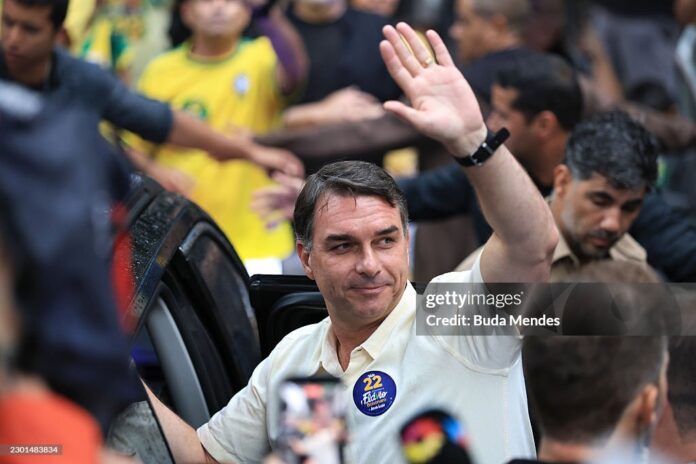

Brazil’s political crisis has entered another dangerous phase. Defeated presidential candidate Flávio Bolsonaro has lost the use of his passports after failing to surrender the documents within a deadline imposed by the Supreme Court. The Federal Police’s decision is more than an administrative intervention. It places one of Brazil’s most influential right-wing political figures under tighter judicial restrictions at precisely the moment when the country needs political stability, institutional restraint and a credible opposition.
The development, confirmed on October 27, 2026, follows an order by Supreme Federal Court (STF) Justice Alexandre de Moraes requiring Bolsonaro to surrender his travel documents within 24 hours and prohibiting him from leaving Brazil. After the deadline expired at 11 a.m. on Tuesday without the physical documents being delivered, the Federal Police cancelled his ordinary and diplomatic passports in its internal systems. The police also indicated that they would inform Moraes of his failure to comply. Importantly, cancellation does not mean Bolsonaro has been arrested or declared a fugitive.
The order emerged from an investigation involving Bolsonaro and lawyer Willer Tomaz, concerning suspected money laundering and foreign-exchange irregularities. Investigators are examining alleged financial connections involving accounts associated with the two men and businesses linked to the betting industry. These remain allegations, not established findings of guilt. Bolsonaro has not been convicted in this investigation, and the presumption of innocence must remain fundamental to any assessment of the case.
Nevertheless, failure to obey a judicial order introduces a separate and potentially more serious question: whether a prominent elected official considers himself subject to the same legal obligations as other citizens. That question carries particular weight in Brazil, where relations between the Bolsonaro political movement and the judiciary have become a defining feature of national politics.
The Legal Case Must Stand Apart from Politics
Timing is combustible, but it does not by itself prove persecution. Reporting indicates that the investigation predates the election. Moraes’s order also reportedly bars Bolsonaro from contacting Tomaz, directly or through intermediaries. The stated concern is therefore the integrity of an ongoing criminal inquiry and possible flight, not merely the candidate’s electoral defeat.
Restrictions on movement are serious, particularly when imposed on a sitting senator and former presidential candidate. Authorities must show that they are necessary, proportionate, evidence-based and open to judicial challenge. A passport restriction may protect an investigation, but it must not become punishment before conviction. The police, for their part, implement judicial orders; they should not be portrayed as independent political actors.
Bolsonaro says he never intended to leave Brazil and will challenge what he calls intimidation. His brother Eduardo had reportedly suggested before the runoff that Flávio should leave if defeated. That remark may have heightened concern, but it does not prove Flávio planned to flee. Democratic legitimacy requires both compliance with court orders and reasoned judicial decisions. Investigators reportedly found no formal record of Bolsonaro leaving the country. He has not been declared a fugitive, and no arrest warrant has been reported. These distinctions are essential.
A Narrow Result, a Deep Political Divide
The election figures explain the wider stakes. The Superior Electoral Court reported that Lula won 64,256,232 votes or 51.79 per cent of valid ballots, against Bolsonaro’s 59,826,041 or 48.21 per cent. The 4.43-million-vote margin delivered a clear legal victory, but the defeated candidate still secured nearly 60 million votes. Turnout was 128.2 million from an electorate of 158.7 million; abstention stood at 19.22 per cent. This was not a sweeping rejection of the right.
Bolsonaro’s family remains a powerful vehicle for conservative, evangelical, law-and-order and anti-establishment constituencies. Lula draws support from organized labour, poorer voters and much of the Northeast. Their competing views on corruption, public security, social policy and the state have hardened into political identities that an election cannot dissolve.
The OECD’s 2025 survey found that 58 per cent of Brazilians expressed high or moderately high trust in police, 45 per cent in courts and just 20 per cent in political parties. Trust in the federal government was 38 per cent, up from 26 per cent in 2022 but below the OECD average of 40 per cent. They show that enforcement agencies and courts operate amid uneven public confidence, while parties face a particularly deep credibility deficit.
The Risks Ahead
The immediate danger is mobilization around a narrative of selective justice. Bolsonaro’s allies may portray the cancellation as retaliation for challenging Lula, especially because the order became public just after the runoff. If that claim spreads unchecked, hostility towards the Supreme Court could intensify, demonstrations could follow and acceptance of future rulings could weaken. The opposite danger is equally serious: retreating because the subject is politically powerful would suggest that influence buys exemption from the law.
It could make him a more potent domestic symbol, consolidating his base while discouraging moderates from defending either the candidate or the court. That would shrink the space for compromise in Congress and complicate Lula’s efforts to govern beyond his coalition.
The Supreme Court should explain its reasoning as fully as legitimate investigative secrecy allows. Bolsonaro must obey lawful orders and challenge them through legal channels, not undermine the electoral process with unsupported claims. Police communications must distinguish cancelled documents from conviction, suspected flight from proven departure and non-compliance from arrest.
Brazil has cast more than 124 million valid votes. Lula has a mandate, not a blank cheque; the opposition has a vast constituency, not a licence to disregard the law. This case will test whether institutions can enforce rules without appearing partisan, and whether political leaders can contest state action without delegitimizing democracy. In a divided country, restraint is not weakness. It is the condition for preventing a legal confrontation from becoming another national crisis.