

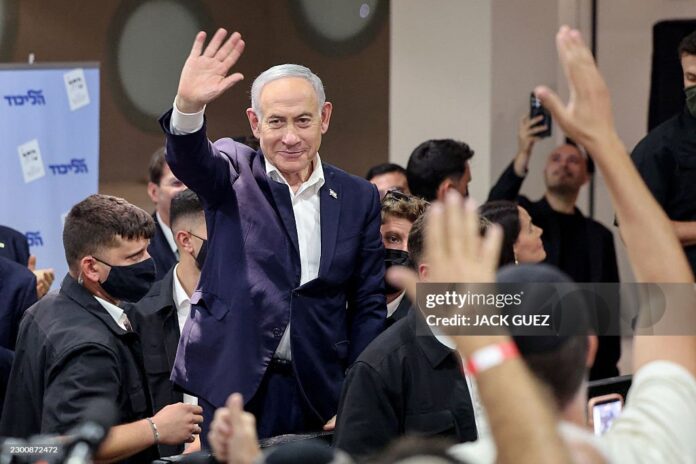

Israel witnessed an extraordinary surge in voter participation on Tuesday, with record-breaking turnout transforming the election into a high-stakes referendum on Prime Minister Benjamin Netanyahu’s leadership, his handling of the October 7 attacks and the wars that have reshaped the country.
Long queues stretched outside polling stations across the country as millions of Israelis headed to the ballot box in the first general election since the Hamas-led assault of October 7, 2023, which plunged Israel into its deadliest national security crisis and triggered conflicts across the region.
Figures released by the Central Elections Committee showed that 44.9 per cent of eligible voters had cast their ballots within the first seven hours of polling, with eight hours still remaining. The committee described the participation rate as unprecedented, signalling unusually strong public engagement in an election widely regarded as a turning point for the country.
At the centre of the contest is Netanyahu, Israel’s longest-serving prime minister, whose 19 years in office have been marked by political resilience, increasingly nationalist policies and deepening divisions over his government’s domestic and international record.
His right-wing coalition has faced mounting criticism over its approach to the Palestinian conflict, the wars in Gaza and Lebanon, and Israel’s growing diplomatic isolation. Netanyahu, however, has presented himself as the country’s strongest defence against external threats, arguing that his experience and determination make him uniquely qualified to lead Israel through its most dangerous period.
Eisenkot Challenges Netanyahu Over October 7
Challenging Netanyahu is Gadi Eisenkot, a former military chief of staff and prominent security hawk who has assembled support from centre-right and right-wing political groups, alongside elements of the weakened Israeli left.
Despite mounting opposition to Netanyahu, the country’s fragmented parliamentary system makes an outright victory difficult, with opinion polls pointing to a closely contested race and no guaranteed path to a governing majority.
The unprecedented turnout has also introduced uncertainty into electoral calculations. A significant increase in participation among Arab citizens of Israel, who make up roughly one-fifth of the population, could undermine Netanyahu’s prospects and strengthen efforts to establish an alternative government. However, the prospect of relying on Arab political parties to secure a parliamentary majority remains controversial among Jewish political leaders.
For many voters opposed to Netanyahu, the election represents a demand for accountability over the October 7 security failures and the government’s subsequent handling of the conflict.
The opposition has pledged to establish a national commission of inquiry into the security breakdown that allowed Hamas militants to launch the October 7 assault, in which approximately 1,200 people were killed and 251 others abducted into Gaza. Netanyahu’s government has resisted calls for such an investigation, making accountability a central campaign issue.
Eisenkot sought to reinforce that message during a visit to Kibbutz Nir Oz in southern Israel, one of the communities devastated during the Hamas attack. Accompanied by Gadi Mozes, a former hostage abducted during the assault, the opposition leader expressed confidence that the election could usher in a fundamental political shift.
He has also criticized the outcome of Israel’s military campaign in Gaza, arguing that despite the enormous destruction and casualties, Hamas continues to exercise control over the territory. Palestinian health authorities put the death toll from the war at more than 74,000.
Eisenkot has pledged that a government under his leadership would dismantle Hamas’ military and governing capabilities within 18 months.
Arab Vote Key to Israel’s Political Future
Meanwhile, Netanyahu’s far-right allies remain confident of retaining their influence. Itamar Ben-Gvir, leader of a hardline party within the governing coalition, voted early in the day at the Kiryat Arba settlement in the occupied West Bank. He predicted Netanyahu would secure another term and described his party as an indispensable force in anchoring the next government firmly on the right.
The Arab vote has emerged as another major battleground. Ahmed Tibi, a candidate representing an Arab political party, said the unprecedented participation of Arab citizens could create the conditions for a new political arrangement and reverse what he described as the country’s worsening political reality.
Eisenkot, however, has ruled out entering a formal partnership with Arab parties, citing differences in political values. Nevertheless, some parliamentary scenarios could see Arab lawmakers provide external support to a minority government seeking to remove Netanyahu from power.
The issue has further inflamed tensions after Netanyahu repeatedly portrayed Arab-Israeli voters as a threat to the country’s future. His opponents have condemned the rhetoric as discriminatory and accused him of exploiting ethnic divisions for electoral advantage.
On Tuesday, Netanyahu shared an artificial intelligence-generated image on X depicting Arab voters, including women wearing niqabs, waiting outside a polling station. He accompanied it with another appeal for supporters to turn out, reinforcing his warning that the election would determine the country’s future.
Political tensions were also visible on Jerusalem’s streets, where vehicles displaying Likud Party flags circulated with loudspeakers broadcasting Islamic calls to prayer alongside messages urging residents to leave their homes because Arab citizens were voting.
Beyond the immediate contest for power, the election is unfolding against the backdrop of Israel’s increasingly complicated relationship with the Palestinians and its Western allies.
Like most major Jewish political leaders in Israel, Eisenkot rejects the two-state solution that once formed the foundation of decades of Israeli-Palestinian peace negotiations. However, he has criticized escalating violence by Jewish settlers against Palestinians in the occupied West Bank, a development that has intensified since 2023 and placed further strain on Israel’s relations with Western governments.
Wars and Coalition Uncertainty Cloud Election
Eisenkot has also positioned himself against Netanyahu’s far-right coalition partners, seeking to attract voters who support a hardline national security policy but oppose the influence of religious and extremist factions within the current government.
The broader security landscape remains equally volatile. Israel’s military offensive following October 7 devastated large parts of Gaza, while Israeli forces currently control approximately two-thirds of the territory under a year-old US-brokered ceasefire. Efforts to negotiate Hamas
disarmament and an Israeli military withdrawal have stalled.
Elsewhere, Israel has inflicted significant damage on Hezbollah, the Iran-backed militant group in Lebanon, while maintaining control over a substantial area of Lebanese territory. Its confrontation with Iran has also escalated sharply, culminating in a 12-day air campaign in 2025 and a joint US-Israeli war against Tehran this year.
Netanyahu has sought to turn his close relationship with US President Donald Trump into an electoral advantage, highlighting Washington’s backing for Israel’s military campaign against Iran. Trump, a key ally of the Israeli prime minister, has publicly endorsed a strategy of pursuing the conflict to its conclusion.
Yet, despite Netanyahu’s extensive political experience and enduring support among right-wing voters, the opposition believes public frustration over the security failures, prolonged wars and domestic divisions could finally weaken his grip on power.
Israel’s parliamentary system requires a coalition commanding a majority of the 120-seat Knesset, making the final outcome dependent not only on individual party performances but also on complicated negotiations among political blocs.
If neither Netanyahu nor Eisenkot can assemble the numbers needed to form a government, Netanyahu could remain in office as caretaker prime minister until another election is organized.
The possibility is not unprecedented. Netanyahu’s opponents succeeded in removing him from power only once since 2009, following four inconclusive elections held within two years. His return to office just 18 months later underscored his remarkable ability to survive political crises.
With turnout reaching historic levels, Tuesday’s election has become more than a contest between rival political leaders. It is a broader judgment on Netanyahu’s stewardship, the consequences of Israel’s military campaigns, the country’s democratic direction and the unresolved questions surrounding October 7.
Whether the surge in participation translates into a decisive change of government or another political deadlock, the result is likely to shape Israel’s domestic politics and regional security calculations for years to come.