

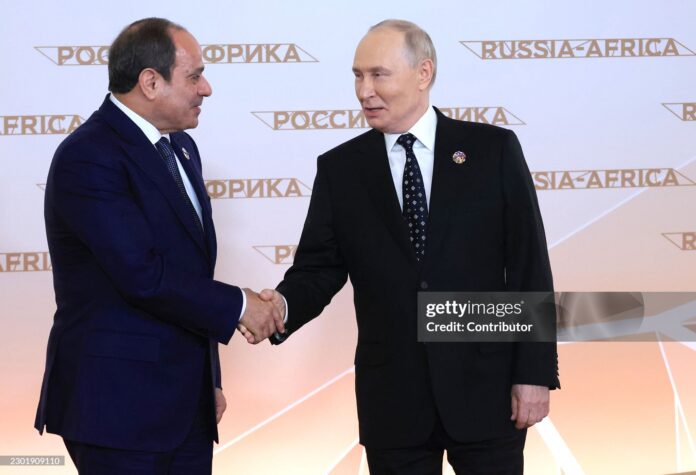

Vladimir Putin’s message to Africa is blunt: the West takes, Russia partners. It resonates on a continent scarred by extraction, unequal trade and debt. But it carries a contradiction. Moscow presents itself as a guardian of food security while waging war against Ukraine, an agricultural exporter whose Black Sea ports and farms matter to global grain markets. The question is whether the Kremlin’s claims survive scrutiny.
Since the 2019 Sochi summit, Putin has sought to turn historical goodwill, arms sales and diplomacy into power. The second summit, in St Petersburg in July 2023, showcased debt relief, grain donations and security cooperation. Putin said Russia had written off $23 billion in African debt and promised 200,000 tonnes of free grain to six countries: Burkina Faso, Central African Republic, Eritrea, Mali, Somalia and Zimbabwe. Moscow says it has military cooperation agreements with more than 40 African states. These are instruments of influence.
The appeal is clear. Russia presents its partnerships as free of Western-style governance conditions. Its security offer attracts governments facing insurgencies. Russian arms, training and Wagner-linked forces have expanded Moscow’s access in the Sahel and Central African Republic. Nuclear-energy agreements and mining interests add an economic dimension. Influence, however, is not development; security ties may protect governments without building accountable institutions or diversified economies.
The Economics
Trade exposes the limits of Russia’s promise. Russian-African trade reached approximately $24.3 billion in 2024, up 14.7 per cent, according to customs data reported by Interfax. Growth, but the relationship remains small. In 2022, Russia accounted for less than 2 per cent of the continent’s imports; the European Union accounted for 25 per cent and China 18 per cent. African exports to Russia were less than 1 per cent of total exports. Russia is politically active, not a leading economic partner.
Putin’s criticism of Western extraction and debt taps into grievances. African economies have often exported raw minerals and commodities while importing higher-value manufactures, leaving them exposed to volatile prices and external financing. Debt distress is real: UN Trade and Development reported that Africa’s external debt rose from about 19 per cent of GDP in 2010 to nearly 29 per cent in 2022, while external debt climbed from 74.5 per cent to 140 per cent of exports. Debt service crowds out health, education and infrastructure.
But the Kremlin’s account is selective. Africa’s creditors are not a single Western bloc. In 2023, private creditors held 42 per cent of Africa’s external debt, multilateral lenders 35 per cent and bilateral governments 23 per cent. China is the largest bilateral lender; bondholders and commercial banks are also central. Debt reflects borrowing choices, interest rates, commodity dependence, currency shocks and creditor practices. Russia’s claim to offer an alternative deserves examination, not automatic acceptance. Its trade remains weighted towards Russian exports, not transformative African value-added exports.
The War
The contradiction is sharpest in grain. Russia and Ukraine together supplied about one-third of sub-Saharan Africa’s wheat imports in 2021. Exposure varied: in 2020, Russia supplied 33.9 per cent of Ghana’s wheat imports, while Russia and Ukraine together accounted for 58 per cent of Sudan’s. Nigeria, Uganda and Tanzania were exposed too. Dependence varies, but the figures expose concentrated-supply risks.
Russia’s invasion in February 2022 disrupted this trade. Commercial shipping from Ukraine’s Black Sea ports stopped, threatening harvests and export routes. Wheat prices reached a record in March 2022, intensifying pressure on countries already facing pandemic aftershocks, currency weakness and food inflation. The Black Sea Grain Initiative, brokered by the United Nations and Türkiye and signed by Russia and Ukraine in July 2022, enabled nearly 33 million tonnes of grain and foodstuffs to leave three Ukrainian ports for 45 countries. Africa received around four million tonnes, notably Egypt, Tunisia and Libya.
The agreement showed Ukrainian production’s value and wartime vulnerability. Russia withdrew from the initiative in July 2023, ending the arrangement and withdrawing its security guarantees for navigation in the north-western Black Sea. Ukraine developed alternative routes, but attacks on ports continued. Moscow argues that Western sanctions obstruct Russian food and fertilizer exports. The United States, European Union and United Nations say these products are not generally prohibited, while acknowledging that banking, insurance and logistics complications can impede transactions. Russian exports continued; the invasion made Ukrainian exports less predictable.
Africa’s Test
Putin’s offer should neither be dismissed as propaganda nor accepted as solidarity without evidence. Russia is a major wheat exporter and can be a useful supplier of grain, fertilizer, energy, weapons and technical expertise. Debt relief and grain donations may provide relief. African governments are entitled to diversify partnerships rather than let relations with Moscow be dictated by Washington, Brussels or Beijing.
But a dependable development partner is judged by its contribution to long-term resilience, not summit rhetoric. Does it process locally, transfer technology, create skilled jobs and pay transparent royalties? Does it support predictable trade routes and avoid destabilizing food supplies? Apply these standards to every power.
Africa should negotiate from interest, not sentiment. Welcome competition, but demand transparent contracts, local value addition, diversified suppliers, grain reserves and farm investment. They should resist security deals that trade sovereignty for regime protection. Africa needs partners and choices.
Putin is right that Africa deserves equitable economic relations and freedom from exploitative dependence. He is not entitled to present Russia as the answer while ignoring the consequences of its war. Ukraine’s fields and ports are not a footnote to great-power rivalry; they are part of the food system on which millions depend. The credibility gap is plain: Moscow promises dependable partnership while its invasion has helped make a vital food source less secure. Africa should judge the partner by the harvest, not rhetoric.