

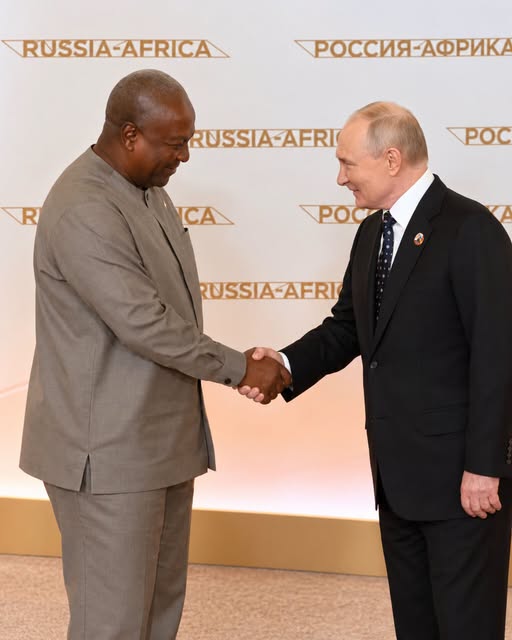

Ghana should welcome Russian investment. It should not mistake diplomatic warmth for development. President John Dramani Mahama’s address at the Russia-Africa Summit in Moscow sets out cooperation in agriculture, digital innovation and a possible nuclear power plant. But the test is not how many opportunities can be named. It is whether Ghana can secure public value without compromising its independence, finances or security.
Mahama was right to call for a peaceful end to the Russia-Ukraine conflict and warn that war damages trade and supply chains far beyond the battlefield. His appeal for cooperation against terrorism, particularly amid insecurity in the Alliance of Sahelian States, reflects Africa’s need for stability. Yet Ghana’s commitment to friendly relations with all countries must mean principled engagement, not strategic silence. A credible foreign policy keeps channels open while defending sovereignty and peaceful dispute resolution.
Investment Is Not a Substitute for Strategy
Russian expertise and capital could support fertilizer production, agro-processing, machinery, pharmaceuticals, transport, energy and digital technology. Ghana’s cocoa, cashew, shea, horticulture and mineral-processing sectors offer room to move beyond raw commodity exports. Hosting the AfCFTA Secretariat is an advantage: investors can view Ghana as a gateway to continental trade.
Still, listing sectors is easy. The hard work is building viable projects, reliable regulation, local skills and transparent procurement. Partnerships must create jobs, transfer technology, strengthen Ghanaian firms and retain value at home. Alternative payment arrangements, including local currencies and digital platforms, may ease legitimate trade. But they require clear rules and financial safeguards. New systems must not become opaque routes around accountability or expose businesses to avoidable compliance risks. Diversification is sensible; due diligence is indispensable.
The Nuclear Question Demands Scrutiny
Discussions with Rosatom over Ghana’s first nuclear power plant are the address’s most consequential disclosure. Nuclear energy could provide reliable, low-carbon electricity for industrial growth. Ghana’s experience with the Soviet-supplied two-megawatt research reactor, and the training of Ghanaian scientists in Russia, gives the relationship historical substance. But a research reactor is not a commercial power station. The scale, cost and institutional demands are fundamentally different.
Before any commitment, Ghanaians deserve an open assessment of financing, construction timelines, electricity prices, waste management, safety, emergency readiness and decommissioning. Ghana must compare nuclear power fairly with renewables, storage and grid upgrades. No supplier should determine its energy future simply because it offers technology. Parliament, independent regulators, experts and affected communities must have meaningful roles. A project of this scale cannot rest on summit diplomacy. It requires evidence and contracts that protect the national interest across generations.
Measure Results, Not Sentiment
Mahama’s proposal for a Russia-Africa programme in digital innovation and artificial intelligence, alongside cooperation in satellite-guided farming and soil mapping, points towards a productive relationship built on knowledge and African capacity. His recollection of studying in Moscow, and tribute to Soviet support for liberation movements, explain the relationship’s emotional depth. History matters. It cannot substitute for present-day performance.
As Ghana approaches the seventieth anniversary of independence in 2027, solidarity should be measured practically. Are farmers receiving affordable fertilizer? Are local manufacturers gaining technology? Is electricity more dependable? Are young people acquiring skills and decent work? Are public agreements transparent and beneficial?
Ghana should engage Russia confidently, as it should other partners. But it must negotiate from a national plan, publish major commitments and judge every project by its costs, risks and public returns. The objective is not to choose sides in a geopolitical contest. It is to choose outcomes for Ghanaians. Friendship is welcome; accountability is non-negotiable and promises must survive changes in political leadership.