

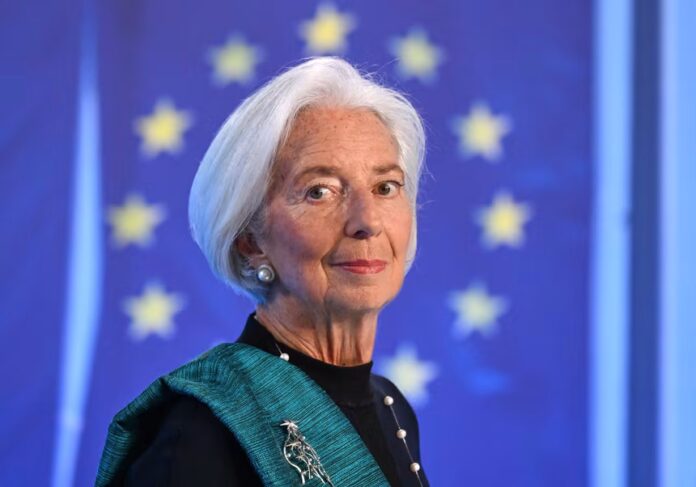

European Central Bank (ECB) President Christine Lagarde has announced plans to leave her position ahead of schedule, saying she wants the freedom to speak more openly on global economic, political and social issues beyond the central bank’s monetary policy responsibilities.
The 70-year-old intends to step down eight months before the end of her mandate in October 2027, bringing an early conclusion to her leadership of the eurozone’s monetary authority, which began in November 2019.
Lagarde, who previously served as managing director of the International Monetary Fund (IMF), said remaining at the helm of the ECB would limit her ability to address issues she considers increasingly important.
She explained that the institution’s strict neutrality requirements prevent its leadership from publicly engaging in matters outside its core mandate, making an early departure necessary for her to pursue a broader public role.
According to Lagarde, she wants to contribute more actively to discussions on global developments, particularly at a time when public debate is increasingly affected by misinformation and distorted representations of facts.
She indicated that her experience spanning more than two decades in international finance and economic leadership had equipped her with perspectives she believes should not remain confined to central banking.
Lagarde acknowledged that leaving a high-profile international institution before the completion of her tenure was not an easy decision, but maintained that the opportunity to express her views freely had become a priority.
She also pointed to the governance framework of the ECB, which requires senior officials to leave their positions rather than seek renewed mandates, as part of the institution’s independence and accountability arrangements.
Meanwhile, Lagarde has sought to ease concerns that her departure could create uncertainty within the ECB or undermine its policy direction.
She disclosed that preparations to identify her successor were already underway, expressing confidence that the institution would have several highly qualified candidates to take over the leadership.
She further assured markets, policymakers and ECB staff that the transition would not interfere with the bank’s decision-making processes, insisting that its institutional structures remain firmly established.
Lagarde’s departure will mark the end of a significant chapter in the ECB’s leadership, following her stewardship of the institution through major economic and financial challenges since 2019.