

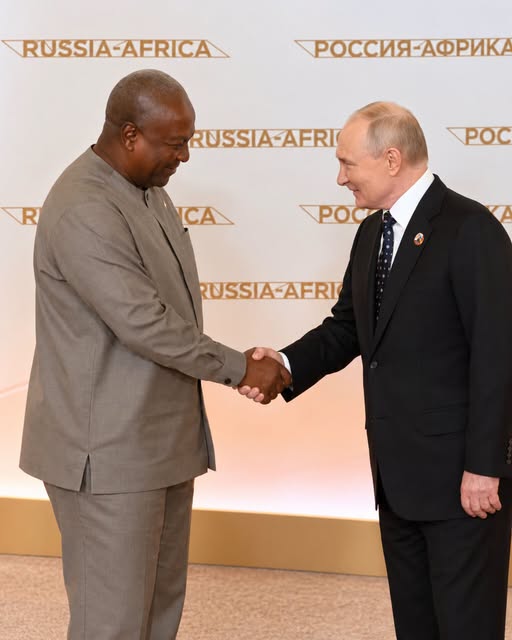

President urges stronger Russia-Africa ties, reveals nuclear power discussions with Rosatom.
President John Dramani Mahama has called for renewed diplomatic efforts to end the Russia-Ukraine conflict while urging Moscow to deepen economic cooperation with Africa, particularly through strategic investments in Ghana.
Speaking at the Third Russia-Africa Summit in Moscow, chaired by Russian President Vladimir Putin, Mr. Mahama welcomed the Russian leader’s readiness to resume trilateral negotiations aimed at resolving the conflict, stressing the need for a peaceful settlement that guarantees lasting security for both countries.
He cautioned that prolonged conflicts across the world continued to exact a devastating human toll while undermining international trade, disrupting logistics networks and weakening global supply chains.
Mr. Mahama also called for stronger international collaboration to confront terrorism, with particular emphasis on the deteriorating security situation in the Alliance of Sahelian States.
Turning to economic relations, President Mahama challenged Russian investors and businesses to explore Ghana’s investment potential through partnerships with local enterprises. He identified agro-processing, fertilizer manufacturing, agricultural machinery, pharmaceuticals, energy, transport infrastructure and digital technology as priority sectors.
He further highlighted investment opportunities in cocoa, cashew, shea nuts, horticulture, mineral processing and manufacturing, describing Ghana’s position as host of the African Continental Free Trade Area (AfCFTA) Secretariat as a strategic advantage for businesses seeking access to the wider African market.
Reasserting Ghana’s foreign policy position, Mr. Mahama stressed that the country remained committed to maintaining friendly relations with all nations, regardless of geopolitical divisions, provided such partnerships advanced its national development objectives.
He also identified significant opportunities to expand trade between Africa and Russia, arguing that stronger financial arrangements were needed to facilitate legitimate commercial transactions. He advocated the exploration of alternative settlement systems, including local currencies and digital payment platforms.
On energy security, the President described inadequate electricity supply as one of the major constraints to Africa’s industrialization and economic transformation. He urged Russia to leverage its expertise in renewable and nuclear energy to support the continent’s energy ambitions.
In a significant disclosure, he confirmed that Ghana had opened discussions with Russia’s state nuclear corporation, Rosatom, over the establishment of the country’s first nuclear power plant.
He also highlighted the longstanding nuclear cooperation between the two countries, recalling that the Soviet Union supplied Ghana with a two-megawatt research reactor in 1964, while Ghanaian scientists received training in Russia to operate the facility.
Agriculture and food security also featured prominently in his address. President Mahama called for dependable supplies of affordable fertilizer, alongside greater investment in domestic fertilizer production and blending capacity.
He identified soil mapping, precision agriculture and satellite-guided farming as additional areas where Russia-Africa cooperation could improve agricultural productivity, strengthen resilience and reduce the continent’s vulnerability to food shortages.
On technological development, he proposed exploring a Russia-Africa Digital Innovation and Artificial Intelligence Programme to bring together universities, research institutions, private businesses and government agencies.
The initiative, he suggested, could create opportunities for knowledge exchange, technological advancement and innovation-driven economic growth.
Beyond contemporary economic relations, President Mahama paid tribute to Russia’s historical support for Africa’s liberation struggles, particularly its opposition to colonialism and apartheid, as well as its contribution to the education and training of thousands of African students.
Drawing on his personal experience, he recalled studying in Moscow on a full scholarship between 1986 and 1988, describing his educational journey as a reflection of the enduring relationship between Ghana and Russia.
As Ghana prepares to commemorate 70 years of independence in 2027, he renewed the country’s appreciation for Russia’s solidarity during the continent’s struggle for decolonization.
President Mahama concluded by challenging summit participants to translate diplomatic goodwill into measurable economic and social outcomes, insisting that the success of Russia-Africa relations should ultimately be judged by improvements in the lives of ordinary citizens.