


Israeli Prime Minister Benjamin Netanyahu is poised to remain in office despite his governing bloc falling short of a parliamentary majority, after unexpectedly strong support among Jewish voters dealt a major setback to opposition efforts to remove him from power.
With nearly 86% of ballots counted on Wednesday, projections by Israel’s three major television broadcasters indicated that Netanyahu’s alliance of right-wing, far-right and ultra-Orthodox parties was on course to secure 53 seats in the 120-member Knesset, compared with 48 for the opposition bloc led by Gadi Eisenkot.
Arab Israeli parties were projected to capture a record 19 seats, potentially emerging as decisive players in the formation of the next government. However, Eisenkot’s prospects of assembling a parliamentary majority appeared increasingly remote, given the reluctance of many Jewish political leaders to enter a coalition dependent on broad support from Arab parties.
Though vote counting was still underway and the final distribution of seats remained subject to change, the emerging results represented a significant reversal of pre-election expectations, which had pointed to a closely contested race.
The outcome leaves Netanyahu positioned to continue as caretaker prime minister while political negotiations unfold, potentially extending his tenure until another election next year. Though caretaker administrations are expected to exercise restraint, they retain substantial executive authority, including powers relating to national security and military operations.
Guy Lurie, a research fellow at the Israel Democracy Institute, explained that a caretaker government formally retains the authority of a regular administration but operates under an obligation to exercise restraint, with its discretion limited in certain areas.
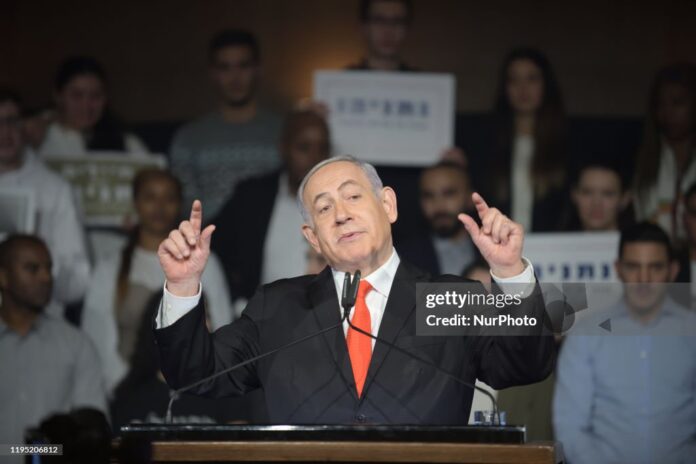
Addressing supporters of his Likud party shortly after 3 a.m., Netanyahu seized on the results to call for the establishment of a strong national government dominated by right-wing parties.
He also used his victory speech to underscore Israel’s military achievements and signal the possibility of further coordinated action against Iran with US President Donald Trump. Netanyahu argued that the two allies were facing a rare opportunity to eliminate what he described as the Iranian threat permanently.
Trump, who had openly campaigned for Netanyahu’s continued leadership, had urged Israeli voters to keep him in office so they could complete their military objectives against Iran. Reacting to the election projections, the US president praised Netanyahu’s performance and maintained that his public endorsement had significantly strengthened the Israeli leader’s electoral position.
Opposition Struggles as Political Tensions Deepen
Eisenkot acknowledged that Netanyahu was likely to remain caretaker prime minister but cautioned against the possibility of the incumbent using the country’s security challenges to advance his political interests.
He urged senior security officials and civil servants to maintain their independence, arguing that Netanyahu was continuing in office without a fresh parliamentary mandate or an explicit expression of public confidence.
Netanyahu’s office has previously rejected allegations that the prime minister is exploiting the conflict with Iran for political advantage. His office did not immediately respond to a request for comment on Wednesday.
The prospect of prolonged political uncertainty, compounded by a caretaker administration without a parliamentary majority, unsettled Israeli financial markets. The shekel weakened by approximately 1.6% to 3.10 against the US dollar, while the benchmark TA-35 and TA-125 stock indices both declined by more than 3%.
Beyond the immediate political calculations, the results highlighted the continued movement of Israel’s Jewish electorate towards the right after years of Netanyahu’s dominance. Once a powerful political force during the country’s first decades, the centre-left has been reduced to a relatively marginal presence.
Opposition to the creation of an independent Palestinian state has also become increasingly widespread among Jewish political parties, reflecting a significant departure from the internationally backed peace initiatives that shaped negotiations from the 1990s.
War and International Isolation Shape Election Outcome
The election was Israel’s first since the October 7, 2023, attacks, when Hamas-led fighters killed approximately 1,200 people and abducted 251 others, triggering a series of devastating conflicts involving Gaza, Lebanon and Iran.
Israel’s subsequent military campaign in Gaza has devastated much of the territory and killed approximately 74,000 Palestinians, according to Gaza health authorities. The scale of the destruction has intensified international criticism of Israel and contributed to its growing diplomatic isolation.
Netanyahu is also facing mounting legal and political pressure. The International Criminal Court in The Hague has issued an arrest warrant for him over alleged war crimes, accusations he has strongly rejected. Separately, he remains embroiled in domestic corruption proceedings, which he has repeatedly dismissed as politically motivated efforts by establishment figures to undermine his leadership.
Voter participation reached 77.7%, the highest level in more than two decades, with particularly strong turnout among Israelis of Palestinian descent, who constitute more than one-fifth of the country’s population.
Many Arab voters were mobilized by what they regard as increasingly hostile rhetoric and discriminatory policies from Netanyahu’s governing coalition, which includes a party leader previously convicted of inciting racial hatred against Arabs.
The strong turnout was reflected at the headquarters of the Joint List, an alliance of several Arab political parties, where supporters erupted in celebration as exit poll projections emerged.
Faten Gattas, a Joint List candidate, said the alliance remained committed to challenging occupation and racial discrimination while asserting the political presence and rights of Arab citizens within Israel.
Arab Parties Emerge as Potential Kingmakers
The projected 19 seats for Arab parties represent an unprecedented parliamentary showing and could complicate efforts to establish a stable government.
An earlier coalition that succeeded in removing Netanyahu from power depended on the support of a small Arab party. However, Eisenkot’s weaker-than-expected performance means that any comparable attempt to assemble an alternative government would now require support from the Joint List itself.
Such an arrangement would face substantial political resistance, given the longstanding reluctance of mainstream Jewish political leaders to form formal governing alliances with Arab parties since Israel’s establishment.
The election therefore leaves Netanyahu with a clear political advantage, even without a parliamentary majority, while exposing the opposition’s difficulty in building a viable alternative.
With negotiations ahead and the possibility of another election still looming, Israel faces an extended period of political uncertainty under a caretaker leader whose grip on power remains considerably stronger than his opponents had anticipated.