

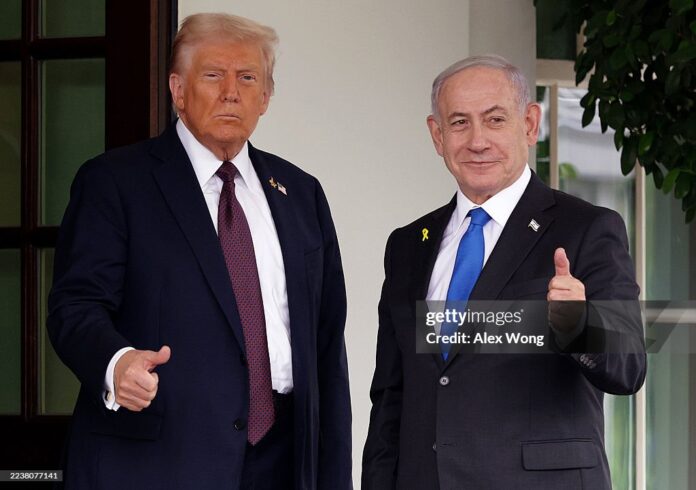

Washington’s money is not charity. It is leverage, access and strategy. Donald Trump’s announcement that the United States will end roughly $4 billion in annual military assistance to Israel by year’s end marks a historic turn in a relationship long treated as untouchable. Trump says he and Prime Minister Benjamin Netanyahu agreed that Israel no longer needs the support and can finance its own defence. The message: a wealthy, technologically advanced ally should not depend indefinitely on American taxpayers. But an announcement is not implemented policy. The terms remain unpublished, Netanyahu’s office has not confirmed them and Congress controls appropriations.
The framework is a ten-year memorandum signed in 2016, covering fiscal years 2019-2028. It envisages $38 billion: $33 billion in Foreign Military Financing and $5 billion for joint missile-defence programmes, subject to congressional appropriation. That means $3.3 billion in annual weapons financing and $500 million for missile defence, not a simple $4 billion cash transfer. The arrangement expires in 2028, so Trump’s timetable would accelerate its end. Congress can appropriate, alter or withhold funds. Ending grants would not automatically end arms sales, intelligence sharing, joint research or diplomatic coordination.
Israel Can Pay. But Can It Replace the System?
There is a powerful case behind Trump’s argument. Israel is not a fragile client state. It has a sophisticated defence industry, a high-income economy and the capacity to mobilize resources under pressure. The Stockholm International Peace Research Institute estimates Israel spent $48.3 billion on its military in 2025 or 7.8 per cent of GDP. Its Defence Ministry says exports reached a record $19.2 billion that year, nearly 30 per cent above 2024. Israeli firms produce drones, missiles, sensors, cyber capabilities, air-defence systems and electronic-warfare technologies used worldwide.
Those figures make self-financing plausible, not painless. American assistance equals nearly eight per cent of Israel’s 2025 military expenditure. Replacing it would require higher taxes, borrowing, cuts or procurement changes. Fiscal pressure is substantial: the Bank of Israel estimates the war begun after 7 October 2023 will cost about 350 billion shekels across 2023-2026, excluding later decisions connected to the 2026 campaign against Iran. Autonomy also has a supply-chain dimension. Israel can design advanced systems, but relies on American platforms, components, munitions, maintenance and technologies not quickly replicated domestically.
The F-35 illustrates dependence. Israel operates the American stealth fighter and relies on a US-controlled ecosystem for upgrades, parts and technical support. Assistance helped finance advanced aircraft purchases. The relationship is more than a cheque: it provides access to the US defence-industrial system, interoperability and technology. Trump says Israel can continue buying American weapons. But market-price purchases are not grants. The transition could raise costs and force choices between readiness, modernization and domestic production.
The Regional Balance Will Shift
For Israel’s adversaries, the announcement may suggest that the alliance is becoming more conditional. Iran and its regional partners could conclude that Washington is less willing to underwrite Israeli operations. The Stockholm International Peace Research Institute (SIPRI) estimated Iran’s military expenditure at $7.4 billion in 2025, far below Israel’s $48.3 billion; yet spending comparisons omit Iran’s missile arsenal, asymmetric networks and purchasing power. The balance also depends on intelligence, air superiority, missile defence and the prospect of American intervention. Uncertainty over assistance can nevertheless affect deterrence, which rests partly on perceptions of commitment.
Missile defence is an immediate concern. The $500 million annual component supports cooperative programmes, including systems designed to intercept rockets and missiles. Israel’s layered architecture. Iron Dome, David’s Sling and Arrow, grew through extensive American-Israeli cooperation. A cut would not switch off the systems, but could slow replenishment, upgrades and joint development. After conflict involving Gaza, Lebanon and Iran, that is no theoretical risk. Israel can spend more domestically, but the burden rises while threats remain multi-front and expensive.
Regional capitals will also read the signal. Arab governments that have normalises or considered normalizing relations with Israel will ask whether Washington is retreating from regional security or simply changing its financing model. Some may welcome a more self-reliant Israel; others may fear that a government paying more of its own bills will feel freer to take military risks. Gulf partners will assess whether American commitments are becoming more transactional. Washington must reassure them that ending one aid stream does not mean abandoning the region.
Washington’s Leverage and the Price of Distance
There is a domestic political calculation. US support for Israel has become more divisive since the Gaza war. Trump frames aid as costly and politically exploitable by Democrats. Ending it lets him claim to protect American resources while preserving arms sales. But the move risks turning a bipartisan commitment into a partisan instrument. A future Congress or administration could reverse it. Israel may hedge by diversifying suppliers and expanding domestic production, reducing Washington’s influence over procurement and strategic choices.
For Washington, savings are real but limited. The $3.8 billion package is modest beside a US defence budget exceeding $900 billion. Aid’s value is not measured only in dollars: it sustains interoperability, supports American manufacturers, strengthens intelligence cooperation and gives Washington influence over a key ally. Continued Israeli purchases preserve commercial benefits, but grants carry leverage that ordinary sales do not. Washington could spend less and influence less.
This is therefore the opening of a negotiation, not proof of a strategic divorce. The questions are what ends on 31 December, whether Congress approves the change, how missile-defence cooperation is funded and whether emergency support remains available. Netanyahu may welcome the symbolism of independence, but Israel must weigh the cost of replacing subsidized access with full-price procurement. Trump can present the move as ending American responsibility for an affluent ally. The deeper test is whether both governments preserve the alliance’s operational substance while changing its financial terms.
Israel may be wealthy enough to pay more of its defence bill. It cannot replace the American strategic ecosystem. Washington need not finance Israel indefinitely to remain its indispensable partner. The danger is mistaking a funding adjustment for a harmless transaction. In the Middle East, alliances are measured not simply by spending, but by what adversaries believe partners will do when the next regional crisis comes.