

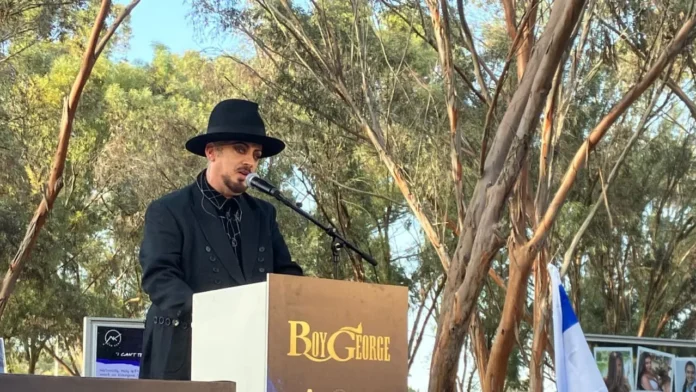

British pop icon Boy George has reaffirmed his support for Israel, declaring that music must offer hope and belonging as he prepares to perform his song ‘We Will Dance Again’ in a country still grappling with the October 7 massacre.
British singer Boy George has taken his message of solidarity with Israel directly to the site of the October 7, 2023, Nova music festival massacre, describing his visit as a deeply moving experience and defending his decision to stand publicly with Israelis and the Jewish community despite growing international pressure on artists to boycott the country.
Speaking at a press conference on Tuesday at the massacre site in Re’im, the Culture Club frontman reflected on the reception he had received since arriving in Israel on Saturday. He said the gratitude directed towards him was overwhelming, given that he considered his position a straightforward expression of human solidarity rather than an extraordinary act of courage.
The singer is scheduled to perform in Tel Aviv on Wednesday and Saturday, November 7. Both performances will feature his recently released song, We Will Dance Again, whose title has become a rallying cry for survivors of the Nova massacre, where more than 360 festivalgoers were killed and dozens abducted by Hamas on October 7.
The song confronts accusations against Israel head-on. Its opening lyrics deliberately challenge the use of the word genocide to describe Israel’s military campaign, while a later passage delivers an unequivocal declaration of solidarity with Jewish people. Boy George said he had no intention of concealing the political message behind the composition, explaining that its purpose was to confront the hostility and misinformation he had witnessed since the massacre.
The visit and concerts were organized by Sylvan Adams, president of the World Jewish Congress Israel, who described the singer’s decision to travel to the country as particularly significant at a time when several international entertainers have distanced themselves from Israel or supported cultural boycotts.
Adams said Boy George’s presence sent an important message to Israelis and survivors who have felt increasingly isolated amid international criticism. He also announced that 1,500 tickets for the November 7 performance, dedicated to the Nova community, had been allocated to massacre survivors and their families through an arrangement with the Museum of Tolerance Jerusalem. The concert will include a special appearance by DJ Ofer Nissim.
The Tribe of Nova Foundation, represented at the gathering by survivor Ofir Amir, and Israel’s Foreign Ministry also supported the singer’s visit and the concert programme. Adams praised the determination of the Nova community to rebuild their lives, insisting that the tragedy would not extinguish its connection to music, celebration and collective identity.
The emotional significance of the occasion was underscored by Omer Shem Tov, who served as master of ceremonies. Abducted from the Nova festival, Shem Tov endured 505 days in Hamas captivity before his release. He described Boy George’s decision to visit Israel as an act of conviction at a time when publicly expressing support for the country had become increasingly controversial.
Shem Tov said the singer could easily have avoided the controversy by remaining abroad, but his willingness to travel to Israel demonstrated a genuine commitment to standing with the Jewish people. He also reflected on returning to the massacre site for the second time since his release, describing the location as a place where profound grief coexists with an enduring sense of hope and human connection.
For Boy George, the visit carried particular weight because it followed an earlier encounter with survivors’ experiences at the Nova exhibition in London. He said seeing the memorial site and listening directly to those affected had given him a deeper understanding of the emotional and spiritual dimensions of the tragedy.
The singer described the site as a powerful testament to the process of healing, while acknowledging that outsiders could never fully comprehend the emotions of those who had experienced the massacre. He said the resilience visible among survivors was an important part of what made the visit so affecting.
Boy George explained that We Will Dance Again emerged partly from his reaction to comments made by musicians he knew who had expressed hostility towards Israel following October 7. Some of their responses, he said, had been deeply disappointing, although not entirely unexpected.
He recalled watching television coverage of the massacre as events unfolded and being horrified by the violence. Equally disturbing, he said, was the subsequent denial and dismissal of what had happened by people with no direct connection to the victims or the events.
The repeated use of genocide accusations against Israel also influenced his decision to address the issue through music. However, he said the song’s central message extended beyond challenging a particular political narrative. Its most important declaration was an explicit expression of support for Jewish people at a time when many felt increasingly vulnerable.
Having performed the song internationally, including at synagogues, Boy George said bringing it to Israel would give it a special significance. He intends to make it one of the defining moments of his performances, arguing that music should create an atmosphere in which people feel accepted, protected and valued.
The singer’s position is rooted partly in his own experiences of discrimination and social exclusion. Asked whether he could have anticipated becoming a prominent voice of support for Israel when he rose to international fame in the 1980s, particularly after appearing in Culture Club’s Karma Chameleon video wearing a T-shirt bearing Hebrew lettering, he said his younger self had little understanding of the cultural and political issues that would later shape his public outlook.
He recalled growing up in southeast London during the 1970s, when racism was widespread and the far-right National Front maintained a presence close to his neighbourhood. As a young punk rocker, he was frequently handed the organization’s propaganda leaflets, an experience that left him questioning why its supporters assumed he would identify with their ideology.
His experiences as a gay teenager who often felt rejected by mainstream society helped shape his opposition to prejudice. Boy George said he had developed a lasting affinity for people who were marginalized or treated as outsiders, having experienced bullying and exclusion himself.
He acknowledged that his early ambitions were largely centred on attracting attention through his unconventional appearance rather than making political statements. Nevertheless, the experiences of his youth had left him particularly sensitive to discrimination directed at vulnerable communities.
That perspective, he explained, informed his response to the atmosphere surrounding Jewish communities after October 7. He recalled receiving messages from Jewish friends in London who were increasingly anxious about their safety and uncertain about the hostility they were encountering.
Israeli friends also questioned why he had not spoken out earlier. Boy George said he had wanted to find a meaningful way to express his position rather than issue a routine statement on social media. The eventual decision to write and release We Will Dance Again provided that opportunity.
He has also confronted musicians whose public positions he considers unfair or hostile towards Israel. Asked whether he planned to engage with artists who had remained silent or criticized the country, he responded humorously that some had already blocked him.
But his criticism has not been limited to private disagreements. He said he had publicly challenged musicians whose comments he opposed, although most had declined to respond. Some of those disagreements had damaged relationships with artists whose work he had previously admired.
While acknowledging that he continued to appreciate their music, he said their public positions had altered how he felt about listening to it. He argued that hostility towards Israel had increasingly become a matter of social conformity, with some entertainers adopting prevailing opinions rather than examining the issues independently.
Boy George also drew a distinction between criticising the policies of an Israeli government and directing hostility towards an entire population. He said political disagreement should never justify condemning people collectively on the basis of information encountered through television networks or social media platforms.
Despite the attention surrounding his latest visit, the singer stressed that his relationship with Israel long predates the current controversy. He said he had travelled to the country many times over the years and had consistently felt welcomed, comfortable and accepted.
He also revealed that attempts to discourage him from visiting Israel were nothing new. Among the approaches he recalled was receiving a letter from Roger Waters, the Pink Floyd co-founder known for his anti-Israel activism. Boy George said he had simply discarded the correspondence.
His appearance at the Nova site also revealed the lighter side of a performer whose flamboyant personality has remained a defining feature of his career for more than four decades. During an earlier meeting with President Isaac Herzog, he had joked that his life was becoming increasingly Jewish, prompting questions at Tuesday’s press conference about whether he might consider converting to Judaism.
He dismissed the possibility with characteristic humour, suggesting that the process sounded too demanding for his temperament, although he joked that having a Jewish boyfriend could potentially change his thinking.
Adams also teased the singer about his transformation from a flamboyant young pop star into a more mature public figure, suggesting that he might consider replacing his stage name with Man George.
Boy George was having none of it. He said he intended to retain his familiar name, partly because continuing to be known as Boy George would irritate those who expected him to change.
For a singer whose latest work has placed him at the centre of an increasingly contentious international debate, the visit to Re’im was about more than a concert or a political statement. It was an opportunity to demonstrate solidarity with survivors, challenge what he regards as the distortion of October 7 and reaffirm his belief that music should bring people together rather than deepen divisions.