


China is not strengthening its relationship with Gabon merely to win another African friend. It is consolidating strategic access to minerals, expanding its geopolitical influence and deepening its security partnerships in a continent whose importance to global power competition is growing rapidly. The implications extend far beyond Libreville and Beijing.
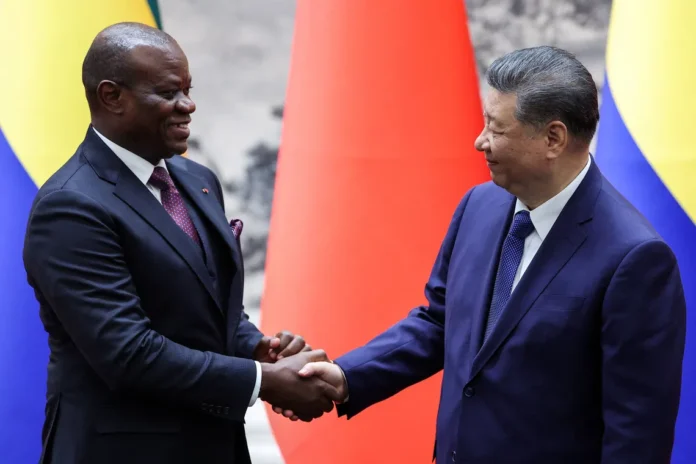
The November 6, 2026, agreement to strengthen bilateral relations, following talks between Chinese President Xi Jinping and Gabonese President Brice Clotaire Oligui Nguema in Beijing, represents an important development in China’s engagement with Central Africa. Both governments have committed themselves to expanding cooperation, particularly in mining, defence and security, alongside trade, education and public health. They have also pledged closer political, governmental, legislative and institutional exchanges. The significance lies not simply in the diplomatic language, but in the strategic interests underpinning it.
For China, Gabon offers something increasingly valuable: access to critical natural resources, an established diplomatic relationship and a strategically positioned Atlantic-facing partner. Diplomatic relations date to April 20, 1974, while the partnership was elevated to a comprehensive strategic cooperative partnership in April 2023. The latest engagement therefore builds on more than five decades of relations rather than inaugurating an entirely new alignment.
The timing also matters. Africa has become an increasingly important arena for competition among China, Western powers, Russia, Turkey and Gulf states. Beijing’s approach combines investment, trade, infrastructure, political engagement and security cooperation. Unlike conventional military alliances, this model creates influence through multiple channels, making economic relationships instruments of long-term geopolitical positioning.
Gabon, meanwhile, is seeking investment, industrialization and diplomatic partners as it navigates its post-2023 political transition. Its leadership needs external capital and international relationships capable of supporting economic transformation. China is positioning itself as a partner willing to engage without making political conditionality the centrepiece of cooperation. That proposition carries considerable appeal, although it should not be confused with an absence of Chinese strategic interests.
Minerals and the Battle for Supply Chains
Mining is the partnership’s most consequential economic pillar. The United States Geological Survey reports that Gabon was the world’s second-largest manganese producer in 2024, accounting for about 25 per cent of global output. China received 38 per cent of Gabon’s manganese ore exports, equal to the European Union’s share; India received 13 per cent. Beijing’s interest is therefore rooted in a substantial existing supply relationship.
Manganese is essential to steel production and increasingly relevant to battery supply chains. As major economies compete for materials underpinning infrastructure, manufacturing and electrification, access to producers becomes a strategic advantage. Chinese companies already hold interests in Gabonese mining, including the M’Bembele operation. Expanded cooperation could extend Chinese influence across extraction, processing and logistics. Yet Gabon’s challenge is to convert mineral wealth into broad-based development. The World Bank says oil, manganese and timber represented 97 per cent of exports in 2024. It estimated growth at 2.9 per cent that year, with more than one-third of Gabonese living in poverty and unemployment at 20 per cent of the workforce. Export concentration leaves the economy vulnerable to commodity-price swings.
Libreville therefore needs more than extraction. It needs local processing, technology transfer, skilled jobs, infrastructure and reliable public revenues. Gabonese officials have already advocated a mining model focused on domestic transformation, training and technology, identifying manganese and gold as priorities in September 2026. For China, processing capacity in Gabon could diversify supply chains and secure industrial inputs. For Gabon, the opportunity is to negotiate value addition rather than remain a supplier of raw materials. The success of this partnership will depend on transparent contracts, local-content rules, measurable benefits, environmental safeguards and the state’s ability to regulate investors.
Defence, Security and the Atlantic Equation
The joint statement commits both countries to stronger cooperation in peace and security, including exchanges between armed forces, law-enforcement bodies and security agencies; however, the announcement does not establish a Chinese military base, mutual-defence treaty or formal alliance. Nevertheless, security relationships can create strategic influence without permanent military deployments, as training, equipment, intelligence exchanges and policing technology help build institutional ties. Gabon’s official account of the visit also reported agreements with Huawei on smart public-security technologies and digital modernization, raising important questions about data protection, cybersecurity and sovereign control.
Gabon’s Atlantic coastline places it within the wider Gulf of Guinea security environment, where piracy, maritime crime, illegal fishing and trafficking threaten shipping and coastal economies, while instability across parts of the Sahel and Central Africa adds further cross-border pressures. Better maritime awareness, border management and professional training could therefore address genuine national security needs. China’s security engagement in Africa includes arms sales, military training, peacekeeping and naval diplomacy. In September 2024, its hospital ship Peace Ark visited Gabon during the Harmony-2024 mission and provided medical services, illustrating Beijing’s combination of military and humanitarian engagement, although this does not constitute evidence of a permanent foothold.
Western governments and other partners will closely monitor whether this cooperation remains focused on capacity-building or develops into strategic dependence. Gabon’s best protection lies in sustained strategic diversification: cooperating with China where useful, maintaining African institutional partnerships and preserving balanced external relations under clear national oversight.
Africa’s Stakes
The agreement reinforces Beijing’s position in Central Africa and signals its determination to sustain high-level engagement through political transitions. With China-Gabon trade reaching 25.91 billion yuan in 2024, according to China’s foreign ministry, the relationship carries growing economic and strategic weight. African governments should neither reject Chinese investment nor treat it as a substitute for Western capital, but negotiate strategically to protect their interests.
The African Continental Free Trade Area offers a framework for linking mineral production to regional manufacturing, allowing Gabon to leverage Chinese finance and technology to develop processing capacity that serves African markets rather than simply exporting unprocessed resources. However, these opportunities are not automatic, as mining can lead to environmental damage, opaque contracts, debt exposure and limited local employment when institutions are weak. Similarly, while security technology can improve public safety, its use without proper oversight can threaten privacy and civil liberties. Therefore, Gabon should insist on transparent procurement, parliamentary scrutiny, independent environmental assessments, local employment targets and the public disclosure of revenues and financial obligations.
The November 6 declaration is a strategic signal, not proof that these outcomes are secured. Its value will be measured by implementation: whether minerals generate domestic industries, security cooperation protects citizens without compromising sovereignty and ordinary Gabonese people see tangible gains. China gains a stronger relationship with a resource-rich Atlantic state; Gabon gains investment prospects and wider diplomatic options. The danger is asymmetry, when access to resources and technology grows faster than the capacity to govern the relationship.
For Africa, the larger test is whether partnerships with global powers drive structural transformation or reproduce external extraction. Gabon has opened a consequential door in Beijing. The task now is to ensure that the benefits flow both ways.