

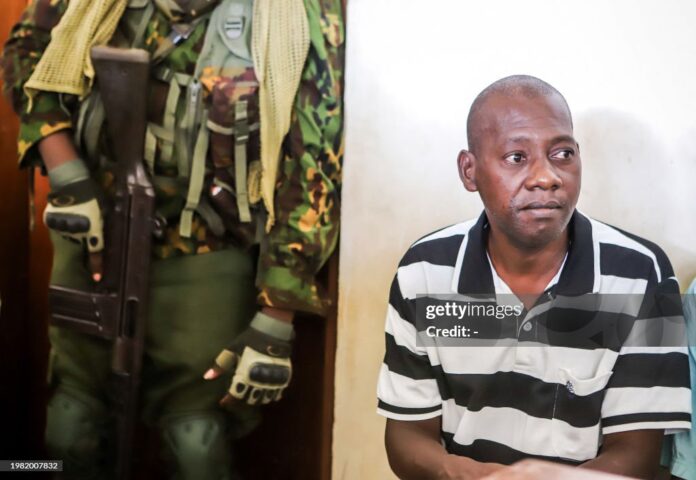

A Kenyan court has sentenced self-proclaimed preacher Paul Mackenzie to 200 years in prison for orchestrating the starvation deaths of 190 children in one of the country’s most horrifying religious cult scandals, in which hundreds of bodies were discovered buried in a forest.
Justice Diana Kavedza handed down the sentence on Friday, imposing 100 years for murder by starvation and another 100 years for direct homicide. The ruling followed a trial that exposed the systematic abuse, torture and killing of followers who had been persuaded that dying through starvation would secure their passage to heaven.
Mackenzie, who led an apocalyptic Christian movement in Shakahola Forest near the coastal town of Malindi, allegedly instructed his followers to stop eating and drinking, including forcing their children to undergo the deadly ritual ahead of what he portrayed as the end of the world.
The court established that his followers were subjected to violence and intimidation to ensure compliance. Victims who attempted to abandon the fast or obtain food and water were reportedly beaten, restrained and confined in makeshift fasting centres.
Delivering the judgment, Kavedza described Mackenzie as a manipulative religious figure who exploited the trust of vulnerable followers, using his charismatic media presence to draw them into his extremist beliefs.
She highlighted the devastating impact on children, many of whom witnessed their brothers and sisters die after days without food. Others were reportedly tortured and locked away after attempting to obtain provisions.
The remains recovered from Shakahola painted an even more disturbing picture. Investigators found severely emaciated bodies in shallow graves and abandoned latrines, while evidence indicated that some victims had been buried alive.
Mackenzie, dressed in a grey polo shirt and black trousers, remained expressionless as the sentence was announced at a temporary courtroom erected outside the main court premises. He had denied responsibility for the deaths, insisting that he never compelled his followers to starve. The judge dismissed his defence.
Twenty-eight co-accused were also convicted last month and handed prison terms ranging from 10 to 160 years. Their lawyer, Lawrence Obonyo, who represents Mackenzie and nearly all the convicted defendants, confirmed that the defence intended to challenge the verdict and sentences on appeal.
The case erupted into national and international outrage in April 2023, when police began exhuming bodies from Shakahola Forest. Although Friday’s proceedings concerned the deaths of 190 children and one adult, the Kenya National Commission on Human Rights says 448 bodies were eventually recovered from the forest.
The suspected death toll could reach 500. Mackenzie faces separate allegations that he ordered the deaths of another 52 people discovered at a different site in a village approximately 30 kilometres away. He has denied the charges in that case.
The scale of the atrocities has drawn comparisons with some of the world’s deadliest cult massacres, including the 2000 doomsday cult killings in Uganda, which claimed more than 700 lives, and the 1978 Jonestown massacre in Guyana, where more than 900 people died after an American cult leader directed followers to consume poison.
For families of the victims, however, the judgment offered little comfort against the magnitude of their loss.
Stephen Mwiti, 48, who lost six children to the cult and whose wife was among those convicted, said his wife had taken their children to Shakahola, where they were starved to death. He questioned how religious beliefs could ever justify subjecting innocent children to such suffering.
Mwiti said no punishment could restore the children he had lost, but expressed hope that Mackenzie would receive a sentence severe enough to ensure he could never again endanger lives.
The tragedy also devastated Mackenzie’s own family. His son, Dan Mackenzie, said he escaped the killings after abandoning his father’s religious movement because he no longer believed its teachings. He also lost friends and a younger brother in the Shakahola massacre, describing the court’s decision as a measure of justice for those who never returned.
Questions about the authorities’ failure to prevent the killings have remained central to the scandal. Mackenzie had attracted police attention as far back as 2017, when officers searched his premises. Two years later, authorities shut down his church in Malindi, prompting him to relocate his operations to Shakahola Forest.
The subsequent discovery of hundreds of bodies triggered widespread demands for stricter regulation of religious organizations. In May 2023, President William Ruto established a task force to examine the country’s legal and regulatory framework governing religious institutions. Separate government-backed and Senate proposals followed in 2024, but neither has yet become law.
Human rights advocates say prosecuting Mackenzie and his associates is only part of the accountability required.
Ojiro Odhiambo, head of rapid response at the Kenya Human Rights Commission, argued that the investigation should also examine the conduct of local administrators, police officers, intelligence agencies and religious authorities who allegedly failed to respond to repeated warning signs.
Justice Kavedza similarly criticized the institutional failures that allowed the killings to unfold, urging parliament to introduce safeguards capable of preventing another tragedy.
Ruto had previously acknowledged the government’s failure to protect the victims, accepting presidential responsibility for the state’s inability to stop the deaths.
Despite Friday’s landmark sentence, the wider Shakahola scandal remains unresolved, with further criminal proceedings and questions over institutional accountability continuing to cast a shadow over one of Kenya’s darkest chapters.