

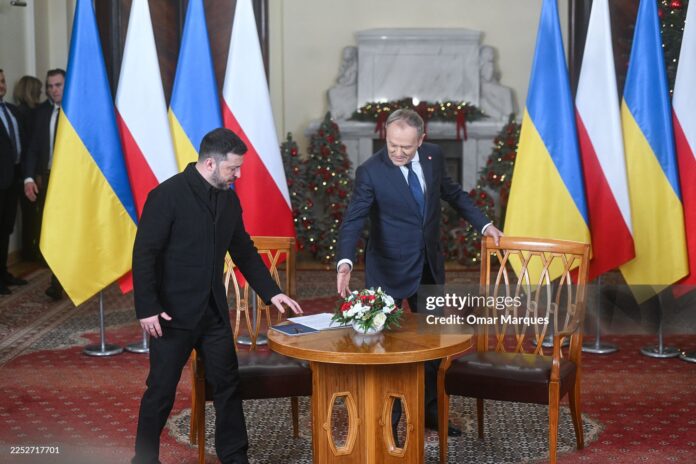

The geography of a peace deal matters as much as its signatures. A settlement that silences countries closest to Russian power may stop the guns in Ukraine while planting the conditions for another European war. That is Warsaw’s blunt warning. Polish Foreign Minister Radosław Sikorski says Western Europe must not negotiate with Moscow over the heads of eastern Europeans. His argument is not that Poland deserves a veto or that diplomacy should stop. It is that excluding the region most exposed to the consequences of the war would be strategically reckless and potentially dangerous.
Speaking to journalists in Warsaw on November 5, Sikorski argued that Eastern Europe and Scandinavia, representing approximately 120 million people, cannot be excluded from discussions. Finland, Norway and the Baltic states border Russia, while Poland shares borders with both Russia and Ukraine. Prime Minister Donald Tusk reinforced the warning, urging European leaders to scrutinize Vladimir Putin’s intentions rather than mistake a US-led diplomatic process for evidence that Moscow genuinely wants peace. Trilateral technical talks involving Ukraine, Russia and the United States are scheduled to resume in Abu Dhabi next week, with wider European discussions also being prepared.
The significance of Poland’s intervention extends beyond diplomatic representation. It exposes a fundamental disagreement within Europe over who should determine the conditions of peace and whose security calculations should shape the continent’s future.
Eastern Europe
For Poland and the Baltic states, the war is not a distant contest managed through diplomatic communiqués but a direct security crisis. Poland borders Ukraine and Russia’s Kaliningrad exclave, while Belarus, whose territory Moscow used to facilitate its invasion, lies along Poland’s eastern frontier. Finland and the Baltic states also face Russia across land or maritime borders. These countries must contend with Russian military deployments, airspace incursions, sabotage, cyber operations, disinformation and the possibility that a ceasefire could give Moscow time to rebuild its military capabilities.
Tusk has warned that Russia’s threat is growing, with Poland and the Baltic states potentially among the first targets of escalation. In September, he told parliament that Moscow could stage drone or missile incidents on NATO territory and portray them as accidents to weaken the alliance’s willingness to respond. Though this does not establish that an attack is imminent, it explains why eastern governments regard the terms of a settlement as matters of national survival rather than diplomatic detail. The region’s exposure is measurable. Eurostat reported that, at the end of July 2026, 953,060 people who fled Ukraine were under temporary protection in Poland, the European Union’s second-largest national host after Germany. Across the EU, the figure stood at 4.43 million.
Poland’s contribution is also operational. According to the Polish presidency, more than 95 per cent of donations from over 40 countries supporting Ukraine passed through the Rzeszów-Jasionka logistics hub in December 2025. Poland is therefore a strategic corridor for military assistance and a potential target for disruption. This strategic responsibility places Warsaw at the centre of European efforts to sustain Ukraine while protecting NATO’s eastern flank.
Warsaw has reinforced this responsibility through military investment. The Stockholm International Peace Research Institute (SIPRI) estimates that Poland’s military expenditure reached 4.5 per cent of GDP in 2025, the highest proportion among NATO members. The International Monetary Fund similarly records an increase from 2.2 per cent of GDP in 2021 to an estimated 4.5 per cent in 2025. Equipment spending alone reached 2.4 per cent of GDP. These figures demonstrate the scale of Poland’s preparations for a deteriorating security environment.
A Ceasefire Is Not a Security Order
The question is not simply whether fighting stops, but what European order follows. A ceasefire freezing Russian territorial gains, restricting Ukraine’s defence or leaving it exposed to renewed coercion could reward aggression. If Moscow concludes that force can redraw borders and win recognition, Moldova, Georgia and other vulnerable states will fear their sovereignty is negotiable. Eastern European governments remember the record. In December 2021, Moscow issued demands to Washington and NATO that would have sharply constrained alliance activity and reversed parts of Europe’s post-Cold War security settlement. Russia launched its invasion on February 24, 2022. For countries that had warned about Russian revisionism, the sequence reinforced a hard conclusion: assurances without credible deterrence are fragile. A new agreement must therefore be judged by whether it prevents another invasion.
That requires Ukraine’s consent, enforceable security guarantees, defensive capacity and a clear response if Russia violates the deal. Guarantees cannot be vague promises to consult later; they need defined commitments, monitoring, military support and consequences. Poland’s support for Ukraine’s NATO membership reflects its belief that durable security requires credible protection. Whether membership is attainable is a separate question, but guarantees cannot be dismissed. Nor should negotiators confuse the end of combat with the end of Russian coercion. Attacks on Ukraine’s energy infrastructure intensify civilian suffering during winter, while hybrid pressure against Kyiv’s supporters can continue after artillery falls silent.
A settlement that ignores sabotage, cyberattacks, disinformation, border provocations and energy leverage would leave Europe vulnerable below the threshold of open war. The end of active fighting, therefore, cannot be the only measure of success. Any agreement must address the broader security threats that could allow Moscow to continue undermining Ukraine and destabilizing Europe without returning to full-scale military confrontation.
Europe Must Speak with One Voice and Listen
The argument over who represents Europe is part of the security problem. Italian Prime Minister Giorgia Meloni complained to European Council President António Costa about fragmented negotiating formats and called for a unifying envoy. Sikorski agrees Europe needs legitimate representation, pointing to EU treaties under which the European Council president or foreign policy chief leads common foreign policy. He favours a process grounded in the Lisbon Treaty, potentially involving Britain. A continent unable to agree who speaks for it risks division. But unity must not become centralization. A European representative is useful only if states most exposed to Russian pressure shape the common position.
Western capitals bring diplomatic weight, economic leverage and military capabilities. Eastern and Nordic states bring frontline intelligence, operational experience and an understanding of deterrence failure. These are complementary assets, not competing claims to own Europe’s policy. Energy policy shows the danger of treating security as an afterthought. Reports that US interlocutors have floated restoring Russian gas flows have alarmed Warsaw. The European Commission says Russian gas accounted for 45 per cent of EU imports in 2021; by 2025 the share had fallen to 12 per cent.
Yet the European Court of Auditors says imports remained at 38 billion cubic metres in 2024, including increased LNG purchases. Renewed dependence would restore Kremlin leverage and undermine Europe’s diversification. This does not mean every European state must share Poland’s threat assessment or that diplomacy should be held hostage to maximalist demands. Negotiations are necessary; compromise may be unavoidable. But compromise cannot reward aggression, exclude Ukraine or ask states most exposed to Russia to accept risks designed elsewhere.
A settlement should include countries that will secure it, host its logistics and bear the consequences if it fails. The test is straightforward. Can Europe negotiate without surrendering eastern members’ security? Can it offer Ukraine peace without making renewed war more likely? Can it ensure Russia understands that a ceasefire is not permission to prepare another assault? Poland’s warning is not a demand for privilege. It is a reminder that peace negotiated over Eastern Europe’s head may prove no peace at all.