

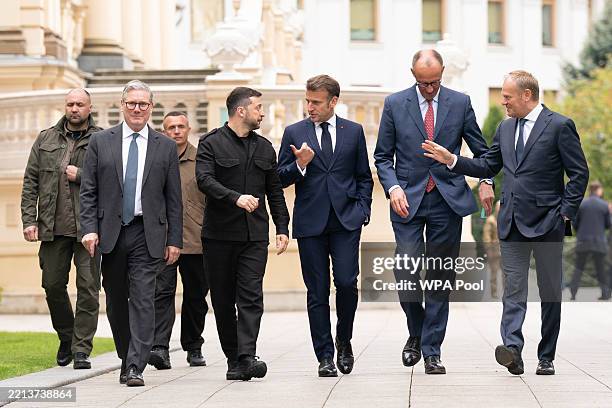

The Kremlin does not get to redraw Europe’s security map. Nor does Washington have the right to bargain over it as though the continent were an empty space between two great powers. That is the blunt message European leaders are sending after President Donald Trump floated a sweeping agreement with Moscow that could reach beyond Ukraine to “all of Europe”. Their resistance defends sovereignty and the principle that security choices cannot be settled over countries’ heads. That distinction separates a negotiated settlement from a coerced geopolitical settlement.
US-led trilateral negotiations involving Ukraine and Russia are due to resume in Abu Dhabi on November 10 and 11, the first such round since February. A settlement that silences the guns but grants Moscow a privileged voice over Europe’s future would not resolve the conflict. It would export its causes into the next decade.
The Proposal and the European Red Line
Trump’s November 5 remarks suggested a “very big” deal involving more than Ukraine, potentially the whole continent. His envoy Jared Kushner has described a broader framework built around permanent security consultations, crisis communications, military transparency, reciprocal steps to reduce escalation and a durable arrangement for European security. Such measures can reduce miscalculation between nuclear powers. The danger lies in the political context: Russia has repeatedly demanded limits on NATO’s presence and influence, and has sought a sphere of influence in which neighbouring states’ choices are constrained.
European officials have therefore drawn a clear distinction between discussing security with Russia and allowing Russia to dictate it. EU foreign-policy chief Kaja Kallas said Europe already has a security architecture, adding that Russia keeps violating the treaties underpinning it and that Vladimir Putin has no veto over European security. Polish Foreign Minister Radoslaw Sikorski warned that an arrangement about Ukraine and Europe reached “above our heads” would be impossible. Ukraine’s foreign minister Andrii Sybiha likewise argued that the priority must be protecting Europe from Russian aggression, not negotiating spheres of influence with the Kremlin. Any agreement requiring European states to change deployments, sanctions or alliance policy cannot be implemented without their consent.
History explains the suspicion. In December 2021, Moscow issued draft demands calling for NATO to halt enlargement, rule out Ukrainian membership and roll back aspects of the alliance’s military posture in countries that joined after 1997. Russia’s full-scale invasion in February 2022 made the stakes unmistakable. A state may debate its own security, but cannot claim authority over another’s alliances.
The Balance of Power Is Not Just Military
Europe’s insistence on a seat at the table is backed by material leverage. The European Union and its member states have mobilized €235.9 billion in overall support for Ukraine, according to the European Commission’s latest figures. That total includes €77.9 billion in military assistance measures, €121.7 billion provided or guaranteed through the EU budget and support for refugees and other needs. The EU has also agreed a €90 billion Ukraine Support Loan for 2026–27, with €60 billion earmarked for military assistance.
NATO’s 2025 annual report says European allies and Canada spent $574 billion on defence, equal to 2.33 per cent of their combined GDP and increased real spending by 20 per cent compared with 2024. The Stockholm International Peace Research Institute (SIPRI) estimates that military expenditure across Europe reached $864 billion in 2025, up 14 per cent in a year. Europe is not self-sufficient: the United States still accounted for 60 per cent of NATO’s combined nominal defence expenditure in 2025. But they show that European governments are investing heavily because they understand the threat and the cost of dependence.
The Council on Foreign Relations’ November 5 assessment says Russia still occupies roughly 20 per cent of Ukrainian territory and that the conflict has produced more than one million military casualties. The European Commission reports that 2,222 Ukrainian civilians were killed in the first eight months of 2026 alone, already exceeding the 2025 total. A ceasefire without credible monitoring, enforcement and rapid support for Ukraine could give Russian forces time to regroup, rearm and attack again.
Abu Dhabi’s Test
The immediate diplomatic challenge is to bridge incompatible positions. Kyiv wants robust, written guarantees against another invasion and refuses to accept decisions made without Ukraine. Moscow continues to press territorial claims and has resisted arrangements that would leave Ukraine securely anchored to the West. The United States wants a breakthrough before winter, but speed is not the same as durability. If Washington treats European objections as an inconvenience, it risks producing a document that lacks the political backing, resources and institutional machinery required to survive its first crisis.
Its governments remain divided over representation, the balance between national capitals and EU institutions, and how much responsibility they are prepared to assume if American support weakens. Britain, France and Germany may provide a diplomatic core, but eastern-flank states cannot be treated as an afterthought. A workable process must include them in a structured way, not merely brief them after Washington and Moscow have struck a bargain.
That does not mean excluding Russia from negotiations. Ending a war requires talking to the aggressor, and nuclear risk requires channels even without trust. But dialogue must be reciprocal and anchored in international law. Any discussion of force posture should be transparent, verifiable and matched by Russian steps, including respect for Ukraine’s sovereignty and a credible end to attacks. No agreement should trade away the rights of non-participants or turn NATO membership into a bargaining chip controlled by Moscow.
The measure of Abu Dhabi will not be whether leaders announce a historic breakthrough. It will be whether they establish a process that protects Ukraine, involves Europe and makes renewed aggression more costly than restraint. Washington can convene. Moscow can negotiate. Neither can own the outcome. Europe’s message is therefore essential: peace is welcome, but a peace imposed through great-power privilege is merely an armistice with a longer fuse. The continent’s future belongs to its sovereign nations, not to the Kremlin, and not to any deal made without them.