

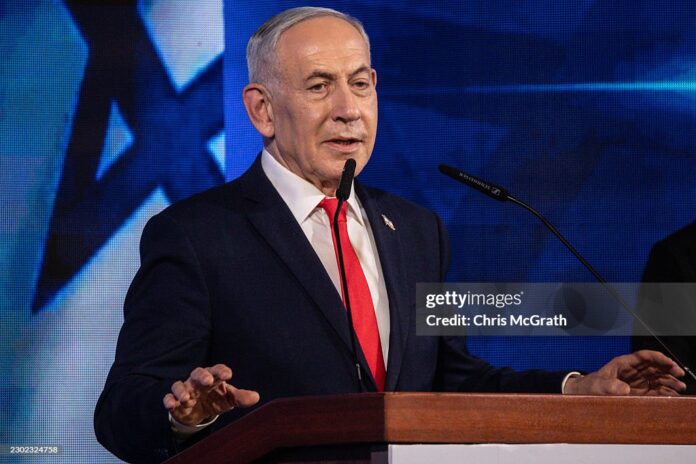

Israel’s security is not an abstraction, and the threats confronting it are not campaign inventions. Hamas massacred approximately 1,200 people on October 7, 2023, and abducted more than 240 others. The assault exposed the catastrophic cost of misjudging an enemy committed to Israel’s destruction. It also reinforced a basic responsibility of any Israeli government: never allow political convenience to compromise the country’s capacity to defend its citizens.
That is the context for Benjamin Netanyahu’s warning that an administration dependent on parties he describes as supporters of Islamist extremism could be unable to confront Hamas, Hezbollah and Iran. His language is politically charged, but the underlying question is legitimate. Can a government prosecute a sustained security strategy if its survival depends on legislators who reject central elements of that strategy, refuse to identify Israel’s enemies as terrorist organizations or question the state’s Jewish character?
The October 27, 2026 election has made that question urgent. Official results give Likud 27 seats, Netanyahu’s bloc 53, the opposition bloc led by Gadi Eisenkot 48 and Arab-led parties 19 in the 120-member Knesset. A government needs 61 seats. The Arab parties’ unprecedented parliamentary weight therefore gives them potential leverage over government formation. Turnout was approximately 78 per cent, underscoring the election’s significance.
The Strategic Stakes Are Enormous
Israel faces a connected network of threats, not three unrelated security problems. Hamas has demonstrated its willingness to target civilians, use hostages as leverage and embed military infrastructure in densely populated areas. Hezbollah possesses a substantial arsenal of rockets and missiles. Iran supplies, funds or supports armed groups across the region and has pursued nuclear capabilities that Israeli leaders regard as an existential danger.
Yet their strategic relationship matters. Tehran’s regional network gives it ways to pressure Israel without relying exclusively on direct confrontation. Hezbollah’s arsenal creates a serious threat to cities and critical infrastructure; Hamas’s October 7 attack demonstrated the consequences of allowing a heavily armed organization to build power beyond Israel’s borders. A government that cannot agree on the nature of these threats risks sending mixed signals to adversaries and allies alike.
Netanyahu’s insistence that Israel must retain freedom of action is therefore not inherently extremism. It reflects the experience of a state that has repeatedly faced wars, terrorism, rocket attacks and threats to its existence. The government’s first obligation is to protect Israeli lives. That obligation includes maintaining intelligence cooperation, military readiness, border security, missile defence and the ability to act against imminent threats.
Coalition Arithmetic Must Not Override Security Commitments
The concern about parliamentary dependence should be assessed through conduct and evidence, not ethnic identity. Arab citizens are part of Israel’s political community, and their right to vote and serve in the Knesset is not in question. Nor should every Arab legislator be treated as an enemy. But democratic representation does not exempt any party from scrutiny of its positions on terrorism, national sovereignty and the security of the state.
The distinction between the two Arab-led lists matters. Ra’am, led by Mansour Abbas, previously supported the Bennett-Lapid coalition from 2021 to 2022, demonstrating that practical cooperation is possible. The Joint List contains different political currents, some of which oppose Israel’s definition as a Jewish state and take sharply critical positions on its military campaigns. So should any statements by individual politicians that appear to excuse violence, glorify terrorists or undermine the legitimacy of Israel’s existence.
The appropriate standard is clear and should apply universally: any party seeking influence over national security must unequivocally condemn attacks on civilians, recognize Hamas and Hezbollah as terrorist organizations, support the safe return of hostages and accept Israel’s right to exist and defend itself. These are not unreasonable ideological tests. They are minimum conditions for responsible participation in decisions affecting the lives of millions.
The opposition may argue that parliamentary support can be secured issue by issue without giving Arab parties control of defence policy. That possibility deserves examination. But a government sustained by votes from legislators who reject its core security doctrine would face a permanent credibility problem. Its enemies would test the gaps; its soldiers would need clarity, not ambiguity; and its allies would question whether commitments made by ministers could survive the next confidence vote.
Unity Must Strengthen Israel, Not Weaken It
Netanyahu’s call for a broad national government is strategically understandable. Israel needs a government capable of making difficult decisions over Gaza, the northern border, Iran, hostage recovery, military service and the country’s long-term defence. Such decisions require public trust and a durable parliamentary foundation. The 53-seat Netanyahu bloc cannot govern alone, while the 48-seat opposition bloc also lacks a majority. The 19 Arab-led seats make coalition negotiations consequential.
A serious analysis must nevertheless acknowledge that national unity should never become a shield against accountability. The October 7 disaster demands scrutiny of intelligence failures, political decisions and military preparedness. National security is strengthened when leaders learn from mistakes, explain their decisions and maintain public confidence. It is weakened when political accusations replace evidence or when legitimate criticism is dismissed as disloyalty.
The same principle applies to coalition partners. Israel should not be asked to dilute its defence posture to secure parliamentary votes. Nor should its Arab citizens be collectively blamed for the statements or conduct of particular politicians. The country’s strength rests on a capable military, resilient institutions, reliable alliances and a society confident enough to debate without surrendering its basic commitments.
The choice before Israel is not between security and democracy. It is between a government with clear, enforceable security principles and one whose survival could depend on partners unwilling to uphold them. Netanyahu is right to insist that the defence of Israel cannot be outsourced to political arithmetic. Any incoming government must demonstrate, publicly and unequivocally, that it will oppose terrorism, protect the country’s citizens and preserve Israel’s right to exist as the homeland of the Jewish people. In a region where hesitation can carry a terrible price, that is not a partisan demand. It is a national necessity, and protect democratic institutions.