

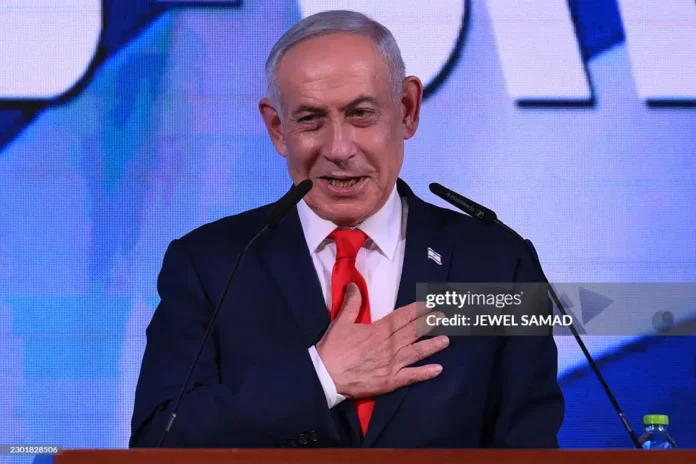

Israel cannot afford to gamble with its national security. That is the unmistakable message Prime Minister Benjamin Netanyahu has delivered amid an increasingly consequential political struggle over the formation of the country’s next government. His warning is stark: a government dependent on Islamist political forces that question Israel’s security priorities could weaken the country from within, undermine its ability to confront terrorism and compromise the protection of its citizens. This is not an ordinary disagreement over coalition arithmetic. It raises fundamental questions about national survival, political responsibility and the security obligations of any government entrusted with leading the Jewish state.
In a video statement on November 7, 2026, Netanyahu called for a national unity government, arguing that an administration dependent on parties he describes as supporters of terrorism would be incapable of confronting radical Islam. He warned that such an arrangement could tear Israel apart internally, just as the country continues confronting formidable external threats. His intervention followed the October 27 general election, which produced a deeply divided parliament and left neither major political bloc with an independent majority.
The stakes are considerable. Israel’s security environment remains exceptionally dangerous following the Hamas-led October 7, 2023, assault, subsequent military operations in Gaza and continuing confrontation with Iran and its regional proxies. In these circumstances, political fragmentation is more than an institutional inconvenience. It can undermine strategic consistency, weaken deterrence and complicate decisions involving military operations, intelligence cooperation and national defence. Netanyahu’s insistence that national security must take precedence over political calculations therefore deserves serious consideration.
The Coalition Question and Israel’s Security Dilemma
The immediate controversy concerns the potential parliamentary support of Arab-majority parties, particularly Ra’am, an Islamist-rooted political movement led by Mansour Abbas and the Joint List. Following the October election, the two Arab political formations secured approximately 19 of the Knesset’s 120 seats, giving them unprecedented influence in determining which political grouping can assemble a governing majority. Netanyahu’s Likud-led bloc was projected to hold 53 seats, while the opposition grouping led by former military chief Gadi Eisenkot was expected to secure 48.
This arithmetic explains Netanyahu’s alarm. A government dependent on parties whose positions on Hamas, Palestinian statehood and Israel’s military campaigns differ substantially from those of mainstream Zionist parties could encounter serious disagreements over essential security decisions. A government must possess the political authority and parliamentary cohesion to defend its citizens, particularly when confronting organizations committed to Israel’s destruction.
There are legitimate reasons to scrutinize the positions of prospective coalition partners. Ra’am is an Islamist party whose political programme includes Palestinian statehood, while its leader has faced criticism for declining to categorically describe Hamas as a terrorist organization. The Joint List, meanwhile, has maintained strong opposition to Israel’s policies in Gaza and Lebanon. Such differences cannot simply be dismissed when national security is involved.
Deterrence, Political Credibility and the Limits of Coalition
Israel’s security doctrine depends on credible deterrence, intelligence coordination and the capacity to make difficult decisions quickly. Hamas’ October 7 assault exposed failures in preparedness and threat assessment; the ensuing war demonstrated the national cost of strategic surprise. Israel cannot allow its next government to become paralyzed by disputes over whether its forces may act against organizations attacking Israeli civilians. Nor can it afford ambiguity about its right to defend its population against Iran and its regional proxies.
Netanyahu’s concern is therefore not merely ideological. If coalition partners cannot agree that Hamas must be defeated as a military and governing force, or cannot support Israeli soldiers, the government could face debilitating contradictions during a crisis. Eisenkot, a former Israel Defense Forces chief, has demanded assurances from potential partners, including recognition of Hamas as a terrorist organization and a commitment to dismantle its military and governing power.
Yet credibility requires precision. Ra’am participated in the Bennett-Lapid coalition in 2021, the first Arab party formally included in an Israeli governing coalition. The Israel Democracy Institute records that Ra’am won eight seats and 5.9 percent of the vote in 2026. Its previous participation does not prove every future arrangement is safe; equally, its Islamist identity alone does not establish that every supporter endorses terrorism. Netanyahu himself previously explored cooperation with Ra’am, complicating the present debate. Security assessments must examine conduct and commitments, not labels.
Unity Must Be Built on Security and Democratic Responsibility
The election demands political maturity. Arab parties won 19 seats, while Arab voter turnout reached 77 percent, up from 53.2 percent in 2022. These figures demonstrate democratic participation by citizens entitled to representation. Israel’s security cannot be strengthened by treating an entire community as suspect. The distinction is between legitimate participation and any organization that endorses violence, excuses attacks on civilians or obstructs the state’s defence.
That distinction sharpens Netanyahu’s central argument. No Israeli government should depend on partners unwilling to reject terrorism, recognize Israel’s right to exist or support the defence of its citizens. Any coalition agreement must establish clear commitments on Hamas, Iran, soldiers’ protection and border security. These must be obligations, not vague assurances offered to secure parliamentary votes.
President Isaac Herzog has given Eisenkot up to six weeks to form a government. A broad coalition of Zionist parties could avoid dependence on Arab factions, but would require compromise over ultra-Orthodox military service and accountability for the failures of October 7. National unity cannot mean immunity from scrutiny or preserving every existing coalition arrangement unchanged.
Israel’s enemies will exploit division. Netanyahu is right that a government unable to agree on fundamental security requirements would be dangerously exposed. But the strongest response is not indiscriminate exclusion or inflammatory generalization. It is a government whose members demonstrate through explicit commitments and consistent actions that Israel’s survival, democratic character and citizens’ safety come first.