

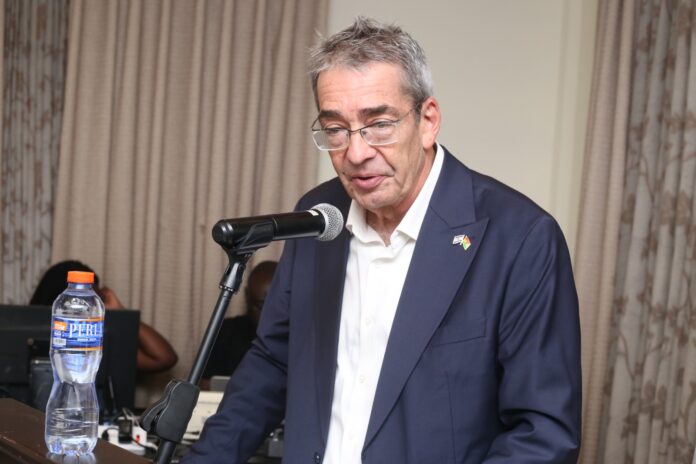

A country that fields its own citizens should not be casually equated with a power drawing foreign nationals into an invasion. That is the hard strategic point behind Israeli Ambassador Roey Gilad’s statement: “Unlike Russia, Israel can lean on its own forces and do not need to recruit Africans in general and Ghanaians in particular to fight their wars”. The wording is blunt, but the distinction is substantive: who supplies a war’s manpower, and whether foreign citizens are deceived or pressured into fighting. That is the essential distinction, and it deserves a fact-based defence.
Gilad is Israel’s ambassador to Ghana, Liberia and Sierra Leone, appointed in September 2024, and a career diplomat with more than three decades of service. The comparison is between Israel’s national military and Russia’s recruitment of Africans for its war against Ukraine. These are not equivalent systems.
The Evidence from Ghana Is Sobering
The most compelling evidence is not Israeli rhetoric. It is the human cost now being reported by Ghana’s own government. On February 27, 2026, Foreign Affairs Minister Samuel Okudzeto Ablakwa said that 272 Ghanaians were believed to have been lured into the Russia-Ukraine war since 2022; an estimated 55 had died and two were prisoners of war. The figures followed his Kyiv visit and discussions with Ukrainian officials. They are estimates, not a completed judicial accounting, but grave enough to demand attention. Reuters report reported the minister’s figures and noted Russia’s denial that it illegally recruits African citizens.
The scale extends beyond Ghana. On February 25, 2026, Ukraine’s Foreign Minister Andrii Sybiha said more than 1,780 Africans from 36 countries were fighting in the Russian army. This is a Ukrainian government estimate, not an independently verified census. Yet reports from African states and investigations point to recruitment through misleading job advertisements, intermediaries and online networks. The Africa Centre for Strategic Studies, citing leaked recruitment data, warns that the known total may understate the scale.
The alleged methods are especially troubling. Young men seeking construction, security, hospitality or logistics work have reportedly travelled to Russia believing they had civilian employment, only to find themselves channelled into military contracts or frontline service. Accounts describe confiscated passports, withheld wages and restricted movement. Not every foreigner in Russia’s armed forces was necessarily deceived; some may have enlisted voluntarily. That distinction must be preserved. But where deception or coercion is involved, the issue is not ordinary military recruitment. It is exploitation, potentially trafficking, with lethal consequences.
Israel’s Manpower Model Is Different
Israel’s defence structure is built around a national force and a large reserve system. The CIA World Factbook’s 2025 figures put the Israel Defense Forces at approximately 170,000 active-duty personnel and more than 400,000 reservists. The Israeli State Comptroller reported that about 318,000 citizens were called up during the first ten months after the October 2023 attacks. These figures show a substantial domestic mobilization base, though the system is not without strain. The Comptroller noted that reserve service rates among non-Arab residents aged 23 to 47 were only 11 per cent during that period, underscoring uneven participation and the burden placed on those who serve.
Israel’s system also rests on compulsory military service for most Jewish and Druze citizens, with important exemptions and differences in eligibility. It is therefore reasonable to say that Israel can draw on its own citizens and established reserves on a scale that makes the systematic recruitment of African nationals unnecessary. This is a statement about the structure of the state’s armed forces, not a claim that Israel has never accepted foreign volunteers or that every soldier is Israeli-born. The IDF has had “lone soldiers” who immigrate or volunteer from abroad. That is not a Russian-style pipeline recruiting African workers into an overseas war.
The comparison is not that Israel’s military conduct is beyond criticism. It is not. Israel’s operations in Gaza, civilian casualties, humanitarian access and compliance with international humanitarian law remain legitimate subjects of scrutiny and debate. Defending Gilad’s specific point is not a blank cheque for Israeli policy. Nor does possessing a domestic army automatically make a war lawful. The relevant question here is narrower: whether Israel relies on recruiting Ghanaians or Africans as expendable manpower. The available evidence does not establish such a practice.
A Principled Ghanaian Response
Ghana should approach this issue through sovereignty, human security and evidence, not reflexive geopolitical alignment. Accra can criticize Israeli policy where it believes international law has been breached and demand answers from Moscow over allegations that Ghanaians were manipulated into a war zone. Consistency is not neutrality between right and wrong. It is applying the same standards to every state.
The Ghanaian government’s reported figures should trigger practical action: stronger scrutiny of overseas job advertisements, public warnings about suspicious recruitment offers, investigation of brokers and online networks, consular support for families, and cooperation with foreign governments to identify missing, detained or deceased citizens. The International Labour Organization’s forced-labour indicators, deception, restricted movement, abuse of vulnerability and withheld wages, offer investigators a framework. Recruitment that begins with a false civilian job offer and ends in combat service deserves urgent examination.
Gilad’s statement is therefore defensible in its central comparison, provided it is read precisely. Israel has a large citizen-based military and reserve structure; credible reports indicate that Russia’s war effort has drawn African nationals, including hundreds of Ghanaians, through recruitment channels that Ghana’s foreign minister says involved deception. Russia disputes illegal-recruitment allegations; figures require verification. But Ghana’s reported deaths and captives cannot be dismissed as propaganda.
The issue is not whether Ghana must choose Israel over Russia. It must choose the safety and dignity of Ghanaians. No foreign power should treat African unemployment, ambition or vulnerability as a reservoir of disposable soldiers. On the evidence currently available, Gilad’s distinction is strategically meaningful and Ghana has compelling reasons to take it seriously.