

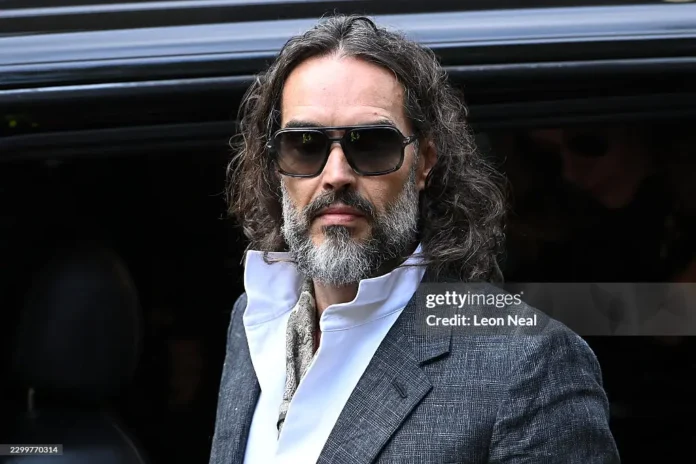

British comedian and former Hollywood star sentenced after jury finds him guilty of rape and three sexual assaults spanning five years.
British comedian and former Hollywood actor Russell Brand has been sentenced to 10 years and six months in prison after a jury convicted him of raping one woman and sexually assaulting three others in a series of attacks spanning five years.
The 51-year-old was sentenced on Monday at Southwark Crown Court in London, following his conviction last Thursday for offences committed between 2004 and 2009. Brand, who denied all the charges, will serve two-thirds of his sentence in custody before becoming eligible for release on licence.
Passing sentence, Judge Joel Bennathan condemned Brand’s conduct, describing him as a sexual predator who exploited his celebrity status and believed his fame placed him above the standards of behaviour expected of others.
The judge stressed that a woman’s clothing, whereabouts or alcohol consumption could never undermine her right to refuse sexual advances or seek justice when that right was violated.
Brand, who was standing in the dock as the sentence was delivered, mouthed a farewell message of love to his wife before being escorted to the cells.
Outside the court, Detective Superintendent Andy Furphy of the Metropolitan Police praised the four women for their determination to pursue justice despite the difficulties associated with confronting a powerful and internationally recognized public figure.
He said their willingness to come forward had helped secure the convictions and could encourage other survivors of sexual violence to report their experiences.
The sentencing comes as Brand remains under investigation over two additional alleged rapes, including one involving a girl who was 16 at the time. Metropolitan Police Commissioner Mark Rowley has also indicated that further complainants could emerge as the investigation develops.
Brand rose to prominence as a television presenter, attracting attention for his flamboyant appearance, outspoken personality and rapid-fire delivery. He subsequently established a Hollywood career, appearing in films including Forgetting Sarah Marshall, Get Him to the Greek and Arthur.
His personal life also attracted considerable public attention, particularly his marriage to American pop star Katy Perry. In more recent years, however, he distanced himself from mainstream entertainment and developed a substantial online following.
During the trial, which lasted four weeks, Brand acknowledged a history of what he characterised as irresponsible sexual behaviour but maintained that consent had always been central to his sexual relationships. He rejected allegations that he had engaged in non-consensual sex.
The jury ultimately convicted him of one count of rape and three counts of sexual assault. He was acquitted of two additional rape charges and one count of attempted indecent assault.
The verdicts brought a measure of vindication to the women whose allegations formed the basis of the prosecution, although their accounts highlighted the lasting psychological consequences of the encounters.
One complainant, who accused Brand of sexually assaulting her and subsequently orally raping her in 2004, described the experience as deeply traumatic. Although the jury convicted him of sexually assaulting her, it found him not guilty of the rape allegation.
Giving her account from behind a screen, she explained that the experience had left her carrying more than two decades of shame and repeatedly questioning whether she could have done anything differently to prevent the incident.
Another complainant, who was raped anally by Brand in 2009, said in a victim impact statement read to the court that the psychological effects of the assault continued to haunt her.
She explained that she had not reported the incident at the time because Brand’s celebrity, financial resources and public influence made her fear that her allegations would be dismissed and that she would not be believed.
Prosecutor Riel Karmy-Jones argued that Brand had used his celebrity status to exercise power over women, exploiting the influence and access that came with his position in the entertainment industry.
The case has intensified scrutiny of the British entertainment sector, particularly concerns about the protection of individuals who face sexual misconduct by influential figures.
Culture Secretary Lisa Nandy said the industry continued to grapple with serious problems involving sexual abuse, raising questions about accountability and the treatment of allegations against high-profile personalities.
Police and prosecutors, meanwhile, have emphasized that neither celebrity status nor the passage of time provides immunity from criminal investigation or prosecution.
David Roberts of the Crown Prosecution Service reiterated that allegations of rape and sexual assault would be treated seriously regardless of the accused person’s identity, influence or circumstances.
Brand’s conviction marks a significant legal reckoning for a once-celebrated entertainer whose career spanned British television, international film and comedy, and whose downfall has renewed debate about power, celebrity and accountability in the entertainment industry.