


Israeli ambassador acknowledges erosion of bipartisan backing in Washington but insists Israel remains America’s most indispensable strategic asset in the Middle East.
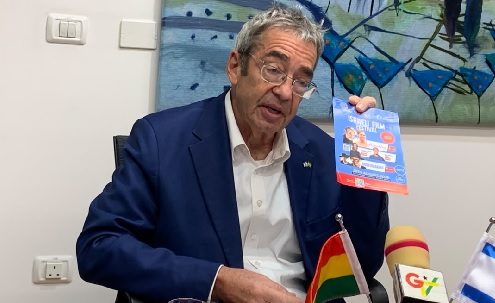
Israel is confronting a changing political climate in Washington as longstanding bipartisan support for the Jewish state comes under increasing pressure, its ambassador to Ghana, Liberia and Sierra Leone, Roey Gilad, has acknowledged.
But despite the shifting political mood in the United States, Mr. Gilad believes Israel’s strategic importance to Washington remains unrivalled, insisting that the two countries’ relationship is built on military strength, shared security interests and decades of strategic cooperation.
His assessment comes amid President Donald Trump’s announcement that the United States intends to terminate approximately $4 billion in annual military assistance to Israel by the end of 2026, following what the American president says was an understanding reached with Israeli Prime Minister Benjamin Netanyahu.
Mr. Gilad disclosed in an interview that Israel had been involved in the decision, portraying the proposed change as a clear demonstration of the country’s enhanced strength, self-reliance and maturity.
However, he conceded that the political foundations of American support for Israel are changing, particularly the bipartisan consensus that has traditionally protected the relationship from partisan divisions.
“Indeed the ‘across the isle’ support for Israel in the US is changing”, he acknowledged.
The admission is significant because American political support has historically been one of the most important pillars of Israel’s international diplomatic and military security architecture.
For decades, successive Democratic and Republican administrations have maintained substantial military and diplomatic backing for Israel, making the relationship one of Washington’s most enduring strategic partnerships in the Middle East.
But growing political disagreements over American military assistance, Israel’s regional security policies and the wider Middle East conflict have increasingly placed that consensus under scrutiny.
Mr. Gilad, nevertheless, remains optimistic that America’s strategic calculations will continue to favour Israel.
He invoked a famous observation attributed to former US Secretary of State Alexander Haig to explain why he believes Israel remains indispensable to American interests.
“I am positive that the Americans don’t forget what former Secretary of State, Alexander Haig, once said about Israel: ‘Israel is the largest aircraft carrier in the world that cannot be sunk’”, he said.
The analogy, he explained, captures Israel’s strategic value to Washington, particularly its military capabilities and its position as a dependable ally in a region characterized by competing geopolitical interests and persistent security threats.
He reinforced the argument by insisting that Israel occupies a unique position among America’s strategic partners in the Middle East.
“Among all US strategic allies in the Middle East, Israel is in a league of its own”, he maintained.
His comments suggest that Israel does not necessarily regard the proposed withdrawal of military assistance as a fundamental rupture in bilateral relations.
Rather, Jerusalem appears confident that the relationship can evolve from one heavily supported by American military financing towards a partnership increasingly defined by technological cooperation, defence innovation and shared strategic interests.
Nevertheless, the changing political environment in Washington presents a challenge that Israel cannot afford to underestimate.
The existing US-Israel security assistance memorandum provides approximately $3.8 billion annually through September 2028. Trump’s announcement of an earlier termination has therefore raised questions about the future of the agreement, congressional involvement and the precise arrangements governing the transition.
The issue is particularly important because American military assistance has traditionally enjoyed support beyond the White House, with Congress playing a central role in appropriating and authorizing security assistance.
Consequently, any significant restructuring of the relationship will require more than presidential assurances if it is to be implemented within the existing legislative and funding framework.
For Israel, the challenge will be to maintain the political goodwill necessary to sustain defence cooperation even as the traditional bipartisan consensus becomes less predictable.
Mr. Gilad’s confidence rests on the argument that Israel offers Washington strategic advantages that extend beyond financial assistance.
Its military capabilities, intelligence cooperation, technological expertise and regional security role, he believes, make it an exceptionally valuable American partner.
That strategic calculation, however, will increasingly have to contend with changing political attitudes among American voters and elected representatives.
The ambassador’s remarks therefore reveal two parallel developments: Israel’s determination to become less dependent on American military financing and its insistence that the underlying strategic relationship remains indispensable to both countries.
For Washington, the question is whether it can redefine its security partnership with Israel without weakening the military and diplomatic advantages that have sustained it for decades.
For Jerusalem, the challenge is whether it can preserve America’s political and strategic commitment while demonstrating that it no longer needs the same level of financial assistance.
Mr. Gilad appears convinced that Israel can achieve both objectives. His message is that American military assistance may be changing, but Israel’s strategic value to Washington is not.