


By Augustina Birago Dwomoh
Finance Minister signals shift from economic stabilization to production-driven growth and sustainable jobs as government prepares to unveil its New Economy Policy on Thursday.
Finance Minister Dr. Cassiel Ato Forson has taken the government’s proposed four-year economic transformation agenda to Ghana’s traditional leadership, seeking the backing of the National House of Chiefs and Asantehene Otumfuo Osei Tutu II ahead of Thursday’s 2027 Budget presentation.
At the heart of his message is a major shift in economic priorities: moving Ghana beyond macroeconomic stabilization towards domestic production, industrial expansion, value addition and sustainable job creation.
During Monday’s engagement with the National House of Chiefs in Kumasi, Dr. Forson outlined the government’s flagship New Economy Policy, a four-year structural transformation programme covering 2027 to 2030.
The initiative is intended to reshape the country’s economic direction, with particular emphasis on building productive industries, expanding local manufacturing and creating lasting employment opportunities for Ghana’s growing youth population.
Dr. Forson made clear that the government’s next economic priority is not simply to stabilize the economy but to build an economic structure capable of sustaining growth and generating jobs.
Goodbye to Short-Term Job Schemes?
A defining feature of the proposed policy is its emphasis on sustainable employment rather than temporary, state-funded interventions.
The finance minister signalled a shift away from reliance on short-term employment programmes such as the Youth Employment Agency (YEA) and the Nation Builders Corps (NABCO), arguing for a more productive economic model in which businesses and industries generate dependable jobs.
The underlying proposition is that lasting employment cannot depend indefinitely on government-funded stipends and temporary placements. Instead, Ghana must strengthen its productive sectors, stimulate investment and create an environment in which businesses can expand and employ more people.
For millions of young Ghanaians seeking meaningful employment, the success of this approach will ultimately be measured by the number and quality of jobs it creates.
Dr. Forson appealed to traditional authorities to support the transformation agenda, stressing the importance of a unified national effort in delivering the government’s economic ambitions.
Asantehene Grants Ato Forson Private Audience
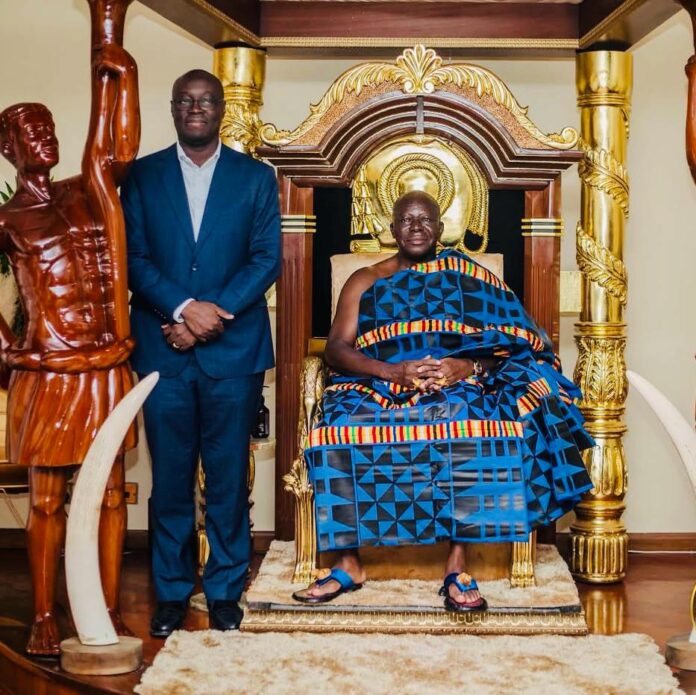
After the engagement with the National House of Chiefs, Dr. Forson paid a courtesy call on Otumfuo Osei Tutu II at the Manhyia Palace.
The Asantehene granted the finance minister a private audience, marking another significant engagement in the government’s consultations with traditional leadership ahead of the Budget.
The outreach reflects the government’s effort to secure broader stakeholder support for its economic transformation programme, particularly as traditional authorities remain important partners in agriculture, land administration, investment and local economic development.
Thursday’s Budget will Put the Plan to the Test
All eyes now turn to Parliament, where Dr. Forson is scheduled to present the 2027 Budget Statement and Economic Policy on Thursday, November 12.
The presentation is expected to provide the details of the New Economy Policy, including the programmes, investments and implementation measures through which the government intends to deliver its four-year transformation agenda.
The critical questions will be how the government intends to finance the ambitious programme, which productive sectors will receive priority, how many jobs it expects to create and what measurable targets will guide implementation.
The stakes are considerable. Ghana’s economic recovery must ultimately translate into stronger domestic production, expanding businesses, higher incomes and employment opportunities that endure.
Dr. Forson’s consultations with the country’s traditional leadership have set the stage. Thursday’s Budget will reveal whether the government’s proposed shift from stabilization to production-led growth is backed by a sufficiently detailed and credible implementation plan.