

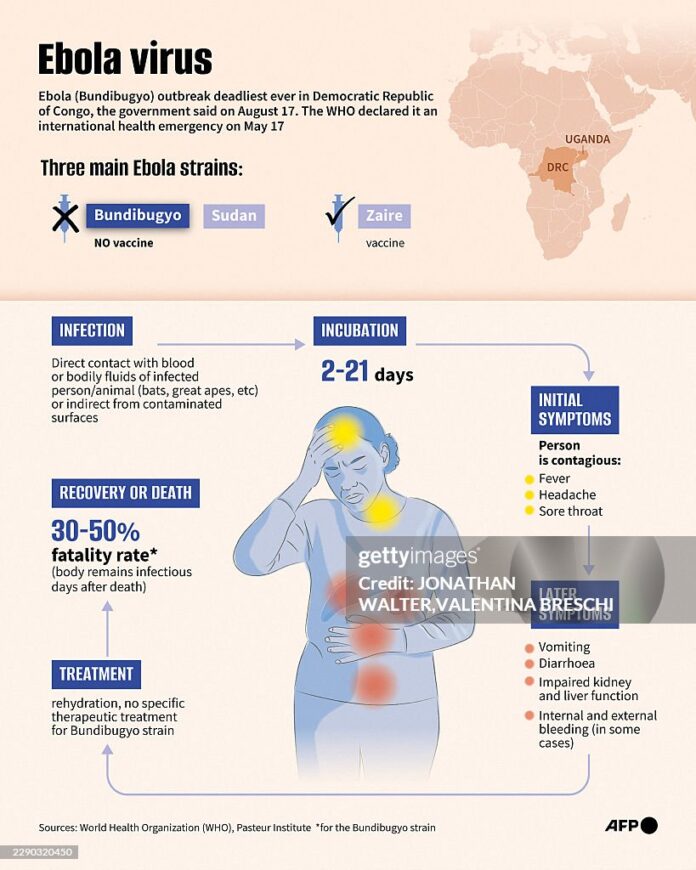

More than 5,500 people dead in six months. Over 11,000 confirmed infections. Eight provinces affected. This is not an ordinary epidemic. It is a devastating indictment of the failure to protect human life and contain a lethal infectious disease. Declared on 15 May 2026, the Bundibugyo Ebola outbreak has become the largest and deadliest Ebola outbreak in the DRC’s history, exposing the extraordinary cost of delayed intervention, inadequate preparedness and institutional weakness.
The economic consequences are profound. Ebola does not simply kill patients; it disrupts the economic relationships that keep households, businesses and communities functioning. Fear discourages travel, interrupts commerce, reduces agricultural activity and undermines consumer confidence. Markets become less accessible, workers stay away from workplaces, transport networks face disruption and small enterprises lose customers. In communities already struggling with insecurity and poverty, these disruptions can push vulnerable households into destitution.
The timing could hardly be worse. The World Bank’s October 2026 economic update projects DRC economic growth of 5.4 per cent this year, down from 5.7 per cent in 2025 and 9.3 per cent in 2022. It also warns that growth remains heavily concentrated in mining, with limited employment benefits for ordinary citizens. Ebola compounds these structural weaknesses, threatening the services, agriculture and informal businesses upon which millions depend.
The implications extend beyond national borders. The outbreak has spread across eight Congolese provinces, while infections have also been confirmed in neighbouring countries. WHO’s November reporting identifies continuing transmission and the risk of further geographical expansion. Cross-border trade, transport, investment and tourism consequently face additional uncertainty. Regional governments must divert scarce resources towards screening, surveillance and emergency preparedness rather than development priorities.
The Economic Price of Containment Failure
The financial burden is equally alarming. Governments must finance emergency treatment, laboratory testing, protective equipment, contact tracing, isolation facilities, public education and the deployment of healthcare personnel. Every additional infection increases these demands. Every preventable death represents not only a human tragedy but also the loss of productive capacity, household income, caregiving and future economic contribution.
The damage is particularly severe in an economy where poverty is already entrenched. The World Bank estimates that 81.1 per cent of Congolese people lived below the $3-a-day international poverty threshold in 2025. Furthermore, mining contributes 36.6 per cent of GDP but only 2.5 per cent of employment, while informal activities account for approximately 90 per cent of jobs. These figures explain why the economic consequences cannot be measured simply by fluctuations in national output: the people least able to absorb an economic shock are disproportionately exposed to it.
The burden on public finances is mounting. Money allocated to emergency response must compete with spending on infrastructure, education, agriculture and other essential services. The World Bank announced $426.6 million in current and planned grant and concessional financing for the DRC and regional response in October. This is substantial assistance, but it also illustrates the enormous financial demands generated by an epidemic that has proved exceptionally difficult to contain.
The consequences will outlive the outbreak. Children deprived of education, households losing breadwinners, businesses collapsing and patients missing treatment for other illnesses will carry the economic scars long after transmission ends. The United Nations Development Programme has recognized these dangers in its June 2026 socioeconomic assessment, examining the outbreak’s implications for growth, employment, trade, investment and public finances.
WHO’s Failure Demands an Uncomfortable Reckoning
WHO cannot reasonably be blamed for Congo’s war, weak infrastructure or every act of violence against medical teams. But acknowledging those constraints is not an acquittal. The organization exists precisely to coordinate international action when national systems are overwhelmed. It declared a public health emergency of international concern on 17 May. Yet six months later, transmission had reached eight provinces and the confirmed death toll exceeded 5,500. That is a catastrophic failure of containment, whatever the operational explanations.
The evidence is damning. On 11 November, WHO Director-General Tedros Adhanom Ghebreyesus acknowledged that more than 1,000 contacts had been lost to follow-up and three confirmed cases were unaccounted for. He also conceded that the response remained below the scale required to identify, isolate and treat every case, trace contacts and interrupt transmission. Attacks on health facilities, displacement and delayed payment of frontline workers have further weakened operations. These are not minor administrative difficulties; they are failures at the heart of epidemic control.
Funding shortages also mattered. In July, WHO said it had received only about 40 per cent of the $115 million it initially required. The World Bank subsequently reported $426.6 million in current and planned grant and concessional financing for the DRC and regional response. That mobilization is significant, but money announced is not the same as cash reaching clinics, laboratories and contact tracers on time. WHO must publish clear accounts of what it requested, received, spent and delivered and explain why early containment did not prevent this extraordinary escalation.
The strongest defence is that Bundibugyo virus has no licensed vaccine or specific treatment, while armed conflict makes access dangerous and community trust difficult. That is true. WHO also reports that diagnostic detection improved from ten days to one or two days by September, and a vaccine trial began in October. But they do not erase the central failure: a response that improves its systems while the epidemic expands across provinces has not yet achieved its primary purpose. Constraints explain difficulty; they do not remove the obligation to anticipate, coordinate and correct.
From Emergency Response to Economic Accountability
The DRC cannot afford a response confined to treatment centres. It needs reliable salaries for health workers, protected clinics, community-led surveillance, safe burial services and uninterrupted maternal, child and routine healthcare. Schools and markets must remain open wherever safety permits. Small traders, farmers and displaced households need practical support, not blanket restrictions that punish livelihoods and discourage transparent reporting. Neighbouring states must coordinate border surveillance without turning public health into indiscriminate economic isolation.
The international response must also shift from pledges to measurable delivery. Donors should publish disbursements; WHO and national authorities should report contact-tracing coverage, testing delays, community deaths and staffing gaps by province. Independent audits must follow emergency funds. Africa’s institutions should have a stronger operational role, rather than remaining dependent on late external mobilization.
Ebola exposes the price of treating health security as charity instead of economic infrastructure. The DRC’s growth, jobs and regional trade cannot be protected while thousands die and basic services falter. WHO has made progress, but its leadership must be judged by outcomes, not briefings, pledges or explanations. More than 11,000 infections and 5,500 deaths are an intolerable verdict. The world must demand accountability, fund the frontline and stop this epidemic before the next preventable failure becomes another continental crisis.