

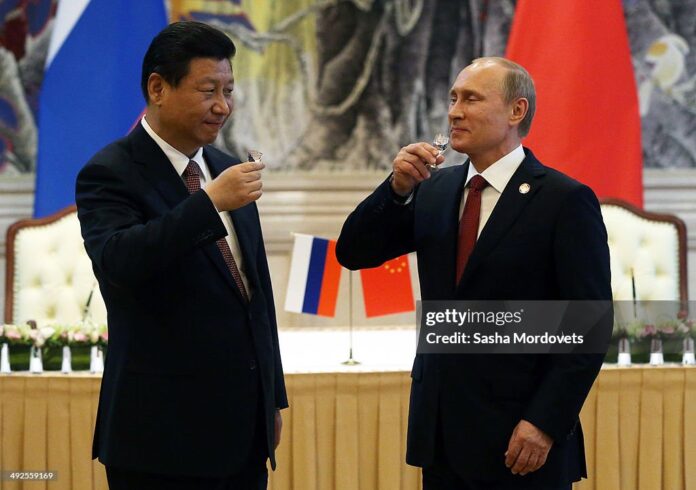

The challenge is not rhetorical. It is a bid to make Western economic power harder to use. As Xi Jinping champions open trade and Vladimir Putin denounces sanctions ahead of their unprecedented meeting with Donald Trump in Shenzhen on November 19, Beijing and Moscow are advancing a shared argument: the United States and its allies have turned their dominance of markets, finance and technology into instruments of coercion.
At the Asia-Pacific Economic Cooperation summit, Xi presented China as a defender of openness, while Putin portrayed sanctions as evidence of Western overreach. The three leaders are expected to discuss trade, artificial intelligence, nuclear weapons and conflicts including Ukraine and Iran. APEC’s 21 economies account for about 61 per cent of global GDP and 46 per cent of global trade in goods and services. Its consensus-based structure cannot compel agreement, but it gives competing powers a venue to court partners, shape expectations and signal which economic model they want others to follow in the coming decade.
The East’s Economic Counter-Offensive
The World Trade Organization reported that Chinese merchandise exports reached $3.77 trillion in 2025, equal to an average 14.4 per cent of global exports over the preceding three years. Its supply chains are central to manufacturing, clean-energy technologies, electronics and consumer goods. Yet Beijing’s message contains a contradiction. China’s export strength is accompanied by industrial subsidies, state direction and a vast trade surplus that trading partners regard as distortive.
The Associated Press reported that China’s surplus was expected to exceed $1 trillion, even as weak domestic demand and a prolonged property downturn weighed on its economy. European and American complaints about overcapacity are not simply protectionist reflexes; they reflect concerns that subsidized production can undercut domestic industries. A defence of open markets will carry greater credibility if China accepts reciprocal access and transparent rules.
Russia’s position is more exposed. Western sanctions have not collapsed its economy or forced the Kremlin to abandon its war, but they have redirected trade and deepened reliance on China. The Centre for Eastern Studies estimates that China accounted for around 30 per cent of Russian exports and 35 per cent of imports in 2025, compared with 16 and 25 per cent respectively in 2021. Chinese machinery, vehicles and electronics have filled gaps left by departing Western suppliers. This gives Moscow an economic lifeline, but also gives Beijing considerable bargaining power.
Russia largely sells energy and raw materials; China supplies higher-value manufactured goods. The World Bank says Russia’s economy grew by only 0.6 per cent in the first half of 2026 and projects growth of 0.8 per cent for the year, reflecting weaker demand and mounting financial pressures.
The West’s Leverage and Its Limits
For Washington and Europe, the danger is not an immediate replacement of the dollar system or a unified anti-Western bloc, but the gradual erosion of their ability to coordinate pressure. Sanctions work partly because banks, insurers, shipping companies and technology suppliers value access to Western markets. If alternative payment channels and trading networks expand, enforcement becomes more expensive and evasion easier. But talk of de-dollarization should be kept in proportion.
IMF data show the dollar represented 56.7 per cent of global foreign-exchange reserves in the second quarter of 2026, while the renminbi accounted for only about 2 per cent. The International Monetary Fund also found that renminbi-denominated payments represented less than 3 per cent of global trade and about 8 per cent of trade finance in the third quarter of 2025. China can reduce its own exposure to dollar channels and help Russia transact beyond them; it cannot yet offer a currency system with comparable depth, convertibility, liquidity and global trust.
Energy disruptions, higher compliance costs and fragmented supply chains can hurt Western companies and consumers, while restrictions can encourage targeted states to build substitutes. Yet sanctions have constrained Russia’s access to advanced technology and capital, raised transaction costs and forced costly rerouting. Their effectiveness should be judged against achievable objectives, not the unrealistic expectation that economic pressure alone will reverse a major war. The Western response must therefore be disciplined. At the same time, treating strategic dependencies as harmless would be naïve. The answer is coordinated, targeted controls; stronger domestic capacity in semiconductors, critical minerals and energy; closer cooperation with allies; and credible investment offers to developing economies. Rules-based trade must be defended through consistency, not merely invoked when convenient.
The Trilateral Test
The Shenzhen meeting could give Putin a diplomatic prize: a seat beside the leaders of the world’s two largest economic powers, despite Russia’s isolation from much of the West. Xi gains by appearing as host and indispensable interlocutor, while Trump can present direct engagement as evidence that he can broker agreements on nuclear risks and geopolitical crises. But a photograph of three presidents should not be mistaken for a strategic alignment. Their interests diverge sharply over Ukraine, Iran, technology, regional security and the future balance of power.
For the West, the danger is complacency: economic centrality does not guarantee political obedience, and sanctions can lose force when allies disagree or alternatives become viable. The decisive question is whether the three leaders can turn slogans into durable arrangements. Xi’s free-trade appeal will be tested by China’s willingness to open markets. Putin’s attack on sanctions will be tested by Russia’s dependence on Chinese trade. Trump’s leverage will depend on whether the United States can combine negotiation with a coherent economic strategy.
This is not yet the birth of a new economic order. It is a contest over who writes its rules, who controls its chokepoints and who pays when those systems are weaponized. The West retains formidable advantages, but it can no longer assume that others will accept its leadership without question. Beijing and Moscow have identified that vulnerability. Whether they can exploit it, and whether Washington can respond without deepening the divisions, is the real geopolitical test.