

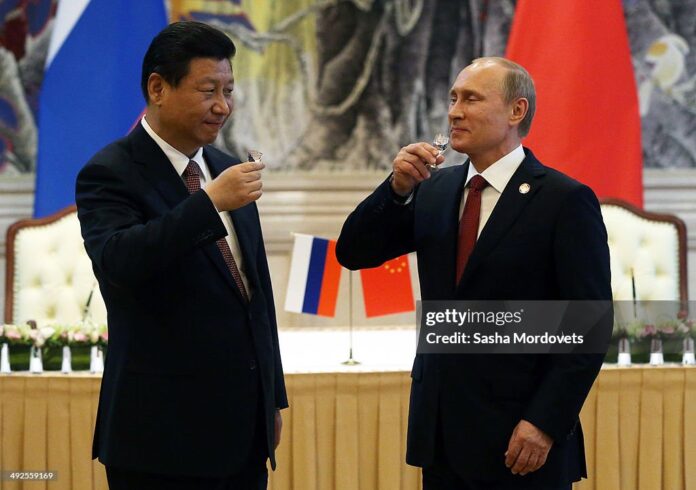

Chinese President Xi Jinping and Russian President Vladimir Putin have mounted a pointed challenge to Western economic influence, defending free trade and condemning sanctions as they prepare for a consequential trilateral meeting with US President Donald Trump.
The two leaders delivered their messages on Wednesday at an Asia-Pacific Economic Cooperation (APEC) summit in Shenzhen, southern China, setting the tone for Thursday’s highly anticipated encounter with Trump, who is travelling from Manila after engagements with key regional allies.
The three presidents are expected to discuss some of the world’s most pressing geopolitical disputes, including Russia’s war in Ukraine, the conflict involving the United States and Iran, international trade, artificial intelligence and nuclear weapons.
The planned meeting has already attracted comparisons with the 1945 Yalta Conference, where the United States, Britain and the Soviet Union negotiated the post-war international order and established spheres of influence. The comparison has heightened concerns among smaller nations that major powers could strike agreements affecting their sovereignty and strategic interests without adequately consulting them.
Addressing business leaders at the summit, Xi positioned China as a defender of international economic cooperation, urging countries to resist protectionism and preserve an open global trading system.
He called for stronger adherence to World Trade Organization rules, greater trade and investment liberalization, and uninterrupted global supply chains, while emphasizing the need for stability in international commerce.
His intervention comes amid renewed tensions between Washington and Beijing following the US announcement of additional restrictions on China’s access to advanced artificial intelligence chips, including products manufactured by Nvidia. The measures threaten to complicate an already fragile trade understanding between the two economic powers, with Beijing warning that it would respond.
Xi also defended China’s industrial and technological development strategy, arguing that continued investment in manufacturing and emerging technologies would generate opportunities beyond its borders.
He pledged further reductions in tariffs and greater access to China’s domestic market, while rejecting what he described as unilateral economic pressure and protectionist policies.
However, China’s position remains contentious among its major trading partners. The country has recorded annual trade surpluses exceeding $1 trillion, prompting criticism from Western governments that accuse Beijing of subsidizing its manufacturing sector, distorting global competition and undermining industries and employment elsewhere.
China maintains that its economic model remains necessary as it seeks to narrow the development gap with wealthier economies. The United States and European Union, however, have expressed growing concern that Beijing’s dominance of critical supply chains could translate into significant geopolitical leverage.
George Chen, a partner and chair of digital practice at The Asia Group, said Xi’s position was likely to find support among developing economies, while reinforcing Beijing’s efforts to distinguish its technological ambitions from Washington’s approach.
The diplomatic manoeuvring comes as Trump embarks on his first Asian tour since his Republican Party suffered defeats in the midterm elections. Relations between Washington and Beijing also face additional complications from allegations involving Nvidia founder Jensen Huang and a suspected Chinese spy.
Despite the mounting tensions, analysts largely expect both countries to avoid a major deterioration in relations, particularly as Trump and Xi are scheduled to meet again at the Group of 20 summit in Miami in December, following Thursday’s encounter in Shenzhen.
Putin, meanwhile, used his address to deliver a direct rebuke to Western governments, portraying their economic influence as increasingly diminished and insisting that sanctions imposed on Russia have failed to achieve their intended objectives.
His remarks came against the backdrop of renewed military pressure on Moscow following Ukraine’s destruction of the strategically important Kerch road bridge connecting Crimea to Russia, a significant setback in the four-year-old war.
Describing Western powers as former global hegemons, Putin characterized Europe’s position as one of humiliating decline and argued that economic restrictions had ultimately strengthened rather than weakened Russia.
He maintained that sanctions, tariffs and export controls could no longer serve as decisive instruments for containing rival economies, insisting that such measures were incapable of stopping national growth or destroying competitors.
Later, during bilateral talks, Xi and Putin reaffirmed their commitment to strengthening relations, describing their partnership as progressing steadily and positively on the international stage.
Both leaders also pledged further cooperation in support of a multipolar international order, an arrangement that would distribute global influence among several major powers rather than concentrate it in the hands of the United States and its Western allies.
Trump, for his part, used his visit to Manila to pledge deeper defence cooperation with the Philippines, whose relations with Beijing have deteriorated over competing territorial claims in the South China Sea.
The US president had also raised the possibility of meeting North Korean leader Kim Jong Un during his China visit, although no such encounter had been confirmed.
The Kremlin has dismissed comparisons between Thursday’s gathering and the historic Yalta Conference as political speculation, even while acknowledging that the discussions could carry substantial implications for international affairs. Beijing has similarly presented the meeting as an opportunity to advance global peace.
The diplomatic tensions are unfolding alongside heightened regional security concerns, with Taiwan and Japan reporting Russian aircraft incursions into their airspace on Tuesday.
Despite describing the international environment as increasingly turbulent, Putin argued that disagreements between major powers should be addressed through direct negotiations rather than confrontation.
He expressed optimism that the forthcoming meeting involving the Russian, Chinese and American presidents could deliver significant benefits, placing considerable expectations on a gathering that could shape the direction of relations among the world’s three most influential powers.