

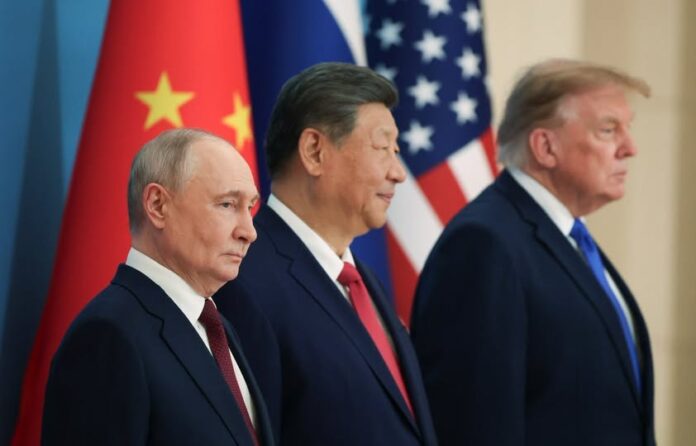

The world’s three most powerful nuclear leaders have pledged to prevent nuclear war. The real question is whether they can be trusted to turn that promise into action. The November 19, 2026, trilateral summit in Shenzhen, China, bringing together United States President Donald Trump, Chinese President Xi Jinping and Russian President Vladimir Putin, represents a potentially significant moment in international diplomacy.
Their joint Declaration Towards Peace commits the three countries to dialogue on reducing nuclear risks, preventing nuclear proliferation, strengthening global energy supplies and reforming the United Nations. On paper, the commitments are ambitious. Geopolitically, however, they expose a deeper reality: the future of international security increasingly depends on whether competing great powers can manage their rivalries without destabilizing the international system.
The significance of this meeting extends far beyond its carefully choreographed diplomatic symbolism. These are not simply three heads of state issuing another declaration of goodwill. They lead the world’s three largest nuclear powers, possess enormous economic and military influence, and occupy permanent seats on the United Nations Security Council. Their cooperation could strengthen international stability. Their disagreements, however, could undermine it. The distinction between a historic diplomatic breakthrough and an exercise in geopolitical positioning will ultimately depend on what happens after the cameras disappear.
Nuclear Restraint
The nuclear pledge is the summit’s most consequential commitment. The Stockholm International Peace Research Institute (SIPRI) estimates that the world possessed 12,187 nuclear warheads in January 2026, including 9,745 in military stockpiles. Russia and the United States hold almost 86 per cent of the global inventory; China’s arsenal is smaller, at an estimated 620 warheads, but expanding. SIPRI estimates that 2,100-2,200 deployed warheads remain on high operational alert, overwhelmingly in Russian and American hands. But the declaration promises dialogue, not numerical limits, inspections, verification or a timetable. New START, which capped deployed US and Russian strategic warheads at 1,550 apiece and provided verification mechanisms, expired on February 5, 2026. Its end removed the last legally binding ceiling on the two largest arsenals.
A trilateral process must address warhead numbers, delivery systems, missile defence and crisis communication. China has resisted arms-control frameworks designed for arsenals far larger than its own, but its expanding capabilities make exclusion increasingly difficult. All nine nuclear-armed states continued modernizing their arsenals in 2025, SIPRI reports. Credibility requires hotlines, exercise notifications, data exchanges and verifiable agreements.
Energy Security
The commitment to increase refined petroleum production and supply places energy at the centre of the new diplomatic arrangement. The US produced a record 13.6 million barrels of crude oil per day in 2025, according to the Energy Information Administration. Russia is a major producer; China is a major importer and refining power. Coordination could ease supply shocks and improve access to refined fuels. But increased output is no binding supply guarantee. The declaration specifies no volumes, prices, destinations or protections for shipping. It says nothing about coordination with Saudi Arabia or OPEC+. African and Asian importers need transparent markets, affordable fuel and reliable shipping. If the three powers marginalize smaller producers or bypass existing institutions, energy security becomes another instrument of great-power bargaining.
UN Reform
The pledge to reform the United Nations may prove the most politically sensitive commitment. The Security Council reflects the power structure of 1945, not today’s world. Its five permanent members, the United States, Russia, China, Britain and France, retain veto power, while Africa, Latin America and much of Asia lack permanent representation. The three leaders cannot dictate reform. Article 108 of the UN Charter sets a formidable threshold: amendments require a two-thirds General Assembly majority and ratification by two-thirds of UN members, including all five permanent Council members. With 193 members, at least 128 must approve the proposal.
Reform requires broad agreement. They could support African representation and better conflict prevention. But the declaration says nothing about new seats, veto powers or accountability. Reform that preserves existing privileges while offering symbolic concessions would deepen distrust. The declaration’s criticism of the International Criminal Court adds another complication. The UN cannot strengthen its credibility by suggesting that international law should protect the powerful from scrutiny.
The World Beyond the Three Capitals
The summit also signals that the three leading nuclear powers want to manage major questions through direct great-power diplomacy. Xi gains stature as host and presents China as an indispensable convenor. Putin receives diplomatic rehabilitation and a prominent international platform. Trump can present engagement with strategic competitors as a demonstration of deal-making. But Europe, Japan, South Korea, India, Ukraine and other exposed states have direct stakes in nuclear stability, energy security and UN reform. An understanding that overlooks allies and affected countries could revive fears of spheres of influence, especially where decisions touch Ukraine, Taiwan or the Korean Peninsula.
The declaration offers no detailed settlement of the conflicts and rivalries that generate nuclear danger. Its value depends on inclusive follow-up diplomacy and transparent commitments. The diplomatic architecture also matters. A regular leaders’ forum could reduce surprise and create habits of consultation, especially when crises involve more than one theatre. But without working-level channels, agreed agendas and public reporting, the process could remain personalized and fragile. A change of administration, a new military crisis or a dispute over sanctions could quickly interrupt it. Institutionalizing dialogue is therefore as important as the leaders’ initial political signal. Smaller states must retain a voice, or stability among powerful states may come at the expense of everyone else.
Shenzhen is an opening, not a peace settlement. If the three leaders translate their promises into verifiable nuclear-risk reduction, dependable energy cooperation and inclusive UN reform, they could help stabilize a fragmented international order. If they use peace language to consolidate privilege and bargain over other countries’ interests, the summit will legitimize a narrower, less accountable system. The world does not need a directorate of three nuclear capitals. It needs those capitals to recognize that exceptional power carries exceptional responsibility.