

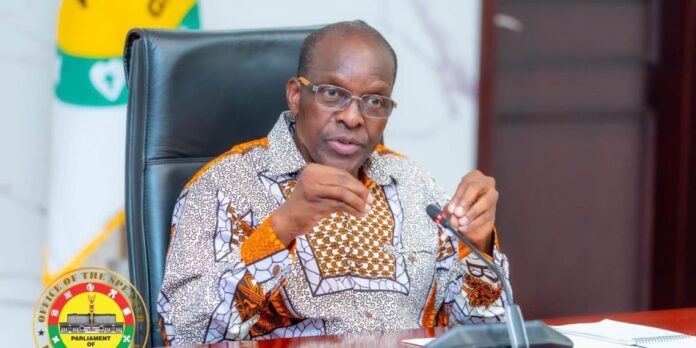

Ghana cannot credibly demand accountability from public officials while allowing political parties to operate under weak financial scrutiny. Political money is not a private matter when it shapes elections, influences public policy and determines who ultimately gains access to political power. Speaker of Parliament Alban Bagbin’s call for tighter controls on party financing is therefore more than a proposal for regulatory reform; it is a necessary challenge to the opacity surrounding the financial machinery of Ghanaian politics.
The demand for compulsory disclosures, independent audits and campaign spending limits confronts a fundamental weakness in democratic governance: the danger that political influence may be accumulated, exercised and rewarded without sufficient public scrutiny. Parties are indispensable to democracy, but their importance cannot become an excuse for financial secrecy. If they expect citizens to trust their promises, they must demonstrate greater transparency in how they fund their operations and campaigns.
Transparency Is Not a Political Luxury
Bagbin’s proposals, conveyed by First Deputy Speaker Bernard Ahiafor during an engagement between Parliament’s Open Government Partnership and the United Nations Office on Drugs and Crime, underscore the need to strengthen the rules governing political finance. The emphasis on disclosure and independent auditing is particularly significant because accountability cannot exist where financial information remains inaccessible or where scrutiny depends largely on voluntary cooperation.
Political parties should be required to disclose their sources of funding, demonstrate how contributions are received and spent, and submit their accounts to independent examination. Such requirements would establish a stronger basis for assessing whether party finances comply with the law and whether financial arrangements deserve public confidence.
Transparency, however, must be meaningful rather than ceremonial. Publishing figures without adequate detail, timeliness or independent verification would accomplish little. Disclosure rules must make financial information accessible, understandable and sufficiently comprehensive to expose questionable arrangements. Citizens should not have to rely on political assurances when verifiable financial records can provide stronger evidence.
Spending Limits and the Unequal Contest
Campaign expenditure restrictions raise an equally important question: how much money should determine the competitiveness of political contests? Elections are supposed to provide citizens with meaningful choices, not become competitions in financial muscle. When campaign spending is inadequately regulated, the possibility of disproportionate financial influence becomes a serious concern, even where the source of funding is not necessarily unlawful.
Spending limits could help establish clearer boundaries for campaign financing and encourage parties to compete through ideas, organization and public engagement rather than escalating expenditure. Yet restrictions alone will not guarantee fairness. If limits are introduced without credible monitoring, parties could simply shift spending into less visible channels, informal arrangements or activities that evade classification as campaign expenses.
The challenge, therefore, is to design rules that are enforceable, realistic and consistent across political parties. Regulation must not become a weapon against smaller parties or a convenient instrument for selectively policing political opponents. Fairness demands uniform standards, impartial oversight and consequences that apply regardless of political affiliation.
Parliament Must Deliver, Not Merely Declare
Bagbin’s intervention will mean little if it remains another well-articulated reform proposal without legislative action. Ghana needs a regulatory framework that closes loopholes, strengthens enforcement and establishes clear institutional responsibilities for monitoring political finances. The credibility of such a framework will depend not only on the rules themselves but also on the independence, resources and authority of the bodies tasked with implementing them.
Parliament must resist the temptation to treat political financing reform as an issue that can be postponed until the next election cycle. The parties represented in the legislature have a direct stake in the rules, making reform politically sensitive. That is precisely why the process must be guided by public interest rather than partisan convenience.
Democracy cannot flourish on trust alone; it needs verifiable accountability. Ghana’s political parties must open their financial books, accept independent scrutiny and operate within enforceable spending limits. The objective is not to suffocate political activity, but to protect democratic competition from financial excess, secrecy and undue influence. Parliament now has an opportunity to turn the Speaker’s call into lasting institutional reform. It should not squander it.