


Nuclear war has no winners. It has no meaningful victory, no acceptable casualties and no guarantee that civilization would survive its consequences. Yet the three countries possessing the largest nuclear arsenals have spent decades treating these weapons as instruments of strategic leverage, deterrence and geopolitical intimidation. That is what makes their latest declaration in Shenzhen so consequential.
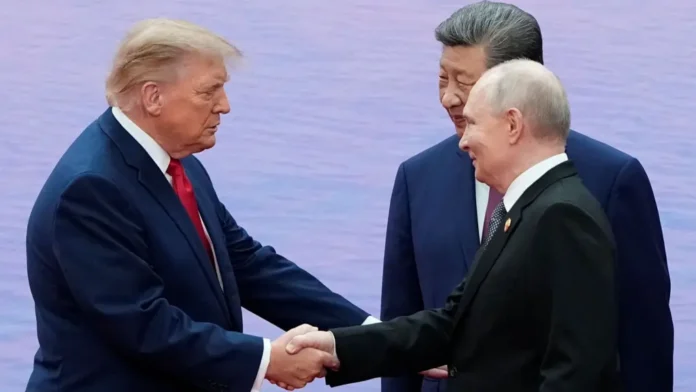
On November 19, 2026, United States President Donald Trump, Russian President Vladimir Putin and Chinese President Xi Jinping made history by holding an unprecedented trilateral summit in the Chinese city. Their differences over Ukraine, Iran, Taiwan, international influence and the global balance of power remain profound. Nevertheless, they found common ground on an issue that transcends national rivalries: preventing nuclear catastrophe.
Their joint four-point Declaration towards Peace reaffirmed an unequivocal principle: nuclear war cannot be won and must never be fought. More importantly, the three governments committed themselves to dialogue on reducing nuclear risks and preventing the proliferation of nuclear weapons.
The significance should not be underestimated. Washington, Moscow and Beijing are not merely three influential capitals. They are the world’s foremost nuclear powers, permanent members of the United Nations Security Council and principal architects of the international security arrangements established after the Second World War. Their decisions can determine whether geopolitical confrontations remain conventional or escalate into a catastrophe without precedent.
For once, their leaders acknowledged that nuclear competition cannot be allowed to become nuclear destruction. However, recognizing a danger and eliminating it are two very different achievements. The Shenzhen declaration is an important diplomatic signal, but its credibility will ultimately depend on whether words become verifiable commitments, sustained negotiations and practical restraints on military behaviour.
An Arsenal That Makes Miscalculation Unforgivable
The numbers explain the urgency. The Federation of American Scientists estimates that, in 2026, Russia possesses approximately 5,420 nuclear warheads in its total inventory, the United States 5,042 and China 620. Together, these three states account for roughly 91 per cent of the world’s estimated 12,187 nuclear weapons. These are estimates, not official audited totals, because governments conceal important details of their arsenals.
The danger is not simply the number of weapons. It is their readiness, destructive capacity and the speed at which decisions may have to be made during a crisis. The Stockholm International Peace Research Institute estimated that approximately 2,100 deployed nuclear warheads worldwide were maintained on high operational alert in January 2025, almost all belonging to Russia and the United States. Such readiness compresses decision-making time and increases the consequences of false warnings, technical failures or mistaken assumptions.
The stakes are global. A nuclear exchange would not remain regional: radioactive fallout, disrupted food production and economic collapse would cross borders. Scientific modelling warns that smoke from nuclear firestorms could reduce sunlight, shorten growing seasons and threaten food supplies far from the battlefield. The consequences would depend on the scale and location of an exchange. But governments cannot confine nuclear costs to an adversary. Even limited use could trigger escalation and humanitarian emergencies. Sustained cooperation must therefore become an urgent strategic necessity worldwide.
Russia’s war against Ukraine has repeatedly brought nuclear rhetoric into European security calculations. Washington and Moscow have clashed over arms control, military support for Kyiv and NATO’s posture. Meanwhile, China is expanding and modernizing its nuclear forces, seeking a more credible deterrent as its rivalry with the United States intensifies. Each calls its posture defensive, but one state’s security measures can look threatening to another, fuelling an action-reaction cycle.
The expiry of the New START treaty on February 5, 2026, deepens this uncertainty. With its expiration, the world’s two largest nuclear powers lost their last binding bilateral treaty imposing numerical limits on deployed strategic forces. Without a successor, mistrust and worst-case planning can flourish.
A Declaration Is Not Yet Disarmament
The leaders promised dialogue; they did not announce a new arms-control treaty, numerical reductions, a timetable, inspection arrangements or binding limits on nuclear deployments. Beijing has traditionally argued that its arsenal is far smaller than those of Washington and Moscow and that the two largest stockpiles should take the lead in reductions. China’s arsenal is growing, and its opacity makes it harder for rivals to assess intentions. Washington and Moscow must also acknowledge their responsibility for the deterioration of arms control. A credible framework must recognize unequal arsenals while establishing reciprocal obligations, reliable communication and a pathway towards greater transparency.
The declaration also sits uneasily beside the conduct of its signatories. Russia’s nuclear signalling during the Ukraine war, China’s military pressure around Taiwan and America’s reliance on nuclear deterrence expose the gap between diplomatic language and strategic practice. Their interests remain sharply competitive.
Turning the Warning into a Strategy
The three governments should establish regular senior-level nuclear consultations, restore military-to-military communication channels and strengthen hotlines designed to prevent incidents from escalating. They should discuss advance notification of major missile tests, clarify nuclear doctrines and improve procedures for communicating during emergencies. They are necessary precisely because trust is scarce. A second priority must be a serious successor framework to New START. Washington and Moscow should pursue verifiable limits while Beijing joins a structured process suited to its smaller but expanding arsenal. Other nuclear-armed states must also be part of the longer-term conversation.
The United Nations and the Non-Proliferation Treaty framework offer essential diplomatic foundations. Their commitment to prevent proliferation must be matched by progress on disarmament, the bargain at the heart of the NPT. They cannot credibly demand that other countries reject nuclear weapons while treating their own arsenals as permanently indispensable.
Shenzhen has produced a rare moment of strategic clarity. The leaders of the world’s three largest nuclear powers have publicly acknowledged that nuclear war is unwinnable and must never be fought. But history will not judge this summit by the force of its wording or the symbolism of its photographs. It will judge whether the declaration reduces weapons, restores safeguards and prevents a crisis from becoming irreversible. The warning has been delivered. Now the three capitals must prove they believe it.