

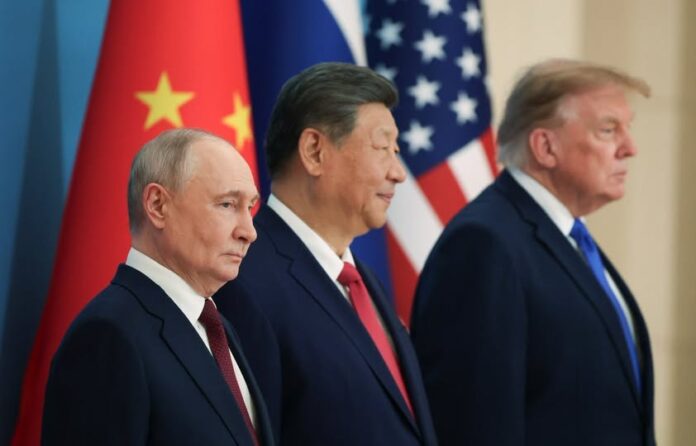

The leaders of the world’s three biggest nuclear powers have pledged to prevent nuclear war, strengthen global energy supplies and reshape the United Nations after a landmark trilateral summit in China.
In a declaration with potentially far-reaching consequences for global security, US President Donald Trump, Russian President Vladimir Putin and Chinese President Xi Jinping have committed to closer cooperation on nuclear risk reduction, international stability and energy security.
The three leaders adopted the Russia-China-US Heads of State Declaration Towards Peace following their historic meeting in Shenzhen on Thursday, marking a significant diplomatic moment among three powers whose competing interests have long complicated international cooperation.
At the heart of the declaration is an unequivocal warning about the dangers of nuclear conflict: a nuclear war cannot be won and must never be fought.
The three countries pledged to open a dialogue on reducing nuclear risks and preventing the proliferation of nuclear weapons, signalling a willingness to address one of the most dangerous threats to international security through direct engagement.
The commitment comes amid mounting global tensions and growing concerns over nuclear weapons, strategic rivalries and the possibility of escalating international conflicts.
Beyond nuclear security, the leaders also agreed to pursue reforms of the United Nations, arguing that the organization must become more effective in responding to global challenges and fulfilling its fundamental responsibility for maintaining international peace and security.
Energy security also featured prominently in the declaration, with Russia, China and the United States expressing plans to increase the production and supply of refined petroleum products while reaffirming the importance of stable global energy flows.
The statement further emphasized state sovereignty and the immunities of government officials, with the three presidents warning that the International Criminal Court and similar institutions must not abuse their jurisdiction.
Although the declaration establishes areas of common ground, it does not spell out specific implementation timelines, nuclear reduction targets or binding commitments.
That leaves a crucial question hanging over the summit: can three powers with sharply competing geopolitical interests turn their historic declaration into meaningful action?
For now, the message from Shenzhen is clear: Washington, Moscow and Beijing recognize that preventing nuclear catastrophe and safeguarding global stability require dialogue, even among rivals.