

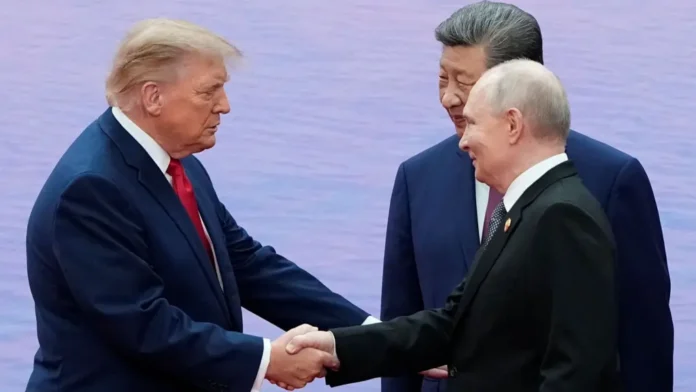

Washington, Moscow and Beijing have put aside their rivalries long enough to deliver a blunt message to the world: nuclear war must never happen.
In a rare display of diplomatic alignment, Donald Trump, Vladimir Putin and Xi Jinping have jointly declared that nuclear war cannot be won and must never be fought, placing nuclear risk reduction at the centre of their historic trilateral summit in Shenzhen, China.
The three presidents adopted a joint declaration on Thursday, committing their countries to dialogue aimed at reducing nuclear dangers and preventing the spread of nuclear weapons.
The statement is particularly significant because Russia, China and the United States possess some of the world’s most powerful nuclear arsenals, while their strategic rivalries remain a major challenge to international security.
Their agreement to pursue nuclear risk reduction dialogue offers a potential opening for cooperation at a time when mistrust between major powers continues to threaten global stability.
But the declaration goes beyond nuclear weapons. The three leaders also called for reform of the United Nations, insisting that the organization must become more capable of addressing emerging global threats and delivering on its core mission of maintaining international peace and security.
On energy, the countries pledged to pursue increased production and supply of refined petroleum products, underscoring the importance of reliable energy flows for nations around the world.
They also issued a joint position on sovereignty and international justice, affirming the importance of state consent and immunity for government officials while cautioning that the International Criminal Court and similar institutions must not overstep their jurisdiction.
The declaration represents an important diplomatic statement, but its real significance will depend on what happens after the summit.
There are no specific nuclear disarmament targets, enforcement mechanisms or deadlines outlined in the text. Nor does the declaration resolve the broader geopolitical disagreements separating Washington, Moscow and Beijing.
Still, the symbolism is difficult to ignore. Three presidents whose countries shape the global security order have publicly acknowledged a shared responsibility to prevent nuclear catastrophe.
Whether that understanding can survive their competing interests remains uncertain. But in a world increasingly shaped by geopolitical confrontation, their message carries enormous weight: the consequences of nuclear war are too devastating for the world’s most powerful nations to leave dialogue behind.