

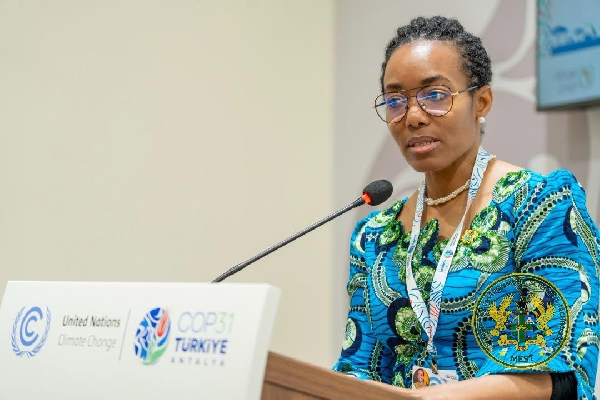

Africa is being asked to pay for a climate crisis it did little to create. Farmers lose harvests, cities flood and public budgets absorb the damage, while countries enriched by coal, oil and gas debate whether support is charity or obligation. Dr. Zanetor Agyeman-Rawlings’ declaration at COP31 that Africa has come to claim what is rightfully its own deserves support. This demand is grounded in science, history and fairness.
The Numbers Expose the Injustice
Responsibility matters. The Intergovernmental Panel on Climate Change found that developed countries generated 57 per cent of cumulative fossil-fuel and industrial carbon dioxide emissions between 1850 and 2019. Africa accounted for about 3 per cent on that measure; even including land-use emissions, developed countries retained the largest historical share, at 45 per cent. Accounting boundaries affect precise totals, but not the conclusion: industrialized economies built much of their wealth on carbon-intensive growth, and their accumulated emissions dominate the historical record.
This is not to absolve emerging economies of responsibility. It is about proportion, capacity and history. Africa is home to roughly one-fifth of humanity, yet its cumulative carbon dioxide contribution remains small. It cannot shoulder costs on the same terms as wealthy states whose industrialization loaded the atmosphere for generations.
The consequences are immediate. The World Meteorological Organization’s State of the Climate in Africa 2025 reported that climate-and weather-related hazards affected at least 13 million people across the continent and caused more than 3,000 deaths. Drought affected over 8.5 million people in East Africa; floods accounted for more than half of reported extreme events. Only 40 per cent of African countries had multi-hazard early-warning systems. These figures mean lost incomes, damaged infrastructure, food insecurity and pressure on public services. Rain-fed agriculture makes the continent particularly exposed. Erratic rainfall brings crop and livestock losses; floods destroy roads, homes, clinics and markets. Sea-level rise threatens coastal settlements, while heat strains workers and health systems. Weak infrastructure and inequality magnify harm, but do not erase global warming’s role.
Finance Is an Obligation, Not Charity
The financial gap is indefensible. The Global Centre on Adaptation and Climate Policy Initiative estimate Africa needs about US$70 billion annually for adaptation, based on national climate plans. Adaptation finance reached US$14.8 billion in 2023, more than double its 2017 level but far below requirements. The Organization for Economic Co-operation and Development (OECD) cites another estimate: US$53 billion annually for 2020-2035, against average annual flows of about US$13 billion in 2021–22. Different methods agree the gap remains vast. Globally, UNEP’s 2025 Adaptation Gap Report estimated developing countries would need US$310 billion annually by 2035 under modelled costs, or US$365 billion based on national plans. International public adaptation finance was just US$26 billion in 2023. Needs were therefore 12 to 14 times current flows. Africa cannot finance resilience through emergency appeals after disasters have destroyed livelihoods.
Nor should climate finance deepen indebtedness. Loans may suit revenue-generating infrastructure, but a government rebuilding a flood-damaged school cannot necessarily repay commercial borrowing. When vulnerable countries borrow to address damage caused largely by emissions elsewhere, the cost shifts from historic polluters to those least equipped to bear it. Grants, highly concessional funding, predictable disbursement and direct access for capable African institutions are not technical details. They determine whether promises protect people.
The legal framework supports Africa’s case. Article 9.1 of the Paris Agreement says developed-country parties shall provide financial resources to assist developing countries with mitigation and adaptation. This is not a charitable invitation. It reflects common but differentiated responsibilities and respective capabilities, a principle embedded in the climate convention. Disagreement over the precise division of responsibility cannot turn an agreed obligation into voluntary goodwill.
The False Choice of A “Just” Transition
Critics argue that every country must act, emerging economies are significant emitters and wealthy governments face competing budget demands. These points deserve consideration. The atmosphere responds to current emissions too; every government must strengthen climate plans, curb pollution and invest in resilience. African governments must improve transparency, protect forests and ensure funds reach communities. But shared responsibility is not identical responsibility. It is incoherent to demand that African countries industrialize without reliable electricity, abandon affordable energy pathways and finance expensive transitions from constrained budgets. Hundreds of millions of Africans still lack electricity. Development cannot be frozen in the name of a transition designed without adequate finance, technology transfer or policy space.
A just transition must expand clean-energy access, create jobs, support manufacturing and let Africa capture value from critical minerals. It must not create trade barriers or leave the continent exporting raw materials while importing expensive green technologies. Wealthy producers cannot subsidize fossil infrastructure while declaring poorer countries’ choices illegitimate. Cleaner alternatives must be affordable.
COP31 Must Deliver, Not Perform
Agyeman-Rawlings’ insistence that Africa will not accept another talk shop is the right test for COP31. The summit must deliver adaptation finance, operational loss-and-damage support, accessible technology, stronger early-warning systems and a credible path for honouring promises. It must not dilute the Paris Agreement through ambiguous language. Finance alone cannot solve vulnerability: governments need sound planning, strong institutions, reliable data and regional cooperation. But this is no excuse for wealthy countries to retreat. African accountability and international support must work together.
The stakes extend beyond Africa. A continent of 1.5 billion people cannot be denied resilient cities, secure food systems and clean-energy industries without consequences for global stability, migration and trade. Investing in African adaptation is not a favour; it is rational prevention.
The moral arithmetic is simple. Those who contributed most to the problem and possess the greatest financial capacity must do more. Africa is not asking to be exempted from climate action. It is demanding that action be fair, financed and consistent with promises already made. Agyeman-Rawlings is right to reject the language of begging. Africa seeks not a handout, but justice: the resources, technology and decision-making power to survive and prosper in a warming world.