

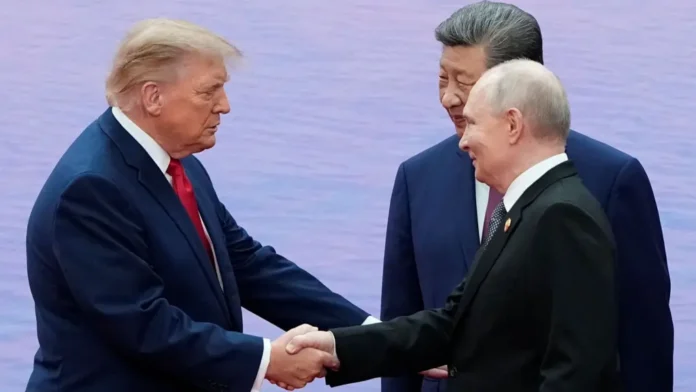

A summit can be a diplomatic victory in photographs and a strategic disappointment in substance. Ukrainian President Volodymyr Zelenskyy says last week’s trilateral meeting in Shenzhen between Donald Trump, Xi Jinping and Vladimir Putin was “very unsuccessful” for Russia. His central contention: Putin failed to secure a great-power bargain that would legitimize spheres of influence or redraw borders, and China did not let itself be pulled into that project. The claim is politically charged, but it identifies a consequential limit on Moscow’s ambitions.
Zelenskyy’s comparison is to the 1945 Yalta conference, where the leaders of the United States, Britain and Soviet Union negotiated the post-war order in Europe. The analogy is imperfect: today’s geopolitical balance, institutions and economic interdependence differ sharply from the wartime settlement. Yet the image of a “Yalta 2.0” is potent precisely because it suggests powerful states deciding smaller countries’ futures over their heads. Zelenskyy argues that this did not happen: Ukraine was not publicly discussed and no border-changing arrangement emerged. Those are claims about the summit’s outcome, not proof of what was said privately.
China’s Leverage and Its Limits
The most important signal may be Beijing’s refusal, as Zelenskyy describes it, to endorse a Russian vision of global repartition. China is not Moscow’s junior partner. It is a major power with its own priorities: stable trade, technological development, regional security and freedom to manoeuvre between Washington and Moscow. Xi can welcome Putin without accepting the Kremlin’s strategic objectives wholesale. That distinction matters.
The partnership has nevertheless given Russia critical economic breathing room since its invasion of Ukraine in February 2022 and the sanctions that followed. China has become a central market for Russian energy and a supplier of goods that help sustain commerce and industrial activity. Bilateral trade reached a record roughly $245 billion in 2024, according to widely reported Chinese and Russian customs figures. This scale reflects a relationship that sanctions and Western decoupling have helped deepen. But asymmetry is growing: China’s economy is vastly larger and its bargaining position stronger. Moscow needs markets, technology and diplomatic cover; Beijing can choose how far to provide them.
A summit that yields no public commitment to Russia’s territorial ambitions therefore does not mean China is abandoning Russia. It may instead indicate Beijing’s preference for a relationship that is useful, but not binding, one that keeps Moscow dependent without tying China to Russia’s war aims, risks or escalation. The wider picture reinforces the need for restraint in interpreting the episode. Beijing has repeatedly called for negotiations and opposed sanctions it considers unilateral, while Western governments accuse Chinese firms and networks of helping Russia obtain dual-use goods. China denies wrongdoing and says it is not a party to the conflict. These competing positions mean a single summit cannot settle the question of China’s alignment. Policy is revealed through sustained decisions, export controls, financial flows, diplomatic language and pressure on Moscow, not ceremonial gestures alone.
The War, the West and the Problem of Optics
For Putin, participation itself had value. A meeting with the American and Chinese presidents helps counter the image of isolation, signals that Russia remains a consequential actor and offers a stage on which Moscow can press for recognition of its status. Even without a concrete deal, the optics can serve domestic audiences and diplomatic messaging. Zelenskyy’s verdict should not obscure this symbolic benefit. Nor should a summit’s lack of an announced Ukraine settlement be confused with a strategic setback that changes battlefield realities. Russia retains manpower, weapons production and the capacity to inflict damage. Ukraine remains dependent on external military, financial and political support. Zelenskyy said the summit was followed by a massive Russian attack involving 111 missiles; that sequence is his account of Putin’s reaction, not independently established evidence that the bombardment was caused by summit disappointment. The attack underscores, regardless, that diplomacy and coercion continue in parallel.
The meeting also raises concerns for Europe. European leaders have warned against a settlement imposed by major powers without Ukraine or European participation. Their fear is not merely that Kyiv could be pressured into concessions, but that precedent would weaken the principle that borders cannot be changed by force. If Washington, Beijing and Moscow were to negotiate security arrangements over Europe’s head, NATO cohesion and confidence in the transatlantic partnership could be strained. The absence of a public carve-up is reassuring; the possibility of opaque bargaining remains a concern.
What Kyiv and the World Should Read into It
Zelenskyy’s statement is both assessment and strategic messaging. By portraying the summit as a failure for Putin, Kyiv seeks to deny the Kremlin a narrative of triumphant great-power diplomacy, reassure partners that resistance to territorial revisionism remains viable and underline Ukraine’s exclusion as a diplomatic injustice. The rhetoric also invites scrutiny of any future agreement: who participates, what is negotiated and whether Ukraine’s sovereignty is treated as a principle or a bargaining chip. The evidence supports a cautious conclusion, not a sweeping one. China may have resisted a Russian push for a world divided into spheres, but Beijing’s economic relationship with Moscow remains substantial. The United States, meanwhile, has its own diplomatic objectives and may pursue talks that Kyiv or European capitals find difficult. The summit’s public record cannot establish the full content of private conversations or predict policy shifts.
For Russia, the immediate disappointment, if Zelenskyy’s interpretation is accurate, is that access to the world’s most powerful leaders did not translate into visible endorsement of its revisionist goals. For China, the advantage is flexibility: it can host, mediate, trade and shape agendas without accepting responsibility for Russia’s choices. For Ukraine and Europe, the lesson is sharper. Diplomatic theatre is not a settlement and a seat at the table is not a guarantee. The test will be whether any ensuing negotiations preserve Ukraine’s agency, security and territorial integrity. Until then, Zelenskyy’s claim is a warning about the stakes, not a definitive verdict on the summit.