

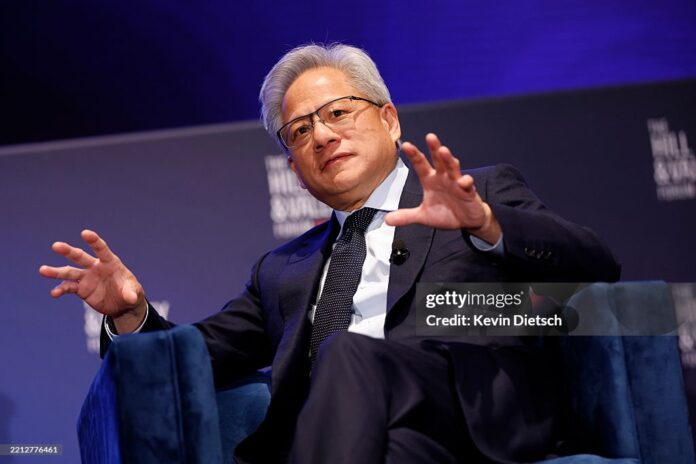

Nvidia has reversed its decision to remove co-founder Jensen Huang as chief executive, following direct intervention by US President Donald Trump, in a dramatic corporate turnaround that sent the chipmaker’s shares surging 33% and reignited debate over the company’s dependence on its billionaire founder.
The board unanimously approved Huang’s reinstatement, declaring that his return posed no national security threat, despite the controversy surrounding his departure and mounting scrutiny of the company. The decision marks an extraordinary reversal, coming just days after Nvidia Chairman Harvey Jones ruled out bringing him back, citing concerns that Huang’s personal conduct had violated the company’s code of ethics and established corporate standards.
Huang resigned on November 12 after revelations of alleged extramarital relationships, including an affair involving a woman suspected of having links to Chinese intelligence. He has also faced allegations of relationships with at least two Nvidia employees. The disclosures triggered widespread uncertainty across the technology industry, rattling investors and threatening confidence in one of the world’s most influential artificial intelligence companies.
Trump emerged as a central figure in the reversal, publicly advocating Huang’s return after initially supporting the board’s decision to keep him out. The president subsequently maintained that there was no credible evidence of criminal wrongdoing by the executive and that his reinstatement presented no identifiable national security danger.
Speaking to CNBC on Monday, Trump defended Huang, describing him as an exceptional technological talent whose contribution to American innovation should not be overlooked. He also acknowledged that his personal involvement had played a significant role in persuading the company to reverse course.
The president said he had engaged with Nvidia’s board members, both directly and through intermediaries, over concerns about Huang’s return. According to Trump, his administration provided the national security assurances the directors had requested before approving the reinstatement.
However, Trump cautioned that Nvidia must continue strengthening its oversight of compliance with US export restrictions, particularly those governing the sale of advanced artificial intelligence processors to China.
The president had intensified his campaign for Huang’s return in the days preceding the announcement. During remarks before departing Washington for an Asian trip last week, Trump indicated that he would welcome the executive’s comeback, suggesting the controversy had provided him with an important lesson.
Following the announcement, Trump described the board’s reversal as the appropriate outcome, while prominent figures across the technology sector welcomed the development. Tesla chief executive Elon Musk also endorsed the decision, arguing that the company had corrected a major mistake.
The scale of support for Huang has raised questions about the extent of political and shareholder influence behind the decision. Steve Sosnick, chief strategist at Interactive Brokers, observed that while there was considerable pressure for the executive’s return, the precise influence exerted by the administration and investors would remain difficult to establish.
Nevertheless, the episode has reinforced perceptions that Huang occupies an unusually powerful position within Nvidia, raising questions about the extent to which the company can function independently of its co-founder.
The board’s earlier position had appeared unequivocal. Jones had insisted that Huang’s alleged personal conduct was incompatible with Nvidia’s internal standards and cultural expectations. In his absence, the company appointed Chief Financial Officer Colette Kress as interim chief executive, with management assuring employees and investors that operations would continue without disruption.
Huang’s return now overturns that arrangement, although Kress will retain her position as chief financial officer.
In a statement announcing his comeback, Huang expressed his readiness to resume leadership, describing Nvidia as a pivotal force in what he characterized as a new era of industrial transformation driven by artificial intelligence.
His departure had attracted an extraordinary public reaction. A petition demanding his reinstatement gathered more than 180,000 signatures, with Musk among those supporting the campaign. The response highlighted the unusual degree of personal loyalty Huang commands among investors, technology executives and supporters of Nvidia’s role in the global AI revolution.
Beyond the leadership controversy, Nvidia continues to confront several regulatory challenges. US authorities, including the Securities and Exchange Commission and the Department of Justice, are examining matters ranging from possible accounting irregularities to allegations of illegal chip smuggling.
The company has also established a board committee to investigate whether foreign intelligence operations attempted to target Huang. Separately, it has initiated the process of appointing a new chief compliance officer as part of broader efforts to strengthen internal oversight.
National security concerns remain particularly acute as Washington tightens restrictions on the movement of sophisticated AI chips into China. US regulators have introduced stricter licensing requirements for certain semiconductor exports and overseas data centres serving Chinese businesses, while lawmakers are preparing to question Huang over Nvidia’s commercial interests in the Chinese market.
The executive has consistently advocated greater access to China, arguing that participation in the market is important to maintaining the competitiveness of American technology companies.
Nvidia’s leadership upheaval has already had commercial consequences. Reuters reported on Monday that Huang’s sudden departure unsettled customers in China, prompting some to cancel or delay orders and placing billions of dollars in potential revenue at risk.
Last week, despite the uncertainty surrounding its leadership, Nvidia established another board committee dedicated to national security and export-control issues. The company also raised its annual sales-growth expectations and projected fourth-quarter revenue above Wall Street forecasts, signalling continued confidence in demand for its AI chips.
Huang’s reinstatement therefore comes at a critical moment for Nvidia, as it navigates intensifying geopolitical tensions, regulatory investigations and unprecedented demand for artificial intelligence technology.
The decision also exposes the extraordinary influence of a founder whose leadership has become closely intertwined with the company’s identity, strategic direction and market valuation. While Trump’s intervention helped clear the way for his return, Nvidia must now demonstrate that its commitment to corporate accountability and national security can coexist with its reliance on one of the technology industry’s most influential executives.