


The Sahel is becoming one of the most dangerous geopolitical fault lines in the world, and abandoning it would be a strategic blunder of enormous proportions. The consequences would not be confined to Burkina Faso, Mali and Niger. They would reverberate across West Africa, threaten coastal states, intensify irregular migration and create further opportunities for external powers seeking to expand their influence. President John Dramani Mahama’s appeal to Germany and the European Union not to abandon the Sahel is therefore more than a diplomatic expression of solidarity. It is a warning about the security implications of Europe’s diminishing influence in a region where Russia is steadily establishing itself as an alternative strategic partner.
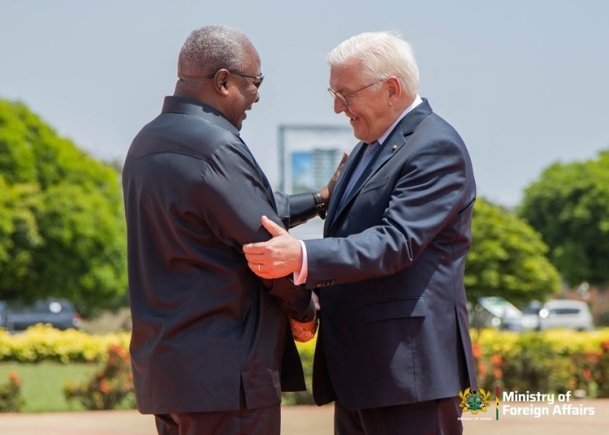
Speaking during bilateral discussions with German President Frank-Walter Steinmeier in Accra on November 24, 2026, Mahama urged European partners to maintain their engagement with Sahelian countries confronting violent extremism. Ghana, he indicated, was prepared to work with Germany and other international partners to confront the security crisis. His intervention comes as Accra intensifies efforts to repair relations between the Economic Community of West African States (ECOWAS) and the Alliance of Sahel States (AES), comprising Burkina Faso, Mali and Niger.
The urgency is unmistakable. According to the Institute for Economics and Peace’s Global Terrorism Index 2025, the Sahel accounted for 51 per cent of global terrorism deaths in 2024. The region recorded 3,885 terrorism-related fatalities that year, while nearly 20,000 people had been killed in terrorist violence since 2019. Separately, the Africa Centre for Strategic Studies estimated that militant Islamist violence accounted for 10,685 fatalities in the Sahel over the preceding year, within a continental total of 22,307. These figures employ different methodologies and should not be conflated, but both demonstrate the extraordinary concentration of violence in the region.
This is not simply a counterterrorism emergency. It is a crisis of state authority, territorial control, governance and regional cooperation. Jama’at Nusrat al-Islam wal-Muslimin (JNIM), affiliated with al-Qaeda and the Islamic State Sahel Province have exploited weak institutions, communal grievances, economic exclusion and poorly secured borders to expand their operational reach. Their activities increasingly threaten transport corridors, commercial networks and the livelihoods of rural populations.
Mahama’s message consequently challenges a dangerous assumption in European foreign policy: that withdrawing from politically difficult partnerships necessarily reduces exposure to insecurity. It does not. In the Sahel, disengagement can create precisely the strategic vacuum that competing powers and armed extremist organizations are waiting to exploit.
ECOWAS-AES
The political fracture makes the security crisis harder to solve. Burkina Faso, Mali and Niger formally left ECOWAS on January 29, 2025, after rejecting pressure following military coups. Their departure created an unprecedented rupture in a region whose threats ignore borders. ECOWAS nevertheless preserved visa-free movement and existing trade treatment for citizens and goods from the three states, recognizing that institutional separation cannot sever geography, family networks or commerce.
Ghana’s mediation has a significant opening. At the October 17, 2026 ministerial meeting in Dakar, ECOWAS and AES representatives agreed to establish joint thematic working groups to develop a cooperation framework. The AES has not reversed its withdrawal, while disputes over sovereignty, democratic legitimacy and regional security remain unresolved. But technical dialogue can restore contact and protect cooperation on intelligence, border management, trafficking and trade. Ghana should not make reintegration a precondition. Its immediate task is to stop political estrangement becoming security fragmentation.
Accra has leverage as an ECOWAS member bordering Burkina Faso. Instability moving south threatens Ghana’s northern districts and the wider Gulf of Guinea. Coastal states cannot treat the Sahel as somebody else’s war. Ghana’s diplomacy must produce practical arrangements: intelligence exchange, coordinated border patrols, community early-warning systems and humanitarian access. Otherwise, Dakar risks becoming another communiqué without consequence.
Russia’s Opening and Europe’s Strategic Retreat
Russia has moved to occupy space left by Western withdrawals. After Wagner’s expansion, Moscow reorganized much of its African security presence under the state-linked Africa Corps, bringing deployments more directly under Russian military intelligence oversight. The offer appeals to juntas: weapons, training and combat support. In April 2025, Russia pledged equipment, training and technical assistance for the AES plan to establish a 5,000-member joint force. This strengthens Moscow’s position, but does not prove Russian support can defeat the insurgencies.
The relationship generates influence beyond the battlefield. Security assistance can create arms dependence, diplomatic alignment and opportunities in mining and energy. The US Congressional Research Service describes Russia’s African approach as combining security services, commercial interests and influence operations. Yet allegations of abuses by Russian-linked forces and local militaries risk deepening civilian grievances. A partner that protects regimes but fails to protect communities may prolong instability and furnish insurgents with propaganda.
Europe should reject the false choice between abandoning juntas and endorsing them. Germany and the EU can sustain principled engagement through humanitarian assistance, development finance, civilian protection, professional military education and accountable border security. Berlin’s 2023 policy realignment envisaged shifting security engagement towards Niger, Mauritania and Gulf of Guinea states as its Mali military role ended. Europe should work through African institutions and measure success by civilian safety, not training programmes delivered.
The Price of Disengagement
The threat is spreading. The Armed Conflict Location & Event Data (ACLED) recorded more than 10,000 political-violence fatalities in Burkina Faso, Mali and Niger between January 1 and November 28, 2025 and documented militant expansion towards Benin and Nigeria. These figures cover political violence, not terrorism alone, but expose the scale of regional instability. A widening conflict threatens Ghana, Côte d’Ivoire, Togo and Benin, as well as trade routes connecting landlocked states to Atlantic ports.
Mahama’s appeal is a call for strategic realism. Europe cannot dictate the Sahel’s political future; Russia cannot guarantee security merely by supplying weapons. The region needs African-led cooperation backed by partners prepared to invest over time. Ghana must turn ECOWAS-AES dialogue into practical security collaboration. Germany and the EU must remain engaged without confusing engagement with political endorsement. It is whether West Africa can rebuild enough trust and shared capacity to deny extremists the ungoverned spaces in which they thrive. Abandonment would surrender that contest prematurely.